 By
By  November 19th, 2025
Chinese team on lunar habitat construction is led by Ding Lieyun. He is an academician of the Chinese Academy of Engineering and chief scientist of the National Center of Technology Innovation for Digital Construction (NCTI-DC) at central China’s Huazhong University.
Image credit: CCTV/Inside Outer Space screengrab
One of the items returned by the landing of China’s Shenzhou-20 crew were “lunar soil bricks” intended to further the country’s construction technology for the Moon.
The Xinhua news agency reports that the first set of experimental bricks were returned to Earth after a year-long exposure to the space environment.
The experiment began in November 2024, when China’s Tianzhou-8 cargo ship ferried the simulated lunar-soil samples up to the space station.
A total of 74 small bricks were designed to be mounted on an external exposure platform on the station’s exterior, Xinhua reports.

Ding Lieyun, a scientist at Huazhong University of Science and Technology.
Image credit: Huazhong University
Three year study
The project is led by Ding Lieyun, a scientist at Huazhong University of Science and Technology. Planned as a three-year study, Ding and colleagues will study sample batches exposed for extended periods to the harshness of space.
By analyzing the chemical fingerprint of authentic lunar specimens brought back by China’s Chang’e-5 mission, Ding’s team engineered a regolith simulant and pressed it into bricks through hot-press sintering.
That selected simulant was volcanic ash from Changbai Mountain in northeast China’s Jilin Province, material that closely mirrors the composition of lunar regolith.
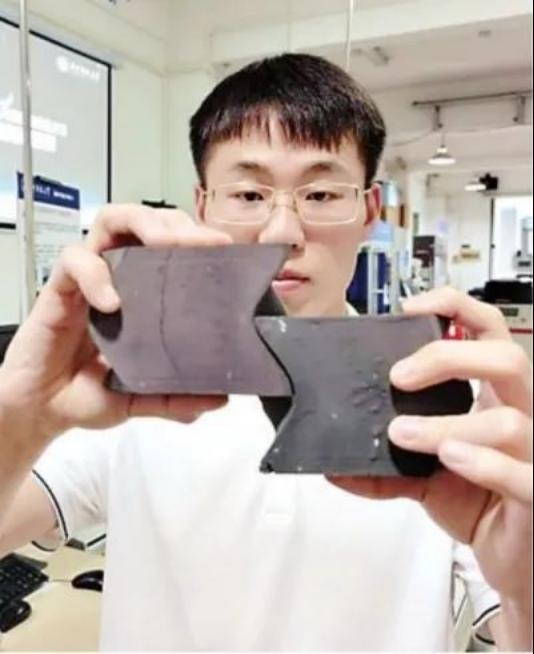
Image credit: Huazhong University
The research team has developed a way to sinter simulated lunar dust into bricks of various sizes. The sintering process is expected to be powered by concentrated solar energy on the Moon.
They also developed a robotic system to handle assembly of lunar structures like LEGO blocks, with the final step involving the use of 3D printing to reinforce the structure.
China’s long-term lunar program includes landing astronauts on the Moon by 2030 and building a basic model of the International Lunar Research Station (ILRS) by 2035.
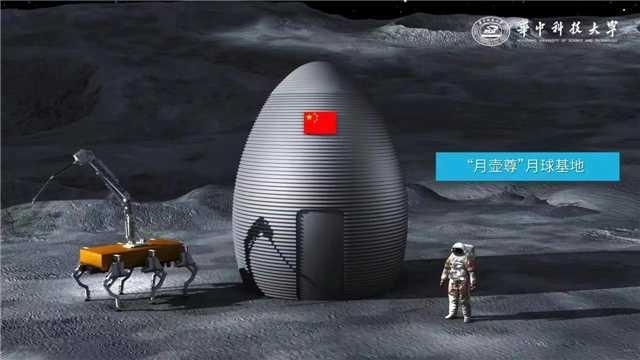
Image credit: Huazhong University
For more information, go to these earlier stories:
Building Blocks: China to Test Moon Construction Bricks on Space Station
Moon Dwellings: China Taps 7,000 Year Old Building Technique
https://www.leonarddavid.com/moon-dwellings-china-taps-7000-year-old-building-technique/
 Posted in Space News

