 By
By  October 21st, 2024
Lunar brick specialist, Zhou Cheng.
Image credit: CCTV/Inside Outer Space screengrab
China rolled out last week a roadmap for the development of space science in China through 2050. A phase of that agenda is constructing the International Lunar Research Station, or ILRS.
Now in research status is use of the lunar regolith to help build that lunar base in the 2028-2035 time period.
In fact, test bricks for lunar construction will be sent to China’s space station aboard the Tianzhou-8 cargo spacecraft. The first lunar brick is expected to return to the Earth by the end of 2025.

Image credit: CCTV/Inside Outer Space screengrab
Brick strength
Flying the lunar soil bricks is an output from China’s National Center of Technology Innovation for Digital Construction and the Huazhong University of Science and Technology (HUST).
The bricks are called simulated lunar soil bricks, said Zhou Cheng, a professor at the center. They have a similar density to that of ordinary bricks but are more than three times stronger than standard red bricks or concrete bricks, Zhou told China Central Television (CCTV).
Temperatures on the lunar surface exceed 180 degrees Celsius during the lunar day and dip to minus 190 degrees Celsius during lunar night – a 14 day/night cycle.

Photo taking during Chang’e-5 moon surface sampling session in December 2020.
Credit: CNSA/China Central Television (CCTV)
In addition, significant levels of cosmic radiation and micrometeorites also strike the surface of the Moon, given its lack of atmospheric protection. Also, there is frequent moonquake activity.
On-station test program
All of these will place demanding requirements on the mechanical, thermal and radiation resistance properties of lunar surface construction materials, Zhou added.
“What we care about the most is its mechanical and thermal performances, including heat preservation and insulation effectiveness, as well as its ability to withstand cosmic radiation. The Moon has a vacuum environment, so there is significant cosmic radiation,” Zhou said.

Simulated lunar bricks to be flown on China space station. Image credit: CCTV/Inside Outer Space screengrab
As for use of the Chinese space station to evaluate lunar soil bricks, the total planned exposure period for the bricks is three years.
So every year, researchers will return one sample panel exposed on the space station to the Earth and conduct related experiments, according to Zhou.
Simulated lunar soil compositions
The research team also designed the bricks in two shapes: columnar and flaky. The pillar-shaped lunar soil bricks are primarily intended for mechanical testing, while the larger-exposed flakes are used to assess thermal and radiation effects.

Image credit: CCTV/Inside Outer Space screengrab
In addition to their various forms, these bricks are made from five simulated compositions of lunar soil and undergo three distinct sintering processes, providing more accurate scientific data for the construction of future lunar bases.
3D-printing robot
As reported by China Global Television Network (CGTN), the team also developed another construction option using additive manufacturing technology. In addition, a 3D-printing robot has been invented to print houses using lunar soil.
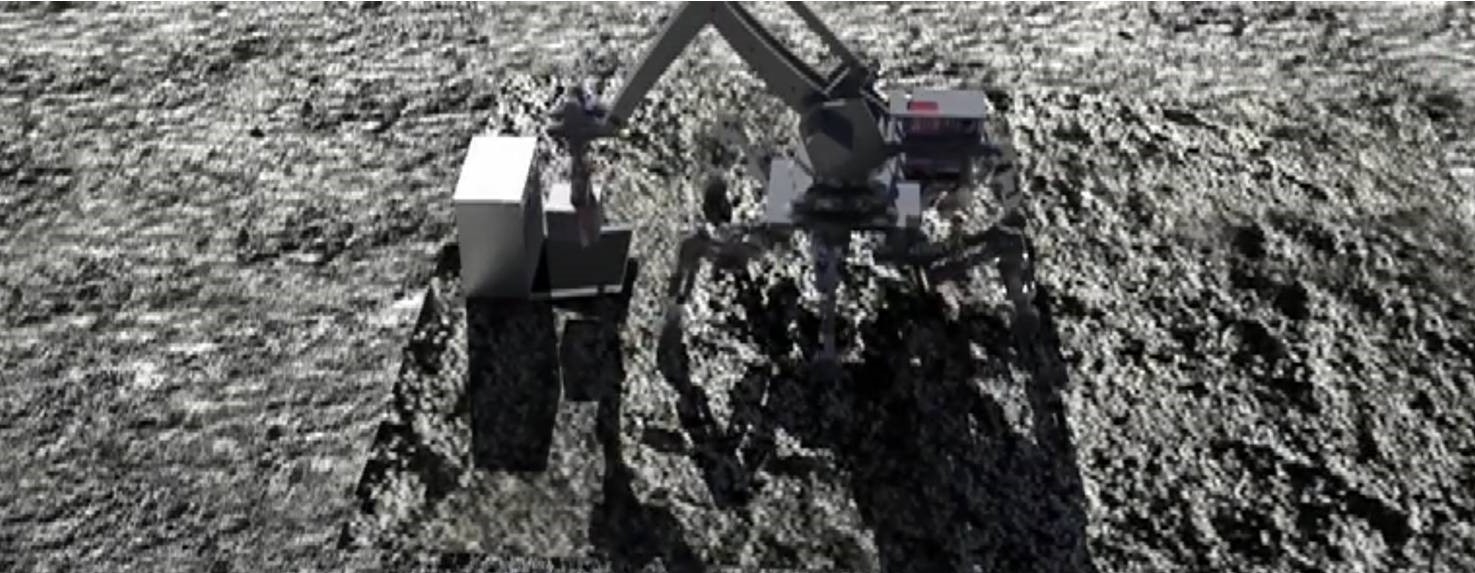
Image credit: CCTV/Inside Outer Space screengrab
Zhou told CGTN that the composition of lunar soil varies in different locations on the Moon, noting that one composition simulates the lunar soil at the landing site of China’s Chang’e-5 lander, which is mainly basalt.
Some other compositions simulate soil found at other locations that is mainly anorthosite, said Zhou.
The HUST team used five different simulated lunar soil compositions and three different sintering processes to help acquire accurate scientific data for selection of materials and process optimization for future lunar base construction.
 Posted in Space News

