 By
By  July 30th, 2025
X-37B (OTV-8) military space plane being readied for flight.
Image credit: U.S. Air Force/U.S. Space Force
The Boeing-built X-37B Orbital Test Vehicle (OTV) is preparing to launch its eighth mission (OTV-8) from Florida’s Space Coast, with liftoff scheduled no earlier than August 21.
This upcoming flight comes after the completion of OTV-7 in March of this year.
According to a Boeing statement, OTV-8 will fly with a service module. Doing so expands the capacity for experiments for mission partners, which include the Air Force Research Laboratory and the Defense Innovation Unit.

OTV-6 was the first mission to introduce a service module that expanded the capabilities of the spacecraft.
Image credit: Staff Sgt. Adam Shanks
GPS-denied navigation
“The mission will host demonstrations of high-bandwidth inter-satellite laser communications technologies,” Boeing explains, “as well as the highest performing quantum inertial sensor ever tested in space. The U.S. Space Force will leverage insights from this mission to inform future space architectures.”
“OTV 8’s quantum inertial sensor demonstration is a welcome step forward for the operational resilience of Guardians in space,” said Space Delta 9 Commander Colonel Ramsey Hom.
“Whether navigating beyond Earth-based orbits in cis-lunar space or operating in GPS-denied environments, quantum inertial sensing allows for robust navigation capabilities where GPS navigation is not possible,” Hom adds.

The U.S. Space Force’s X-37B Orbital Test Vehicle Mission Seven successfully landed at Vandenberg Space Force Base, Calif., March 7, 2025. The X-37B landed at Vandenberg SFB to exercise the service’s ability to recover the spaceplane across multiple sites.
Image credit: U.S. Space Force courtesy photo
“Ultimately, this technology contributes significantly to our thrust within the Fifth Space Operations Squadron and across the Space Force guaranteeing movement and maneuverability even in GPS-denied environments,” Hom points out.
Cutting-edge technologies
Boeing and Space Force teams are preparing the spaceplane for launch at Boeing’s facility at Kennedy Space Center, Florida.
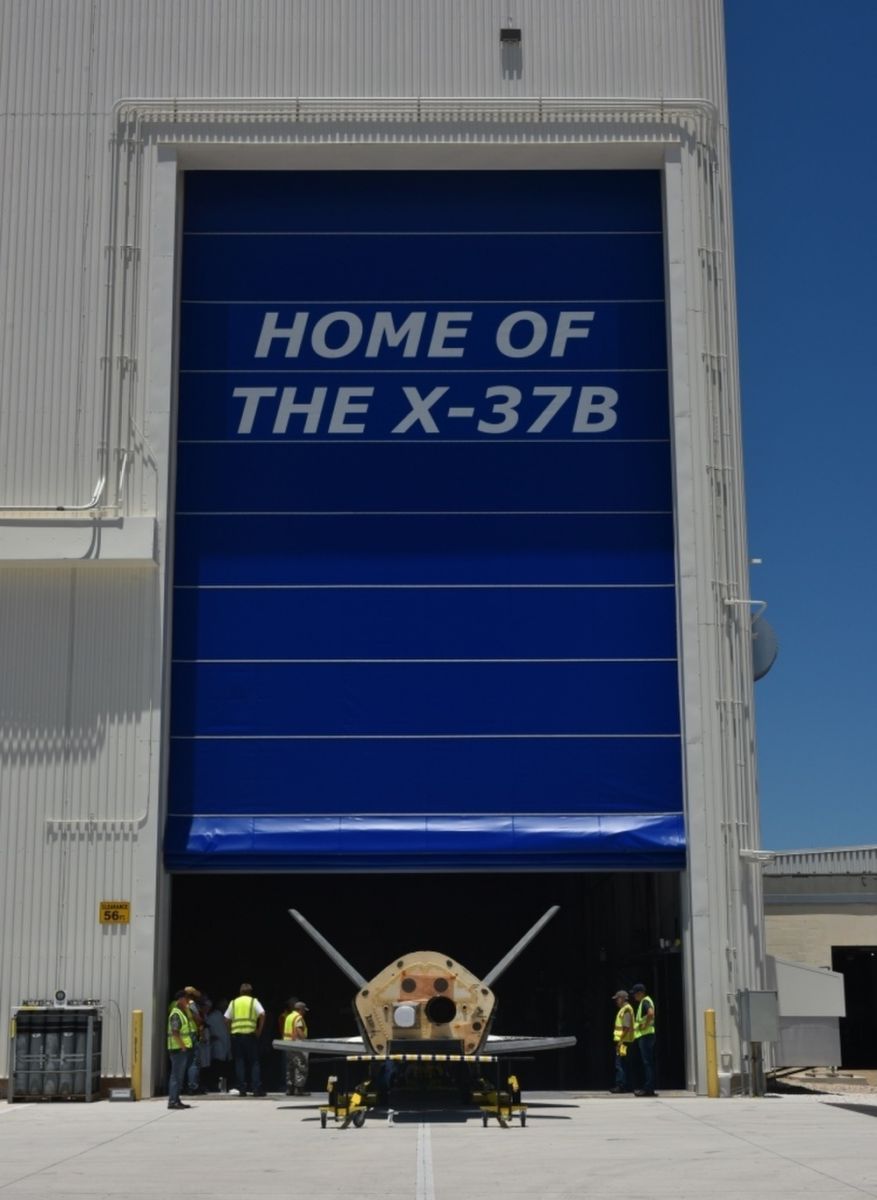
X-37B hangar at Kennedy Space Center.
Credit: Michael Martin/SAF
“With each successive flight, the X-37B has demonstrated adaptability and flexibility by hosting diverse experiments and pioneering new orbital regimes,” said Michelle Parker, vice president of Boeing Space Mission Systems. “This mission continues that legacy by fielding cutting-edge technologies that advance our nation’s space capability and improve the resilience of future architectures.”
Since its inaugural launch in April 2010, the spaceplane program (a fleet of two vehicles) has chalked up more than 4,200 days in space.
 Posted in Space News

