 By
By  January 14th, 2016
Credit: Big Ear Radio Telescope
Back in 1977, the Big Ear Radio Telescope at Ohio State University detected a strong narrowband signal northwest of the globular star cluster M55 in the constellation Sagittarius.
At the time, that signal stirred up the juices of Jerry Ehman at Ohio State’s Big Ear effort, prompting him to write “Wow!” in the margin of a computer printout of the signal.
Interstellar beacon?
The Wow episode has turned up a volume of conversation over the past decades. Had an interstellar beacon been recorded, the best candidate ever seen by searches for radio signals from the stars?
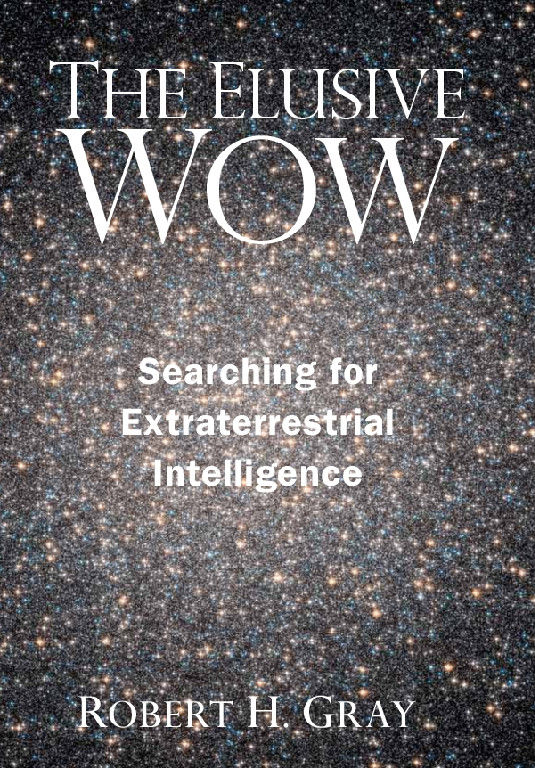
This saga is well-documented in an excellent book written by Robert Gray: The Elusive Wow – Searching for Extraterrestrial Intelligence (Palmer Square Press, 2012).
Credit: Palmer Square Press
Cometary culprits
But now a new twist to the story stems from a paper authored by Antonio Paris of St. Petersburg College in Florida and Evan Davies of The Explorers Club in New York.
In a Washington Academy of Sciences paper they contend that a comet or perhaps two comets could be the source of the hydrogen line signal detected by the Ohio State University on August 15, 1977. Chemicals in comets emit radio waves, they note.
The cometary culprits they point to are 266P/Christensen and /2008 Y2 (Gibbs), suggesting that “their orbital period could account for why the ‘Wow’ signal was intermittent and not detected during subsequent searches of the area.
From July 27, 1977 to August 15, 1977 those two comets were transiting in the neighborhood of the Chi Sagittarii star group, Paris and Davies report in their paper. All that adds up, the researchers contend, to those comets being “strong candidates” for the origin of the 1977 “Wow” signal.
Wrong explanation
But not so fast, responds Robert Dixon. He was a key figure in bringing the Big Ear instrument to bear on the search for other star folk.

The Big Ear Observatory.
Courtesy of North American Astrophysical Observatory
Dixon told Inside Outer Space that SETI experts in his group are facing off on Facebook about the comet hypothesis.
“The proposed explanation is wrong,” Dixon said. “It ignores the fact that the signal turned on or off within a few minutes, and the comet surely could not have done that. We had two closely-spaced beams in the sky, and the signal appeared in only one of them,” he said.
Resources
To bone up on the discussion, go to the Paris and Davies paper:
“Hydrogen Clouds from Comets 266/P Christensen and P/2008 Y2 (Gibbs) are Candidates for the Source of the 1977 “WOW” Signal” at:
http://planetary-science.org/wp-content/uploads/2016/01/Paris_Davies-H-I-Line-Signal.pdf
Meanwhile, keep your ears and eyes focused on follow-up SETI chat – even if it’s Earth-emitted.
 Posted in Space News

