 By
By  January 8th, 2023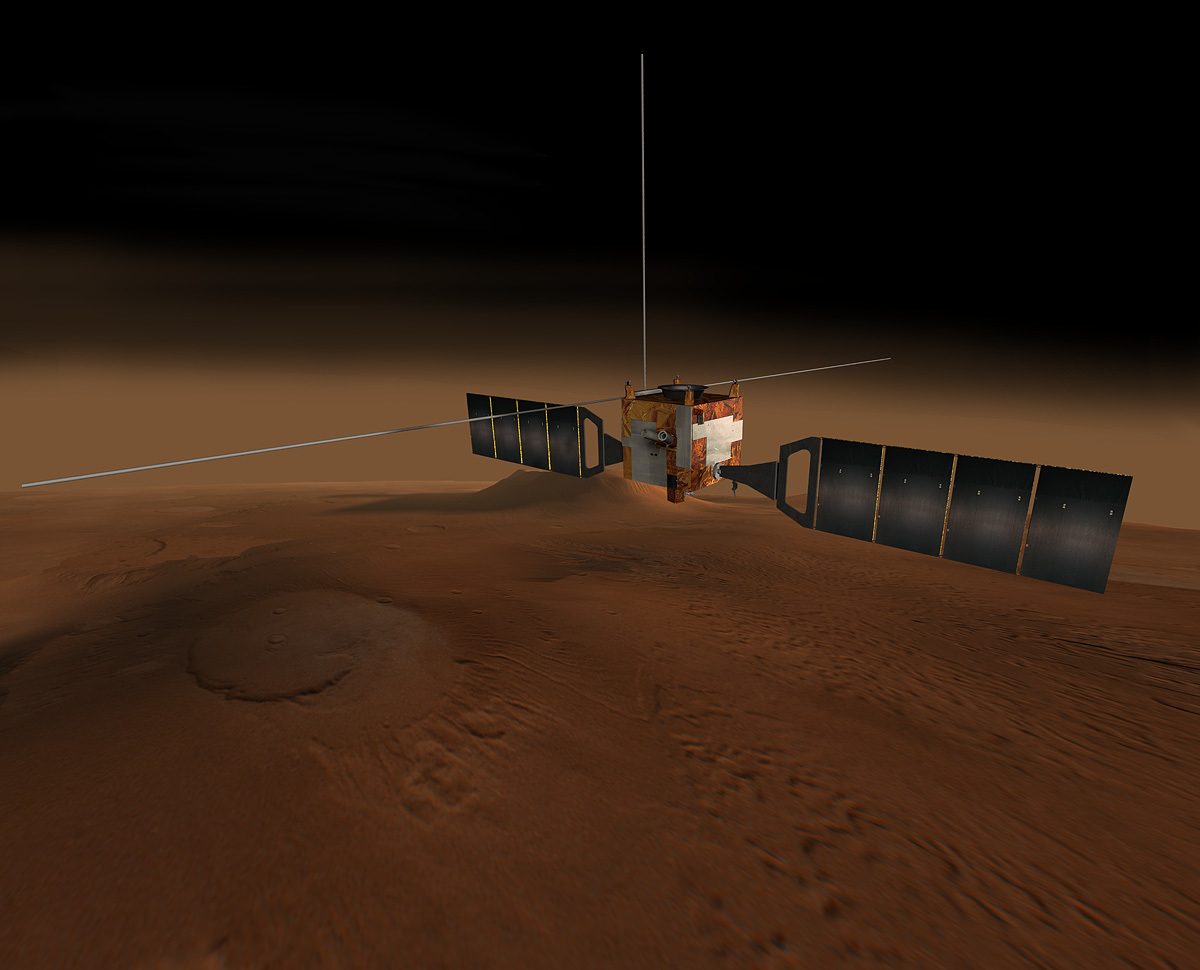
Image credit: ESA
Red Planet researchers that have benefited by the European Space Agency’s Mars Express orbiter are advocating extending the spacecraft’s mission, a probe launched back in June 2003.
The Mars Express team is soliciting the support of the global scientific community for a mission extension. That orbiter’s work in progress is to end in March of this year.
The final decision on any new extension will be made at the European Space Agency’s (ESA) Science Program Committee meeting on March 7-8th.

The Red Planet as seen by Europe’s Mars Express.
Credit: ESA/D. O’Donnell – CC BY-SA IGO
Accomplishments
“We invite all planetary scientists, astrobiologists, astrophysicists, and engineers interested in Mars science to show their support,” notes a Mars Express team statement.
There’s a long list of Mars Express accomplishments to date, such as:
- First detection of hydrated minerals at the surface, which has firmly established that Mars harbored once conditions conducive to the emergence of life;
- The characterization and mapping of water ice on the surface and deep below it, data that has helped decipher the recent evolution of Mars’ climate and the internal layering of the planet’s polar ice caps;
- A new vision of the Martian atmosphere, with the first annual survey of ozone;
- The first detection of methane whose presence defies our understanding of chemistry on Mars;
- A first comprehensive survey of the plasma surrounding the planet.
Uniquely equipped
Mars Express (MEx) “remains uniquely equipped to cover a broad spectrum of disciplines and feed Mars’community at large. Over time, MEx has come to serve as a backbone for planetary science in Europe; by fostering, and then retaining the expertise and knowledge for the new generation of scientists and engineers who carry ESA’s future in planetary exploration,” the communiqué adds.

Europe’s ExoMars 2020 rover.
Credit: ESA
Furthermore, keeping MEx on the fly would help support the European community that is now engaged in getting ESA’s ExoMars spacecraft off and onto the surface of Mars, as well as ESA’s key role in Mars Sample Return activities.
An ESA review has established that the Mars Express orbiter can operate for at least six more years.
More work to do
A new extension period would, for example, allow identifying and characterizing Oxia Planum, the landing site of the ExoMars rover.
“Stopping MEx in 2023 would not only weaken ESA’s role in exploring Mars, it would also weaken the long-term effort of the scientific community to solve the outstanding questions the Red planet still poses to us,” the support solicitation letter concludes.
To date, over 500 researchers have signed up to support the Mars Express extension. That document can be found at:
https://docs.google.com/document/d/1KrNKkFV6uNv3tvfln-tirmgkkPq6DfNICitBROeVGBQ/edit
 Posted in Space News


Please extend the spacecraft’s mission.
It still offers huge scientific benefits.
The other option is launching a new probe, but that will take years and billions more, than the current mission.
Even as just a ‘civilian’, the continued work of our satellites and probs give me hope for the continued advancement of the human race. There is no such thing as ‘too much’ information/knowledge.
And it makes more sense to continue a program that is already up and running, and has proven itself – than to start afresh with another prob that will cost so much more.