 By
By  June 19th, 2023
Wait a minute!
Image credit: Barbara David
A round of new papers has taken a sharp look at what’s now termed Unidentified Anomalous Phenomena, or UAP.
For some, UAP is a new three-letter term for Unidentified Flying Objects or UFOs – a flying saucer stand-in that conquers up crashed or captured craft of extraterrestrial origin, even recovered pilots or passengers from afar.
The scene is an aviation forum, held June 12-16 in San Diego, California, held by the influential American Institute of Aeronautics and Astronautics (AIAA).

Image credit: Yannick Peings, Marik von Rennenkampff/AIAA
At the recent forum a suite of papers were included, all dedicated to sorting out what’s behind UAP observations – and provide rigor to analyzing what’s going on with the reported sightings:
- Detection, Characterization, and Evaluation of Unidentified Anomalous Phenomena
- Recommendations to Improve Acquisition and Management of Aviation-Related UAP Data
- Aerodynamic Interactions and Turbulence Mitigation by Unidentified Aerospace-undersea Phenomena
Force field
One paper investigates the hypothesis that the apparent lack of interaction of fast-moving unidentified aerospace-undersea phenomena with their surrounding physical media can be attributed to the implementation of a “functionalized force field.”
“As UAP pose a significant risk to flight safety, our work plays an important role in comprehending how they may operate. This knowledge could lead to the development of technologies that aid in the recognition and avoidance of UAP by aviators, mitigating the risks associated with these unexplained phenomena,” the paper explains.

UAP have been reported by Navy pilots unlike anything they have ever witnessed.
Image credit: Enigma Labs/Lt. Cmdr. Alex Dietrich
Flight characteristics
Addressed at the AIAA forum is the “Gimbal” video, arguably the most recognizable publicly-available footage of UAP. It was recorded in January 2015 off the coast of Jacksonville, Florida by a U.S. Navy jet outfitted with a sensor-laden targeting pod.
The officially released video shows an infrared-significant object skimming over cloud, with the object appearing to stop and rotate in mid-air.
Geometrical reconstructions of the Gimbal UAP incident, the researchers explain, corroborate witness accounts of an object exhibiting highly anomalous flight characteristics.

Image credit: Yannick Peings, Marik von Rennenkampff/AIAA
“At the range given by naval aviators, mathematical reconstructions show that the object conducted advanced maneuvers, despite the apparent lack of wings or infrared signatures indicative of conventional means of propulsion,” report the independent researchers.
For access to this UAP assessment, go to:
https://www.youtube.com/watch?v=WsbMIm9QtEA
Weird nonsensical path
“This is not new work. It has been discussed for over a year,” Mick West, a former video game programmer and noted skeptic of the UAP video, told Inside Outer Space.
“Two paths emerge from the data,” West said, “one looks like the path of a plane, and one looks like it’s just an artifact of the camera jet’s path. The same curve but turned vertical in a way that’s entirely non-physical. Common sense would tell you to pick the first one, a distant plane.”

Mick West, debunker, skeptic, writer.
Credit: Mick West/Inside Outer Space screengrab
West added that “second-hand accounts of what happened, and years-old memories of the event that have changed over time, lead some to prefer the second, weird, nonsensical path.”
Also barely addressed, West continued, is the significant evidence that shows the apparent rotation of the object is actually due to the rotation of the camera, and the “object” being glare which obscures the true shape of the object.
“Based on the actual data we have, which has not changed since it was recorded, a distant plane or drone, flying away and to the left, fits best,” West said.

Shown at Congressional hearing, Video 1 2021 flyby movie showing a purported UAP.
Credit: Counterterrorism, Counterintelligence, and Counterproliferation Subcommittee/Inside Outer Space screengrab
Why AIAA?
Previously, under AIAA auspices, an Unidentified Anomalous Phenomena Integration & Outreach Committee was formed.
This group was fashioned to improve aviation safety by enhancing scientific knowledge of, and mitigating barriers to, the study of UAP.
That AIAA study group has three subcommittees chartered to perform outreach activities, address human factors issues, and support stakeholders with hardware factors analysis related to the detection, characterization, and evaluation of UAP.
Flight safety and national security
While AIAA and its members wrap their minds around UAP, another group has been organized: the Americans for Safe Aerospace – a military pilot-led 501(c)(3) nonprofit organization. It too is calling for transparency in the study of UAP, “operating in our airspace and posing a risk to flight safety and national security,” explains the group.
This new organization’s intent “is raising awareness of these issues, reducing the stigma of reporting and providing military and commercial pilot domain knowledge for policy makers.” It was founded by Ryan Graves, a former Lieutenant U.S. Navy F/A-18 pilot, who was the first active duty pilot to come forward to Congress about UAP.
Graves is also the sparkplug behind the AIAA’s Unidentified Anomalous Phenomena Integration & Outreach Committee.
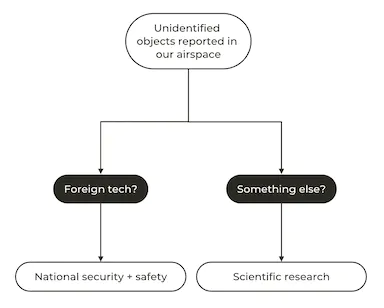
Transparent disclosure
“Let’s identify what’s in our skies,” is the group’s mission credo explains the group’s website. “Identifying domain awareness gaps is critical to U.S. national security. If UAP are foreign assets, we must respond appropriately. If UAP continue to defy conventional explanation — we must invest in scientific research.”
The newly formed organization “supports military and commercial pilots and aerospace workers impacted by UAP, scientists committed to investigating this mystery, and concerned citizens who believe in transparent disclosure from our government.”
For more information on Americans for Safe Aerospace, go to:
 Posted in Space News

