 By
By  January 2nd, 2016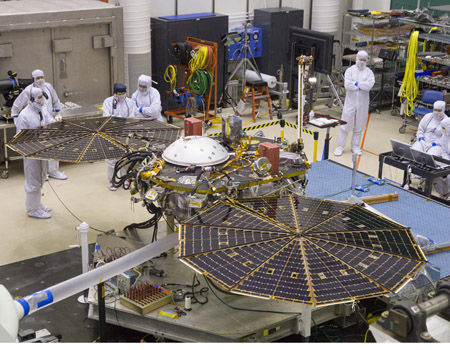
InSight Mars lander undergoing a solar array deployment test in the MTF clean room at Lockheed Martin.
Credit: Lockheed Martin
The recent decision by NASA to suspend the planned March 2016 launch of the Discovery-class InSight mission to Mars was due to unsuccessful attempts to repair a leak in a section of the prime instrument in the science payload.
That instrument was the sensitive Seismic Experiment for Interior Structure (SEIS).
The spacecraft’s name, InSight, says it all: Interior exploration using Seismic Investigations Geodesy and Heat Transport.
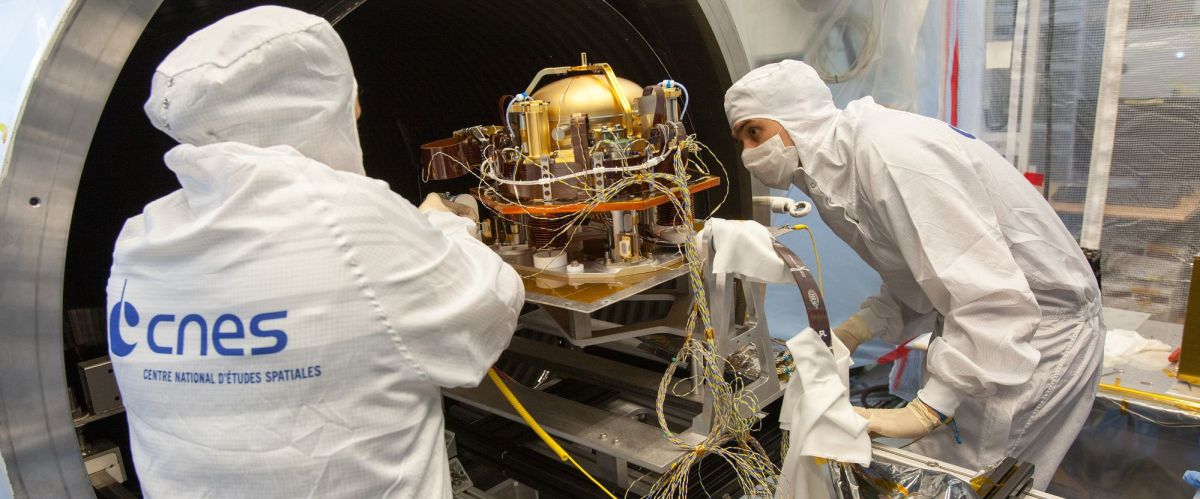
Preparing the SEIS instrument for thermal vacuum testing.
Credit: CNES /MALIGNE Frederick, 2015
Taking the pulse
SEIS is designed to capture the “pulse” of the Red Planet — its internal activity — by taking precise measurements of quakes and other internal commotion. Doing so equates to a better understand the planet’s history and structure.
Testing troubles
The sphere-shaped device itself is made of a series of measurement instruments, mainly composed of three French seismometers called VBB (Very Broad Band) and designed by the Institut de Physique du Globe de Paris (IPGP).
Overall, SEIS is an instrument provided by four European countries: France, Switzerland, United Kingdom and Germany.
The troubled SEIS had previously failed to retain vacuum conditions – a problem that was fixed. But during follow-up tests in extreme cold temperature (-49 degrees Fahrenheit/-45 degrees Celsius) another leak was detected.
Despite the repairs and the significant efforts of the teams, a cold pressure build-up, probably caused by a new leak, was detected on the sphere including the three low frequency seismometers of the IPGP and Sodern, a French company based in Limeil-Brévannes, near Paris, that specializes in space instrumentation.
NASA officials determined there was insufficient time to resolve another leak, and complete the work and thorough testing required to ensure a successful mission.
Finding a solution
“This is the first time a sensitive instrument is realized. We were very close to the result, a fault has occurred, requiring further investigations. Our teams will find a solution, but unfortunately not in time for the flight in 2016,” said Marc Pircher, Director of the Toulouse Space Center.
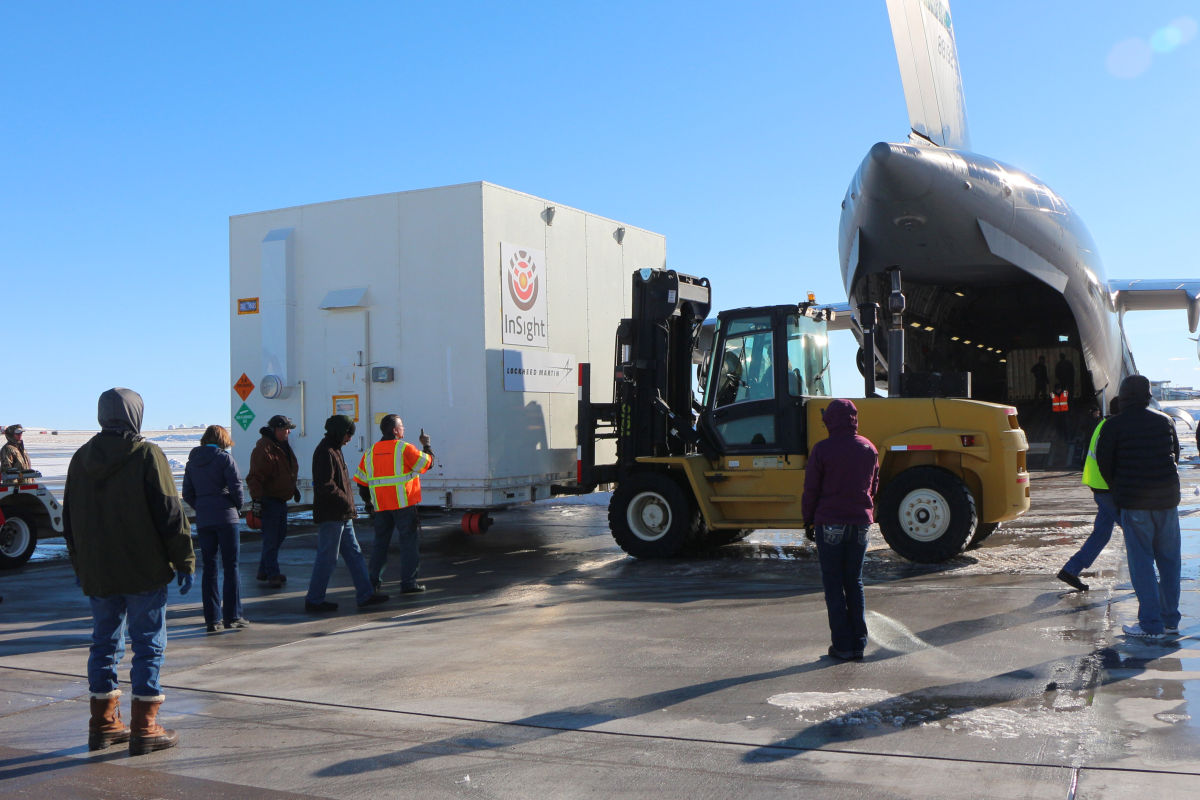
A Lockheed Martin team shipped NASA’s InSight Mars lander from Colorado where it was built to Vandenberg Air Force Base, California where it was slated for launch in March 2016.
Credit: Lockheed Martin
InSight was built by Lockheed Martin and delivered on December 16 to Vandenberg Air Force Base in California for its projected launch. With the 2016 launch canceled, the spacecraft is being returned from Vandenberg to Lockheed’s facility in Denver.
While at Vandenberg, within the Astrotech Space Operations facility, InSight was slated to undergo final processing including the installation and testing of the SEIS instrument, system-level checkout, propellant loading and a spin balance test.
“Our team worked hard to get the InSight spacecraft built, tested and shipped to the launch site on schedule. Although InSight won’t launch in March as planned, we will work closely with NASA, JPL and their partners to map out the path forward for the spacecraft and its important mission,” Lockheed Martin said in a statement provided to Inside Outer Space.
What next?
So what next for InSight…and getting its legs firmly down on Mars?
For legal and policy reasons, NASA can’t go any further than saying that the launch is suspended, explains W. Bruce Banerdt, Principal Investigator for the InSight Mission to Mars at the Jet Propulsion Laboratory in Pasadena, California.
“They have explicitly stated that the mission is not canceled, but there is a process they have to follow to decide whether and how they can extend us,” Banerdt told Inside Outer Space.
Cost cap
“Legally, there is a cost cap on a Discovery mission, and, as I understand it, they [NASA] have to go to Congress to get authorization to exceed that cap,” Banerdt said.

This artist’s concept depicts NASA’s InSight Mars lander fully deployed for studying the deep interior of Mars. Robot arm would deploy the sensitive Seismic Experiment for Interior Structure (SEIS) device, white object in foreground.
Credit: NASA/JPL-Caltech
NASA managers have expressed strong support for both the science of InSight and the mission itself, Banerdt said, “so I am optimistic that we will eventually get the go-ahead.”
Banerdt said that the InSight team is in the beginning stages of putting together a plan, with schedule and budget, to present to NASA for launching in 2018. “It will likely be at least a couple of months before any decision can be made, even provisionally,” he said.
For more information on the SES go to this video in French at:
https://www.youtube.com/watch?v=k3IOKszmnyo
For an English video on InSight, go to:
https://www.youtube.com/watch?v=7VVKyYhwfBk
 Posted in Space News

