 By
By  June 23rd, 2023
Prime Minister of India, Narendra Modi at the Indian Space Research Organization (ISRO).
Image Credit: ISRO
The recent meeting between U.S. President Joe Biden and Indian Prime Minister Narendra Modi has produced a number of space-related initiatives.
In a White House statement, the two “set a course to reach new frontiers across all sectors of space cooperation.”
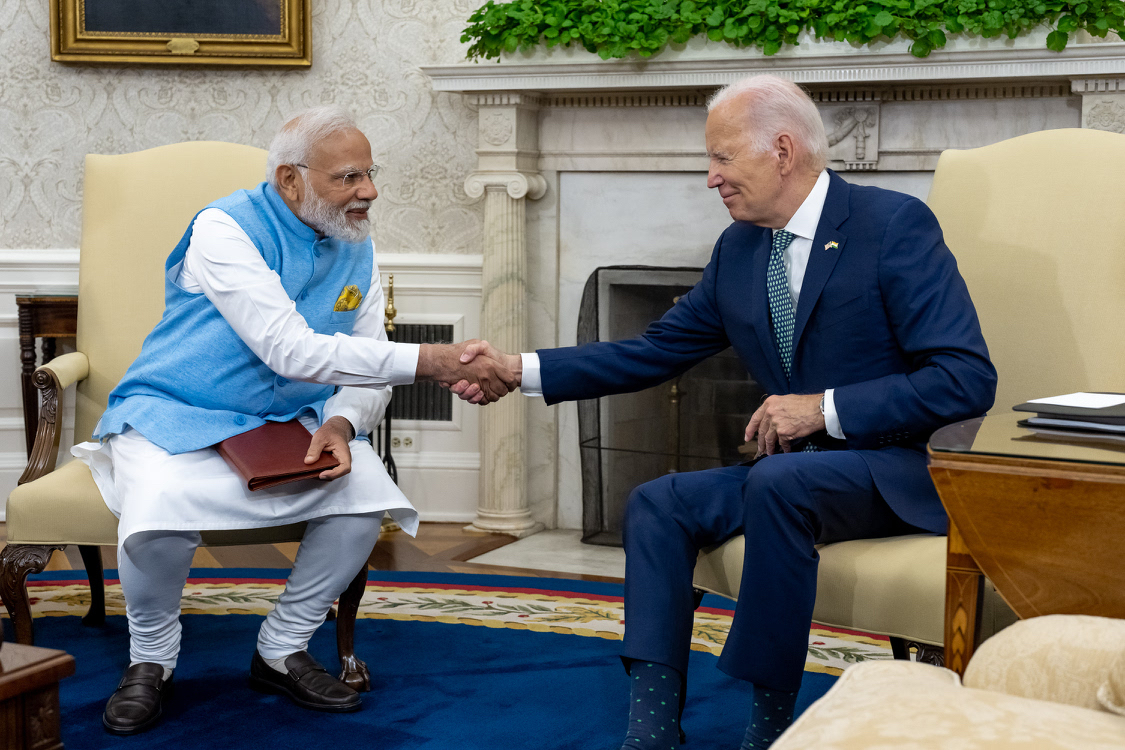
Image credit: White House
To that end, India has inked the growing list of countries signing the U.S.-led Artemis Accords and NASA will provide advanced training to Indian astronauts at the Johnson Space Center in Houston, Texas, “with a goal of mounting a joint effort to the International Space Station in 2024.”
Earlier, on June 21, the Republic of Ecuador became the 26th nation to sign the Artemis Accords.
As explained by the U.S. State Department, the Artemis Accords, which are grounded in the Outer Space Treaty of 1967, “are a set of non-legally binding principles to guide sustainable civil space exploration. These principles, which include transparency, peaceful purposes, registering of space objects and release of scientific data, help make the space environment safer and more predictable, and allow all nations – even those without space programs – to benefit from the data obtained in space.”

Image credit: Roscosmos/NASA
The Artemis Accords signatories are: Australia, Bahrain, Brazil, Canada, Colombia, Czech Republic, Ecuador, France, India, Israel, Italy, Japan, the Republic of Korea, Luxembourg, Mexico, New Zealand, Nigeria, Poland, Romania, Rwanda, Saudi Arabia, Singapore, Spain, Ukraine, the United Arab Emirates, the United Kingdom, and the United States.
Lunar research station
The U.S./Indian space cooperative initiatives signal a growing banding together of nations to explore space – outreach that is also underway in China.
A number of nations have also expressed interest to join China in establishing an international lunar research station (ILRS).
Russia, Pakistan, the United Arab Emirates and the Asia-Pacific Space Cooperation Organization (APSCO) have already signed agreements to participate in the China lunar effort.

International Lunar Research Station. Image credit: CNSA
The Chinese National Space Administration (CNSA) recently explained that the Moon station will be “open to all interested national and international partners.”
Phased flight missions
Reportedly, negotiations are underway with more than ten countries and organizations to participate in a joint program for the exploration of the moon. Malaysia and Venezuela, for example, have responded positively to the invitation to join this project.
As outlined by China space officials, the ILRS project aims to build a permanent lunar base in the 2025-2030s with an initial series of phased flight missions through the end of this decade.

Image credit: CCTV/Inside Outer Space screengrab
Regulatory framework
A regulatory framework is reportedly being created to ensure the construction and operation of the ILRS. It has been noted that those joining in the early stages of blueprinting the Moon research facility will receive better terms and more rights as founding members.
Experts within China’s Deep Space Exploration Laboratory (DSEL) have noted that China intends to complete the signing of agreements and memorandums of understanding with global space agencies and organizations this fall.
In doing so, the intent is to establish an international integrated base for scientific experiments built on surface of the Moon.
 Posted in Space News

