 By
By  May 24th, 2026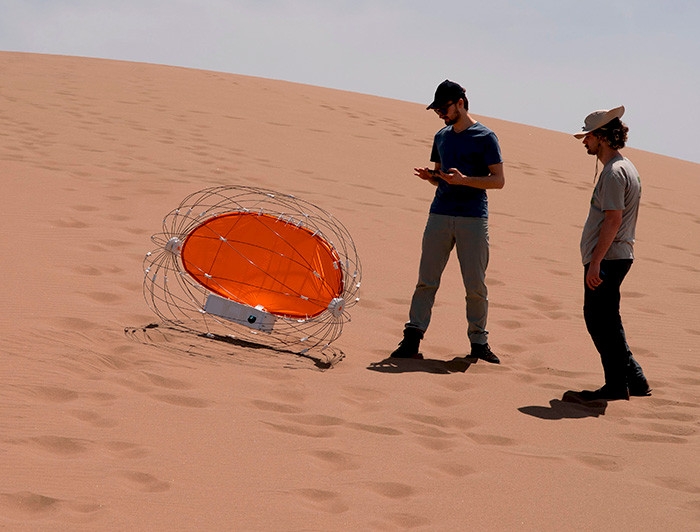
The wind-blown “rover” successfully completed the first of ten days of desert testing.
Image credit: Nicole Saffie
The Atacama Pontifical Catholic University of Chile’s (UC) Alto Patache Station in has served as the base of operations for testing a Mars exploration device – one that uses no wheels or fuel. It’s powered by wind energy.
The Tumbleweed Mars team is an international project working on a lightweight prototype driven by wind energy. The device is outfitted with equipment that can collect a large amount and variety of data.
Testing was done in the heart of Chile’s Tarapacá Region, in what is known as the “absolute desert,” the hyper-arid core of the Atacama Desert.
Years in the making
The project began a decade ago, led by researchers from Delft University of Technology (TU Delft) in the Netherlands, and supported by the European Space Agency (ESA) and the Europlanet Society, among other institutions.
Why the Atacama Desert?
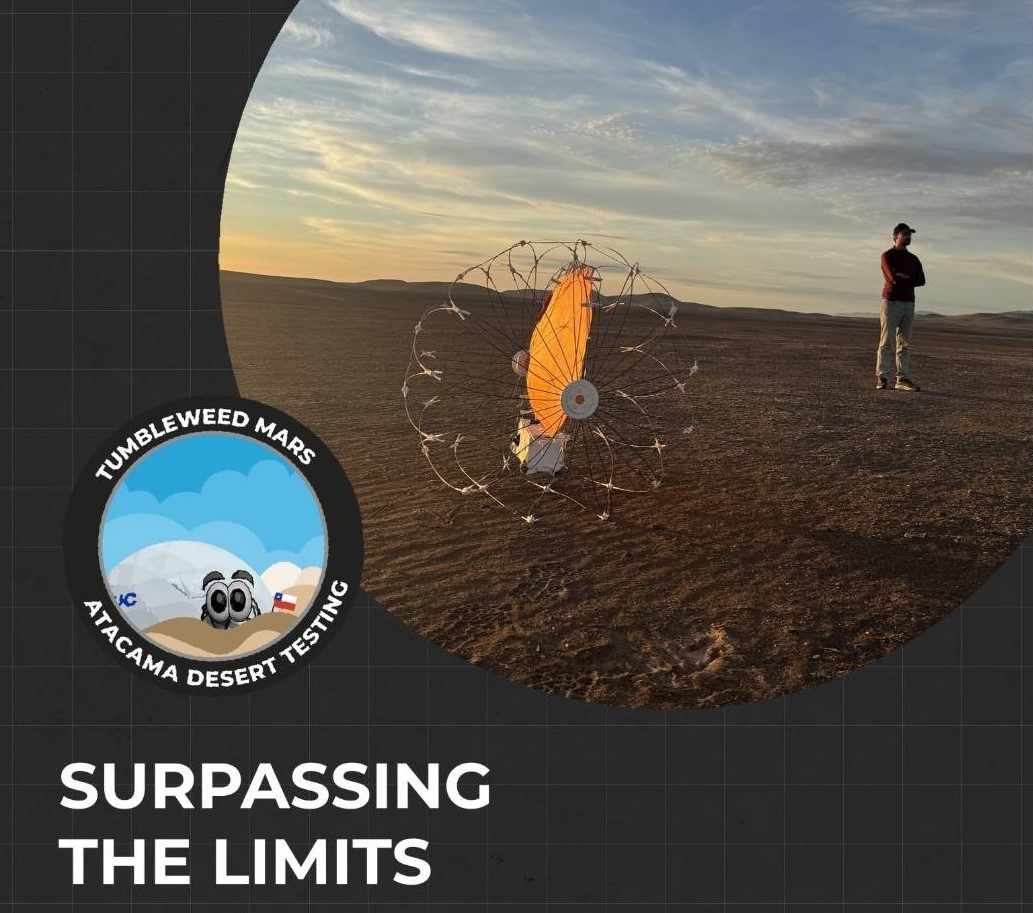
Image credit: Tumbleweed Mars project
Because the winds there are similar to those on Mars, peaking in the afternoons and then subsiding during the night and mornings, explains James Kingsnorth, principal investigator of Tumbleweed Mars .
“So we can test how the prototype works autonomously in this environment,” Kingsnorth adds.
Mission scenario
Without wheels or fuel, the Tumbleweed Mars hardware is capable of reaching 35 miles per hour (57 kilometers per hour).
A mission scenario is having Tumbleweed Mars dropped over the Martian north pole. The Tumbleweeds act as their own parachutes, unfolding on the way down.
Once landed, a swarm of Tumbleweeds can make the best of strong winds. As the wind propels them towards the equator, the rovers gather valuable data through their various integrated sensors.
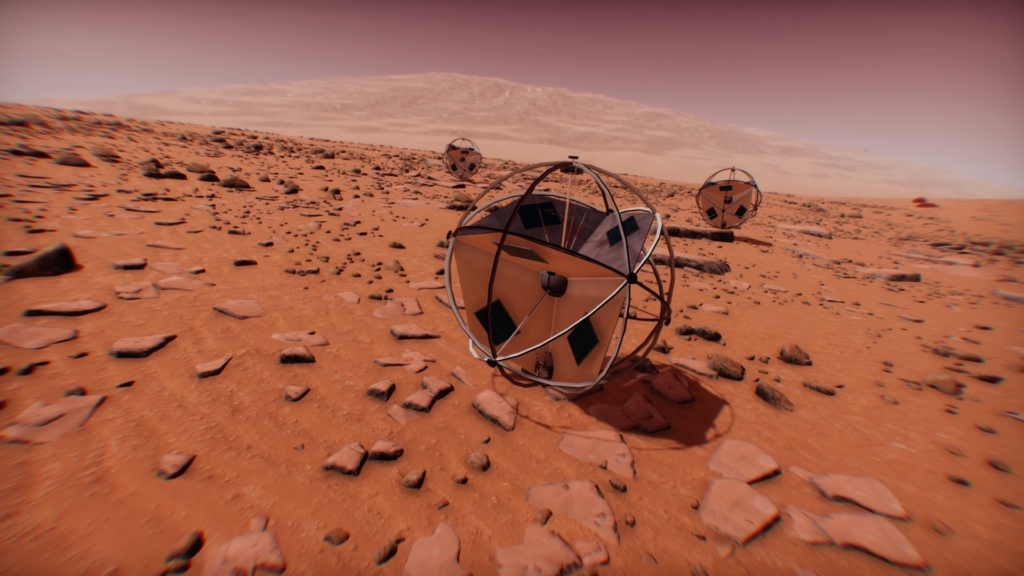
Image credit: Tumbleweed Mars project
Shaped like an ellipse
Tumbleweed Mars is being designed to cover long distances and handle different types of surfaces – such as sand, rocks, and clay — with a high degree of autonomy.
Onboard Tumbleweed Mars is a box serving as the “brain” of the device. It contains a camera, microphone, GPS, a gamma-ray spectrometer, a magnetometer, and sensors that collect a wide variety of data: temperature, atmospheric pressure, humidity, wind, and ultraviolet radiation, among others.
The rover is shaped like an ellipse, a very lightweight structure that weighs roughly 8 pounds (3.5 kilograms). Its frame is made of carbon fiber cables, allowing it to harness wind power.
Road to Mars
The team has officially wrapped up a testing campaign at the Alto Atacama Station, utilizing one of Earth’s most extreme environments to simulate Martian craters and plains.
According to a team report, they gathered critical data that will define the next generation of Tumbleweed Mars.
“We didn’t just meet our goals, we surpassed them, specifically in uphill mobility and impact resistance. Every vibration identified and every structural limit tested out here brings us one step closer on our road to Mars,” they report.
 Posted in Space News


Given the low density of Mars air, the earthbound tunbleweeds need to be able to move in a gentle 7-10 mph breeze- and that is the equivalent of a screaming full-strength dust storm on Mars.
Of course, the tumbleweeds will get trapped in the bottom of a crater within the first few miles, anyway.