 By
By  March 1st, 2017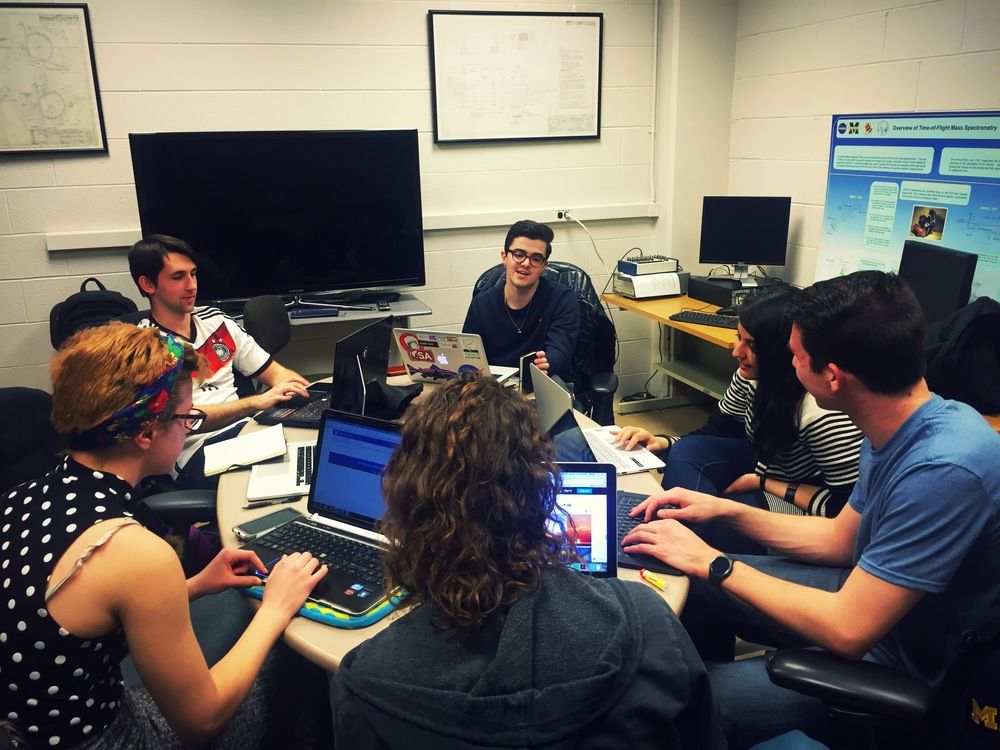
The Michigan Bicentennial Archive (M-BARC) team. Their CubeSat work is dedicated to designing, creating, and launching the first ever space time capsule.
Credit: M-BARC
A multi-disciplinary team at the University of Michigan (U-M) is scoping out a space time capsule.
Called the Michigan Bicentennial Archive (M-BARC) team, their CubeSat work is dedicated to designing, creating, and launching the first ever space time capsule.
It would be an artifact that commemorates the bicentennial of the University of Michigan. The CubeSat must survive the rigors of launch and space for 100 years.

Credit: M-BARC
Also, this small satellite would have its own propulsion system. The team is currently comparing electric and chemical thruster systems for use in the CubeSat.
Storing interviews
The student team is gathering content that will be sent up inside the spacecraft. A considerable amount of the project involves collecting representative media from throughout the University, providing the future recipients of the time capsule with an accurate representation of the University and state of Michigan in 2017.
The CubeSat would contain interviews from 1,000 members of the U-M community and an experiment to test DNA as a medium for storing data in space.

CubeSat design effort is geared to creating a time capsule for space.
Credit: U-M/M-BARC
Storing 1,000 interviews – and protecting this material from radiation – is not an easy task.
The team is working with the Lurie Nanofabrication Facility at the university to nanoprint 8 to 30 GB of data on a 1-inch silicon chip. At least ten chips will be placed at different orientations in the satellite to provide backups in case of cubesat collisions.
DNA experiment
According to a U-M story on the M-BARC effort, radiation also plays an important role in the team’s DNA radiation experiment which tests the genetic code’s ability to store information in space.
One microgram of DNA can hold 900 terabytes of data, equal to roughly 11,000 iPhones.
The team explains that sending physical packages of information out into the cosmos – like that onboard the Voyager spacecraft — it would be worth finding out if the DNA storage technique works. If so more information can be lobbed into space by this method, contrasted to the Voyager record, or even on solid state drives.

Record-toting Voyager spacecraft.
Credit: NASA/JPL
Multidisciplinary
As detailed on the M-BARC website, the multidisciplinary venture involves five distinct sub-teams:
- Bus team is designing the space vehicle itself, as well as the nanoprinting technology that will house our time capsule data.
- Orbit, Launch, and Propulsion team is investigating propulsion methods and determining where the time capsule will be located in space for 100 years.
- Tracking team is devising a way to locate the time capsule from Earth as it orbits for the next century.
- Public Relations team is crafting the content that will exist in the time capsule, managing donations and fundraising, and making sure this project gains momentum at the University of Michigan and beyond.
Location via laser
The team expects construction of at least the payload portion of the CubeSat to begin in the middle of the Winter 2017 semester. The payload includes the DNA experiment and data chips containing interviews.
In due course, say the next century, U-M hopes to retrieve the time-capsule by using a laser to locate the satellite via onboard reflectors.
Visit the M-BARC website at:
Go to this informative video of the project at:
 Posted in Space News

