 By
By  December 15th, 2022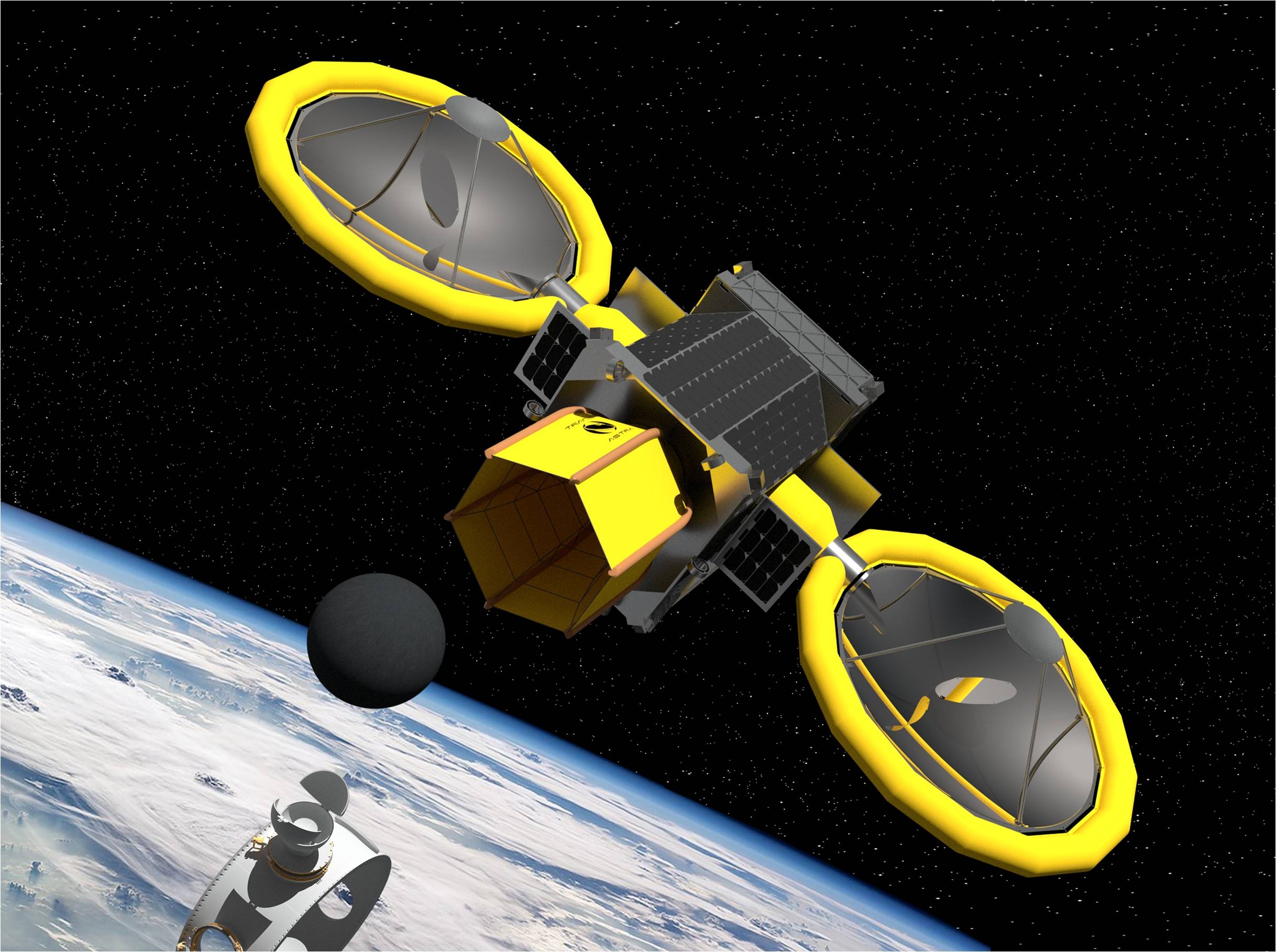
TransAstra’s Mini Bee is an in-space capture spacecraft.
Image credit: TransAstra
Innovative technologies for space debris removal and upgrading the ability to detect and track previously unfound moving spacecraft and other objects have been funded.
California-based TransAstra has been awarded contracts to develop critical emerging technologies in removing space junk and in space domain awareness beyond low Earth orbit for planetary defense and space surveillance purposes.
Capture bag
In a Phase 1 award from NASA’s Ignite program, the Small Business Innovation Research funding to TransAstra calls for design development of a deployable, inflatable capture bag which is capable of fully enclosing small spacecraft and debris for repositioning and de-orbiting.
TransAstra’s Mini Bee Capture Bag is initially designed to do away with debris of 10 centimeters diameter or greater. The bag can readily scale to 10 meters diameter or more.
The technology includes a robotic zipper that yields a nearly hermetic seal and prevents micro debris or liquid from leaking into space.
The capture bag also has the potential to arrest spacecraft that are in an uncontrolled orbit — whether due to fuel depletion or other cause — and safely remove the object.

TransAstra’s Sutter telescope system uses specialized Optimized Matched Filter Tracking (OMFT) software.
Image credit: TransAstra
Space surveillance
Under the second award from the Department of Defense, TransAstra will modify its Sutter technology to enable imaging of very small, faint, fast-moving objects in cislunar and deep space with 100 times greater strength and accuracy than standard imaging techniques, at a fraction of the cost.
Sutter technology makes use of TransAstra’s proprietary Optimized Matched Filter Tracking (OMFT) software. While TransAstra is currently operating its Sutter technology in ground-based systems, the Defense Department award will help fund development of an in-space solution.
“This space domain awareness advancement is necessary to report where objects are in space, understand why they are there, and match mounting threats from near-peer adversaries like China and Russia,” said Joel Sercel, CEO of TransAstra.
“Our technology allows the Space Force to find, fix, and track spacecraft and space debris to mitigate any potential threat throughout cislunar space,” Sercel said in a TransAstra statement.
For more information on TransAstra, go to:
 Posted in Space News

