 By
By  March 1st, 2015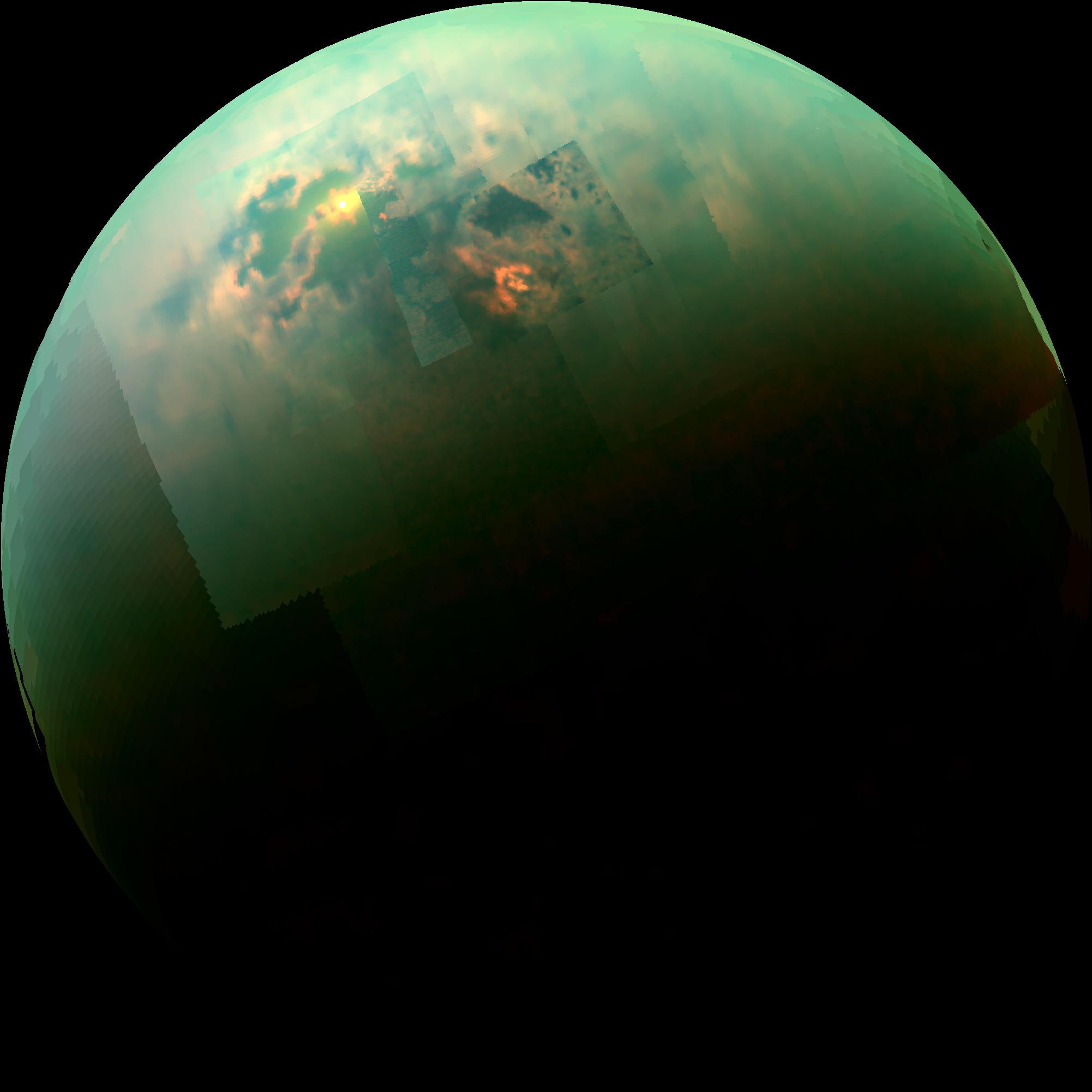
This near-infrared, color mosaic from NASA’s Cassini spacecraft shows the sun glinting off of Titan’s north polar seas. The view was acquired during Cassini’s August 21, 2014 flyby of Titan.
Credit: NASA/JPL-Caltech/University of Arizona/University of Idaho
Saturn’s moon Titan may well be a site for life – but “not as we know it” say Cornell University researchers.
While liquid water is a requirement for life on Earth, other, much colder worlds, may harbor life beyond the bounds of water-based chemistry.
Cornell chemical engineers and astronomers offer a template for life that could thrive in a harsh, cold world – specifically Titan, the giant moon of Saturn. That world is awash with seas not of water, but of liquid methane.
Titan could harbor methane-based, oxygen-free cells that metabolize, reproduce and do everything life on Earth does.

Graduate student James Stevenson, astronomer Jonathan Lunine and chemical engineer Paulette Clancy, with a Cassini image of Titan in the foreground of Saturn, and an azotosome, the theorized cell membrane on Titan.
Credit: Jason Koski/University Photography
That prospect is detailed in the Feb. 27 issue of Science Advances, led by chemical molecular dynamics expert Paulette Clancy, the Samuel W. and Diane M. Bodman Professor of Chemical and Biomolecular Engineering, with first author James Stevenson, a graduate student in chemical engineering.
The paper’s co-author is Jonathan Lunine, the David C. Duncan Professor in the Physical Sciences in the College of Arts and Sciences’ Department of Astronomy.
Promising compound
According to a Cornell press statement: “On Earth, life is based on the phospholipid bilayer membrane, the strong, permeable, water-based vesicle that houses the organic matter of every cell. A vesicle made from such a membrane is called a liposome. Thus, many astronomers seek extraterrestrial life in what’s called the circumstellar habitable zone, the narrow band around the sun in which liquid water can exist. But what if cells weren’t based on water, but on methane, which has a much lower freezing point?”
Candidate compounds from methane for self-assembly into membrane-like structures were theorized. The most promising compound they found is an acrylonitrile azotosome.

An inhabitant of Titan? A representation of a 9-nanometer azotosome, about the size of a virus, with a piece of the membrane cut away to show the hollow interior.
Credit: James Stevenson
Proof of concept
Their theorized cell membrane is composed of small organic nitrogen compounds and capable of functioning in liquid methane temperatures of 292 degrees below zero.
The azotosome is made from nitrogen, carbon and hydrogen molecules known to exist in the cryogenic seas of Titan, but shows the same stability and flexibility that Earth’s analogous liposome does.
While this initial proof of concept is stirring the creative juices, the next step is to try and demonstrate how these cells would behave in the methane environment – what might be the analogue to reproduction and metabolism in oxygen-free, methane-based cells.
Co-author of the work, Lunine says he looks forward to the long-term prospect of testing these ideas on Titan itself, by “someday sending a probe to float on the seas of this amazing moon and directly sampling the organics.”
 Posted in Space News

