 By
By  December 14th, 2021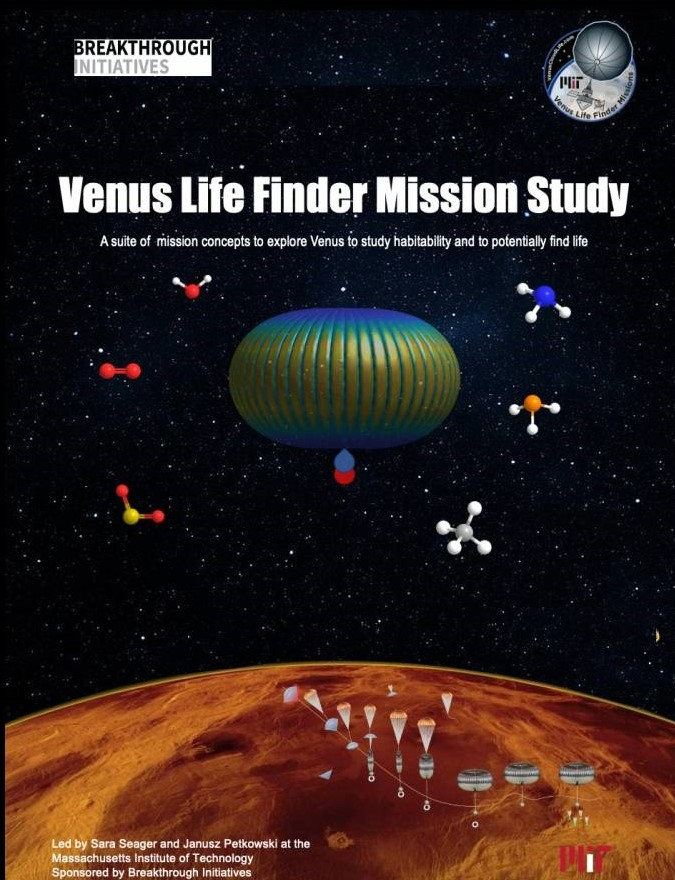
“Newer, nimbler, faster.” That’s the call stemming from a newly issued report led by MIT scientists that details a suite of privately-funded missions to hunt for life on Venus.
The Venus Life Finder (VLF) Missions are a series of three direct Venus atmosphere probes designed to assess the habitability of the Venusian clouds and to search for signs of life and life itself.
According to the report, the VLF missions would be a focused, optimal set of missions that can be launched quickly and with relatively low cost. The mission concepts come out of an 18-month study by an MIT-led worldwide consortium.
The study was partially funded by the Breakthrough Initiatives.

A composite image of the planet Venus as seen by the Japanese probe Akatsuki. The clouds of Venus could have environmental conditions conducive to microbial life.
Credit: JAXA
Sample return
Ultimately, the study concludes, a Venus atmosphere sample return is needed to robustly answer the compelling question, “Is there life on Venus?”
Envisioned is bringing back about one liter of Venus atmosphere and up to tens of grams of Venus cloud particles for detailed studies here on Earth – of the kind that cannot be done remotely.
“We hope this is the start of a new paradigm where you go cheaply, more often, and in a more focused way,” says Sara Seager in MIT’s Department of Earth, Atmospheric and Planetary Sciences (EAPS) and principal investigator for the planned Venus Life Finder Missions.
Lingering mysteries
“There are these lingering mysteries on Venus that we can’t really solve unless we go back there directly,” Seager adds in a MIT statement, saying that lingering chemical anomalies that leave room for the chance of life on that cloud-veiled world.
Seager was part of a team that reported last year a detection of phosphine gas in Venus’ atmosphere. On Earth, that gas is produced only by biological and industrial processes.
Since that claim, the phosphine finding has been challenged. Still, Seager says the controversial finding has sparked positive momentum to the Venus missions. “The whole phosphine controversy made people more interested in Venus. It allowed people to take Venus more seriously,” she says.

Venus in ultraviolet taken by NASA’s Pioneer-Venus Orbiter in 1979 indicating that an unknown absorber is operating in the planet’s top cloud layer.
Credit: NASA
Scientific payload
Based on their research, the Venus Life Finder team focused in on a scientific payload for the mission, which was restricted to just 1 kilogram.
MIT’s Seager says they settled on an instrument called an autofluorescing nephelometer because it could get the job done and was small, cheap, and could be built quickly enough for the compressed mission timeline.
The instrument is currently being built by a New Mexico-based company called Cloud Measurement Solutions, and a Colorado-based company called Droplet Measurement Technologies. The instrument is partially funded by MIT alumni.
Mission suite
Once the probe is in Venus’ atmosphere, the instrument will shine a laser out of a window onto cloud particles, causing any complex molecules within them to light up, or fluoresce. Many organic molecules, such as the amino acid tryptophan, have fluorescent properties.
“If we see fluorescence, we know something interesting is in the cloud particles,” Seager points out. “We can’t guarantee what organic molecule it is, or even be certain it’s an organic molecule. But it’s going to tell you there’s something incredibly interesting going on.”
Whatever the 2023 mission finds, the next mission in the suite is already being planned for 2026.
That probe would involve a larger payload, with a balloon that could spend more time in Venus’ clouds and conduct more extensive experiments. Results from that mission might then set the stage for the culmination of the Venus Life Finder Missions concept: return a sample of Venus’ atmosphere to Earth.

Credit: Rocket Lab
Rocket Lab partnership
A partnership has been put in place with the private entrepreneurial group, Rocket Lab, to provide the science payload and science team to go with their 2023 Venus Mission’s rocket, cruise spacecraft, and direct probe entry vehicle. The Venus direct entry vehicle aboard Rocket Lab’s Photon spacecraft has room for up to one kilogram of science instrumentation for the short-duration (three minute) descent through the cloud layers, the report explains.
As for the overall Venus Life Finder Missions, “we think it’s disruptive,” says Seager. “And that’s the MIT style. We operate right on that line between mainstream and crazy.”
For a detailed look at the report — Venus Life Finder Mission Study – go to:
https://venuscloudlife.com/wp-content/uploads/2021/12/VLFReport_12092021.pdf
 Posted in Space News

