 By
By  April 5th, 2018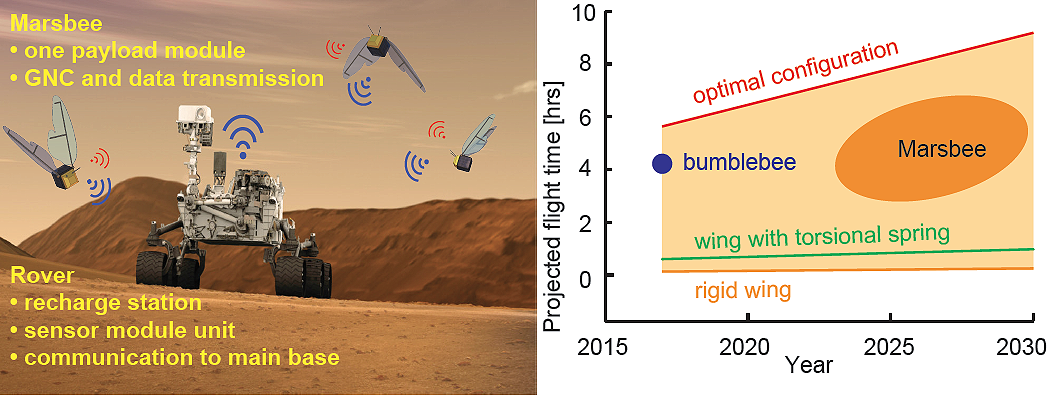
Credit: Kang/UAH
A recent NASA Innovative Advanced Concepts (NIAC) award is focused on letting loose on Mars a swarm of flapping flyers.
“Flying on Mars is challenging because of the ultra-low density in the Martian atmosphere. Our preliminary work shows that bioinspired aerodynamic mechanisms can help in generating sufficient lift to fly on Mars,” explains Chang-kwon Kang, an assistant professor of mechanical and aerospace engineering at The University of Alabama in Huntsville (UAH).
UAH researchers will numerically model, analyze, and optimize a flapping flyer for Martian atmospheric conditions. They will work in tandem with Japanese colleagues that will develop and test a micro-flapping robot that is uniquely designed and constructed for the low-density atmosphere on Mars.
Flapping wing flyers
Kang’s winning NIAC proposal, entitled “Marsbee – Swarm of Flapping Wing Flyers for Enhanced Mars Exploration,” seeks to increase the set of possible exploration and science missions on Mars by investigating the feasibility of flapping-wing aerospace architectures in a Martian environment.

Credit: NASA
At its center is the Marsbee, a robotic bumble-bee-sized flapping-wing flyer whose large cicada-like wings have the ability to generate sufficient lift to hover in the Martian atmosphere. Integrated with sensors and wireless communication devices, these flyers would work in a swarm, with a mobile base serving as their recharging station and a main communication center.
Micro-air vehicle
Given the NIAC Phase I award, researchers want to determine the wing design, motion, and weight that can hover with optimal power in Mars’ atmospheric conditions and to assess the hummingbird micro-air vehicle – one of only a few robotic flappers in the world that can fly on Earth – in Mars conditions.
Should the team go on to receive a Phase II award, the goal will be to build on this research by addressing the maneuverability, wind gust rejection, takeoff/landing, power implications, remote sensing, and mission optimization of the Marsbees.
“Our long-term overarching goal is to develop swarms of Marsbees that can help with the human exploration on Mars,” Kang says in a UAH press statement.
 Posted in Space News

