 By
By  August 17th, 2017
The Expedition 52 crew poses for a unique portrait. Pictured clockwise from top right are, Flight Engineers Paolo Nespoli, Jack Fischer, Peggy Whitson, Sergey Ryazanskiy, Randy Bresnik and Commander Fyodor Yurchikhin.
Credit: NASA
Continuously occupied since early November 2000, the International Space Station (ISS) is being viewed as an archaeological site.
The orbiting complex is eyed by The International Space Station Archaeological Project (ISSAP) as the first large-scale space archaeology project.
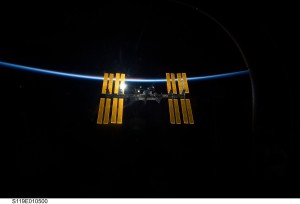
International Space Station.
Credit: NASA
Boldly going where no archaeologists have gone before are scholars Justin Walsh of Chapman University in Orange, California and Alice Gorman of Flinders University in Adelaide, Australia.
Microsociety/miniworld
“We are studying the crew of the International Space Station as a microsociety in a miniworld. Our project will have positive effects on the development of long-duration space missions, and it will extend the discipline of archaeology into a new context,” the ISS Archaeology site explains.
The space station serves as evidence for human adaptation to a completely new environment. The ISS undertaking has involved five space agencies, 25 nations, countless private contractors, and several hundred visitors from 18 countries, from scientists, military officers to a few tourists.
Questions to be addressed
Underpinning the project are seeking answers to questions outside the scope of standard histories. These include:
- How do crewmembers interact with each other and with equipment and spaces originating in other cultures?
- How does material culture reflect gender, race, class, and hierarchy on the ISS?
- How do spaces and objects frame interactions of conflict or cooperation?
- How have crewmembers altered the space station to suit their needs or desires?
- What are the effects of microgravity on the development of society and culture?
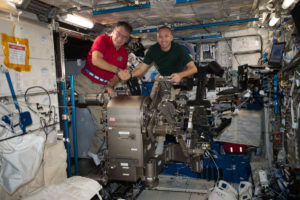
Astronauts Paolo Nespoli and Randy Bresnik are at work in their new home in space where they will live until mid-December.
Credit: NASA
New understanding
“No other site has the potential to illuminate how material culture shapes human experiences of the space environment across this timescale,” the group’s website explains. “We will offer a new understanding of human activity in space, with applications for the development of future missions. The project will also develop new methods for the discipline of archaeology that will enable future study of other remote, unusual, and/or dangerous contexts.”
Resources
Dig into the ISS Archaeological Project by going to:
Note:
On September 21, Justin Walsh will present the lecture “To Boldly Go Where No Archaeologist Has Gone Before: The Archaeology of a Human Habitation Site in Space.” This open to the public, Archaeological Institute of America/Tampa Bay Society lecture, will be held at the University of South Florida. For more information, go to: https://www.archaeological.org/societies/tampabay
 Posted in Space News

