 By
By  August 30th, 2025
NASA’s Robert Mosher displays a piece of webbing material, known as Zylon, which comprise the straps of HIAD aeroshell samples now in Earth orbit aboard the military’s X-37B space plane.
Image credit: NASA/Joe Atkinson
Another payload has been identified flying aboard the recently launched Space Force X-37 space plane – an experiment that may help land humans on Mars.
Lofted into Earth orbit on August 21, the X-36 carries several pieces of webbing material, known as Zylon that are being exposed to the harsh vacuum of space.
The Zylon material is under study as part of NASA’s Hypersonic Inflatable Aerodynamic Decelerator – or HIAD in space shorthand. HIAD is an aeroshell concept under development by NASA’s Langley Research Center in Hampton, Virginia.
The HIAD aeroshell technology is designed to allow larger spacecraft to safely descend through the atmospheres of celestial bodies like Mars, Venus, and even Saturn’s moon, Titan.

Illustration of Low-Earth Orbit Flight Test of an Inflatable Decelerator (LOFTID).
Image credit: NASA
Webbing material
“We’re researching how HIAD technology could help get humans to Mars. We want to look at the effects of long-term exposure to space – as if the Zylon material is going for a potential six to nine-month mission to Mars,” said Robert Mosher, HIAD materials and processing lead at NASA Langley. “We want to make sure we know how to protect those structural materials in the long term,” he added in a NASA statement.
Flying Zylon material aboard the Space Force’s X-37B mission will help NASA researchers understand what kind of aging might occur to the webbing on a long space journey before it experiences the extreme environments of atmospheric entry, during which it has to retain strength at high temperatures.
NASA’s HIAD aeroshell work builds on the agency’s Low-Earth Orbit Flight Test of an Inflatable Decelerator (LOFTID) mission back in 2022.

X-37B (OTV-8) military space plane being readied for flight, with its service module not shown in photo.
Image credit: U.S. Air Force/U.S. Space Force
Sensor, laser communications testing
The Boeing-built X-37B space plane – also identified as the Orbital Test Vehicle (OTV-8) – is outfitted with a service module that expands the capacity for experiments for mission partners, which include the Air Force Research Laboratory and the Defense Innovation Unit.
OTV-8 is to perform a quantum inertial sensor demonstration, as well as testing laser communications.
Shortly after its August 21 launch, the secretive U.S. Space Force X-37B deployed in Earth orbit a payload dubbed Limasat, probably ejected from the space plane’s service module, according to seasoned amateur satellite trackers.
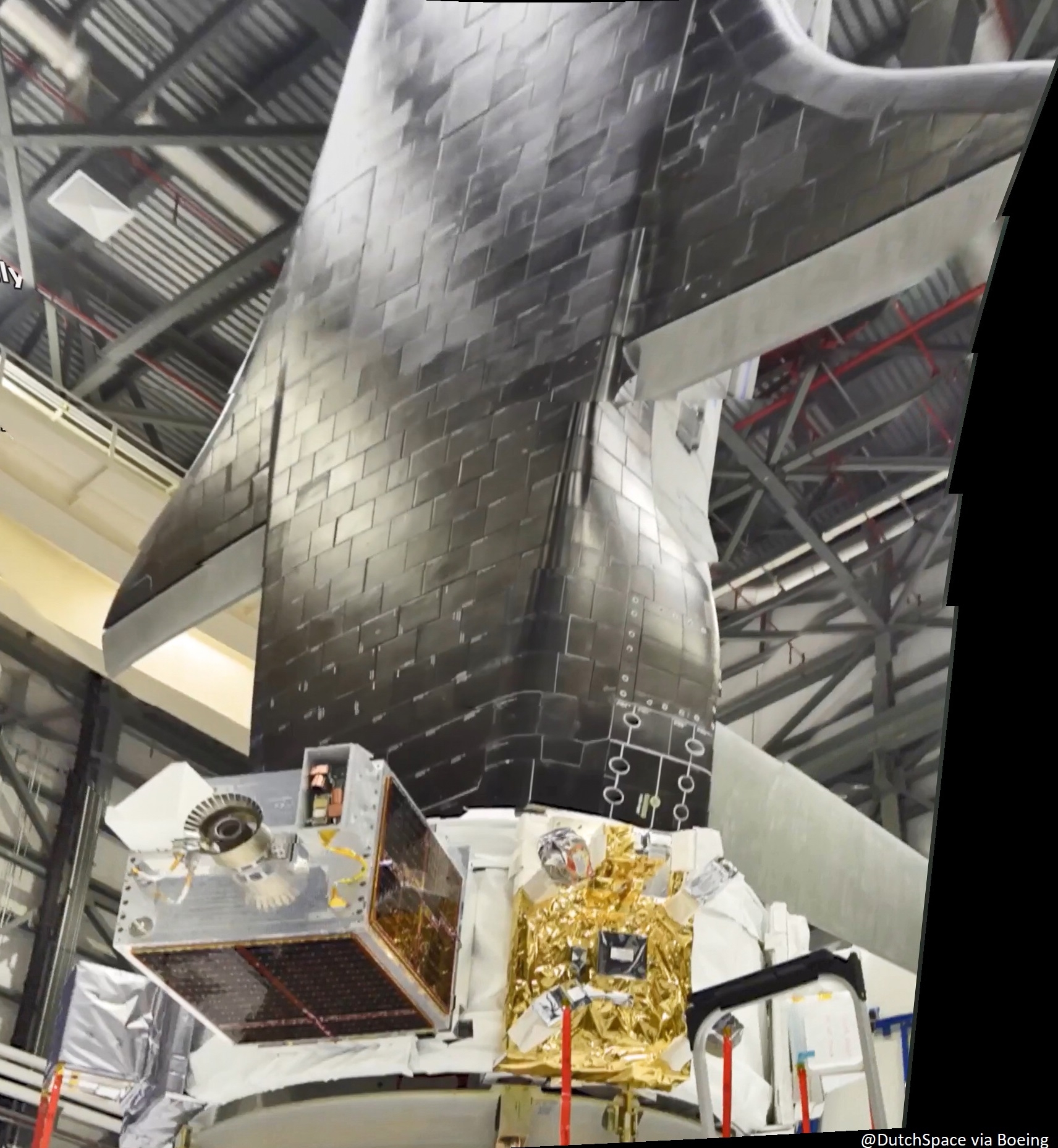
Image of Falconsat 8 mounted on the X-37B OTV-6 service module..
Image credit: Boeing via DutchSpace
Small canisters
As for NASA’s HIAD experiment, multiple samples of strap material are in small canisters on the X-37B, some tightly coiled up while others are loosely stuffed in.
“Typically, we pack a HIAD aeroshell kind of like you pack a parachute, so they’re compressed,” NASA’s Mosher said. “We wanted to see if there was a difference between tightly coiled material and stuff-packed material like you would normally see on a HIAD.”
Some of the canisters also include tiny temperature and humidity sensors set to collect readings at regular intervals.
When the U.S. Space Force de-orbits the X-37B – no telling how long the craft will be in orbit, NASA’s Mosher said he compare them to a set of samples that have remained in canisters here on Earth to look for signs of degradation.

The U.S. Space Force’s X-37B Orbital Test Vehicle Mission Seven successfully landed at Vandenberg Space Force Base, Calif., March 7, 2025. The X-37B landed at Vandenberg SFB to exercise the service’s ability to recover the spaceplane across multiple sites.
Image credit: U.S. Space Force courtesy photo
Previous flights
In related news regarding the hush-hush military space plane, U.S. President Trump’s “One, Big Beautiful Bill Act,” H.R. 1 includes $1 billion for the U.S. Space Force X-37B military spacecraft program.
Here’s a listing of previous flights of the space plane:
OTV-1: launched on April 22, 2010 and landed on December 3, 2010, spending over 224 days on orbit.
OTV-2: launched on March 5, 2011 and landed on June 16, 2012, spending over 468 days on orbit.
OTV-3: launched on December 11, 2012 and landed on October 17, 2014, spending over 674 days on-orbit.
OTV-4: launched on May 20, 2015 and landed on May 7, 2015, spending nearly 718 days on-orbit.
OTV-5: launched on September 7, 2017 and landed on October 27, 2019, spending nearly 780 days on-orbit.
OTV-6: launched on May 17, 2020 and landed on November 12, 2022, circling Earth for 908 days.
OTV-7: lofted on December 28, 2023 and touched down on March 7, 2025, circling Earth for 434 days.
OTV-8: launched on August 21, 2025 with no reported landing date.

Artwork depicts X-37B space plane. Image credit: Boeing/Inside Outer Space screengrab
Testing critical technologies
“OTV-8 exemplifies the X-37B’s status as the U.S. Space Force’s premier test platform for the critical space technologies of tomorrow,” said Air Force Rapid Capabilities Office (AFRCO) Acting Director, William Blauser, in an August 14 press statement. “Through its mission-focused innovation, the X-37B continues to redefine the art of the possible in the final frontier of space,” he stated.
Go to these previous Inside Outer Space-posted stories regarding this latest mission of the X-37B:
U.S. Military Space Plane – August Takeoff
https://www.leonarddavid.com/u-s-military-space-plane-august-takeoff/
Caught on Camera: U.S. Space Force Secretive Space Plane – Payload Deployed

Artwork depicts HIAD use for humans-to-Mars program.
Image credit: NASA Langley Research Center
 Posted in Space News

