 By
By  December 3rd, 2015
This artist’s concept depicts NASA’s InSight Mars lander fully deployed for studying the deep interior of Mars. InSight — short for Interior Exploration using Seismic Investigations, Geodesy and Heat Transport — will investigate processes that formed and shaped Mars.
Credit: NASA/JPL-Caltech
NASA’s next Mars lander has completed assembly and testing at Lockheed Martin Space Systems in Colorado – but one problem. A key science instrument to be carried on the mission is experiencing a problem.
The Interior Exploration Using Seismic Investigations, Geodesy and Heat Transport (InSight) spacecraft is to investigate processes that formed and shaped Mars.
But one major piece of hardware is experiencing a leak in the vacuum container carrying its main sensors. The sensors are part of an instrument called the Seismic Experiment for Interior Structure (SEIS), which is provided by the French Space Agency (CNES).
Ticking countdown clock
The seismometer is the prime science payload that will help answer questions about the interior structure and processes within the deep Martian interior.
The countdown clock is ticking for a slated blastoff to Mars in March of next year of the lander from Vandenberg Air Force Base, California.
The plan calls for the mission to launch during the period March 4 to March 30, 2016, and land on Mars Sept. 28, 2016.

Robot arm would deploy sensitive Seismic Experiment for Interior Structure (SEIS) (white object in foreground).
Credit: NASA/JPL
Bad news
According to a Jet Propulsion Laboratory InSight status report: “The SEIS instrument has three high-sensitivity seismometers enclosed in a sealed sphere. The seismometers need to operate in a vacuum in order to provide exquisite sensitivity to ground motions as small as the width of an atom. After the final sealing of the sphere, a small leak was detected, that would have prevented meeting the science requirements once delivered to the surface of Mars.”
Promising news
A CNES/JPL team is currently working to repair the leak, prior to instrument integration and final environmental tests in France before shipping to the United States for installation into the spacecraft and launch.
The Heat Flow and Physical Properties Package (HP3) from Germany and the rest of the scientific payload for InSight are already installed.
NASA and CNES managers are committed to launching InSight in March and are currently assessing the launch window timeline.
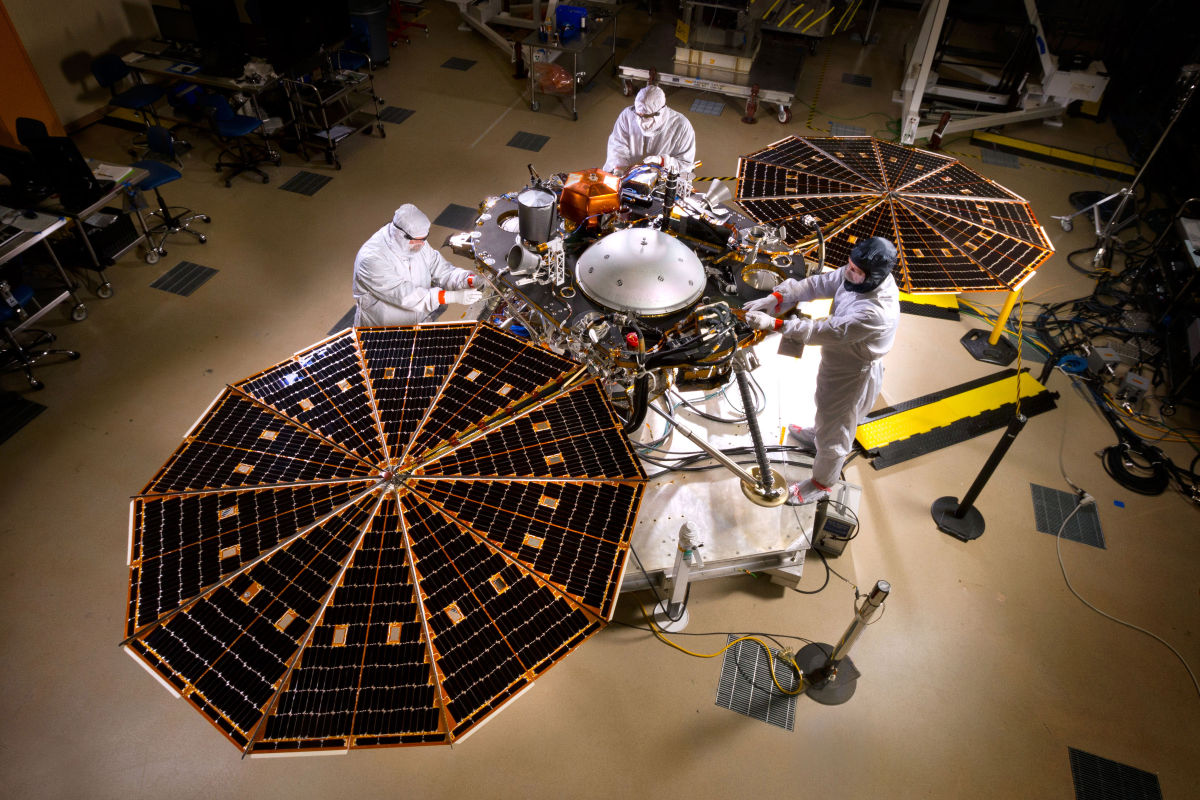
NASA’s InSight Mars lander spacecraft in a Lockheed Martin clean room near Denver. As part of a series of deployment tests, the spacecraft was commanded to deploy its solar arrays in the clean room to test and verify the exact process that it will use on the surface of Mars.
Credit: Lockheed Martin Space Systems
Meanwhile, Lockheed Martin Space Systems is prepared to ship InSight to the Vandenberg AFB launch site. Installation of the seismometer is planned for early January.
The InSight Project is managed by NASA’s Jet Propulsion Laboratory, Pasadena, California. The InSight mission is led by Bruce Banerdt of JPL.
Focus on mission success
In a statement provided to Inside Outer Space from InSight’s builder, Lockheed Martin:
“Lockheed Martin designed and built the InSight Mars lander for NASA on schedule and has recently completed the rigorous environmental testing phase. The spacecraft is now being readied for shipment to the launch site to begin the launch campaign. We understand the importance of this Mars mission and are doing everything possible to accommodate a late delivery of the French Space Agency’s SEIS instrument while still maintaining a focus on mission success.”
 Posted in Space News

