 By
By  February 23rd, 2023
Soyuz craft undergoing preparation for Feb. 23 launch in uncrewed mode.
Image credit: RSC Energia
Russia’s Soyuz MS-23 is ready for launch from the Baikonur Cosmodrome in Kazakhstan.
Typically the craft is flown piloted, but is only housing supplies and is headed spaceward in uncrewed mode to replace Soyuz MS-22.
That older Soyuz is now docked to the International Space Station. Back on December 15, 2022, it experienced a thermal control system depressurization/leak, putting into question its use to carry a return-to-Earth three-person crew.
External influences
“We have done everything so that the Soyuz MS-22 does not pose a danger,” explains Vladimir Solovyov, General Designer for Manned Space Systems and Complexes of RSC Energia in a new Roscosmos Telegram posting.
The external contour of the radiator of the thermal control system of the Soyuz MS-22 spacecraft was depressurized. Specialists later determined that the damage was caused by a purported micrometeoroid impact.

Image credit: Roscosmos/Inside Outer Space screengrab
Similarly, a now-ditched unpiloted cargo ship — Progress MS-21 — suffered the same de-pressurization scenario, created by “external influences,” another Telegram posting explained. The automated supply craft had delivered over 2.5 tons of cargo to the ISS.
Systematic error?
RSC Energia’s Solovyov made note of the measures taken, the work of specialists on Earth and the crew in orbit, further actions, protecting new ships from possible threats, as well as preparing the new Soyuz MS-23 for launch.
That Soyuz replacement ship is to replace Soyuz MS-22 and return to Earth Roscosmos cosmonauts Sergei Prokopiev, Dmitry Petelin and NASA astronaut Francisco Rubio.

Image credit: Roscosmos/Inside Outer Space screengrab
In an earlier Roscosmos posting, former cosmonaut Sergey Krikalev, now Roscosmos executive director for crewed space programs, addressed the situation with the compromised Progress MS-21 that had been docked to the station for several months, launched from Baikonur on October 26 of last year atop a Soyuz-2.1a carrier rocket.
According to Krikalev, by on-orbit inspection of the leak area on the Progress MS-21 radiator, the intent was to find out the cause of its occurrence. There was need to make sure that Russia’s Soyuz and Progress series is not experiencing a systematic error, because it may affect the following ships, he noted in the Telegram communiqué.
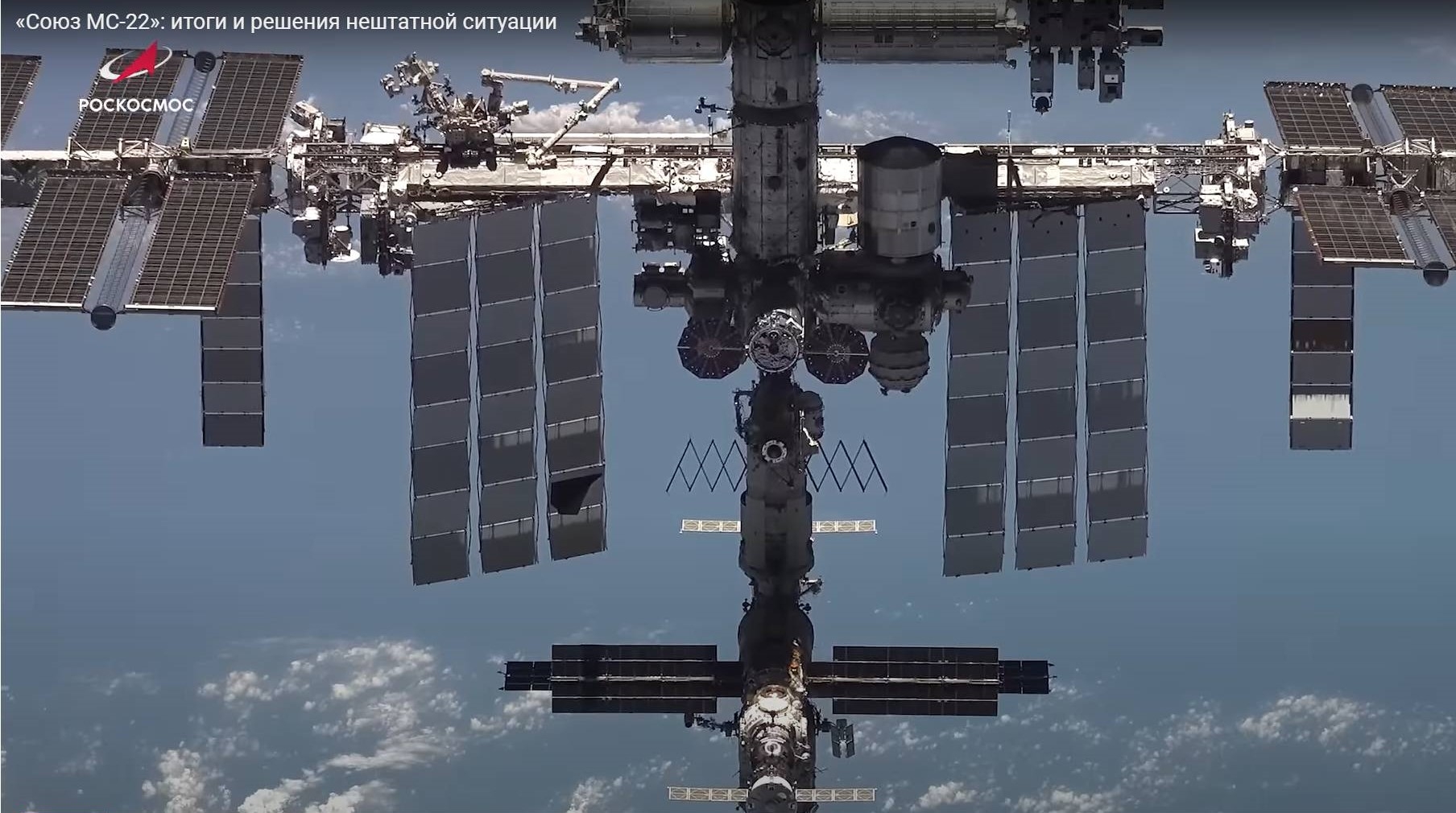
Image credit: Roscosmos/Inside Outer Space screengrab
The Soyuz MS-23 mission is targeted for liftoff today, on Thursday, February 23rd at 7:24 pm Eastern time. Liftoff can be viewed on NASA TV at:
 Posted in Space News

