 By
By  November 9th, 2021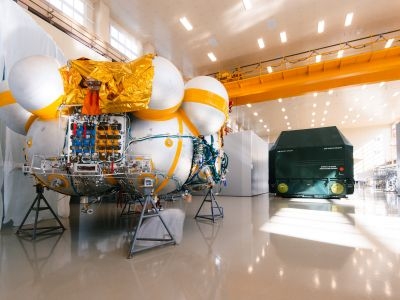
Fregat upper stage. Credit: Roscosmos
Russia’s re-entry into lunar exploration – the Luna-25 – is slowly coming together with a projected launch date apparently sliding from May into July 2022.
Meanwhile, an upper stage “Fregat” designed to launch the Moon probe atop a Soyuz-2.1b booster is being air-shipped to the Vostochny Cosmodrome.

Russia’s Luna-25 Moon lander.
Credit: RSC Energia/Roscosmos
Luna-25 has been produced by NPO Lavochkin and tasked to soft land in the near-polar region and to carry out contact studies of the South Pole of the Moon. The main task of the mission is to develop basic soft landing technologies.
The Fregat upper stage, manufactured by NPO Lavochkin, is used as part of medium-class launch vehicles, hurling payloads on trajectories departing from the Earth. Since 2000, the Fregat upper stage has provided 101 launch campaigns and launched more than 700 spacecraft, both Russian and foreign, into various near-earth orbits and departure trajectories.

Factory floor integration of science instruments on Russia’s Luna-25 Moon mission, originally targeted for an October 2021 sendoff.
Credit: Roscosmos
Follow-on missions
Originally targeted for sendoff in October 2021, Luna-25 opens a long-term Russian lunar program, which includes missions to study the Moon from orbit and surface, collect and return lunar soil to Earth, as well as construct a visited lunar base, in cooperation with the Chinese National Space Administration within a large-scale project to create an International Scientific Lunar Station.
As noted by the Institute of Space Research of the Russian Academy of Sciences, there are follow-on Russian Moon missions on the books: Luna-26 (or Luna-Resurs-Orbiter), an orbital mission to study Moon from low polar orbit. Luna-27 would be a landing mission (or Luna-Resurs-Lander), designed to study lunar regolith on-the-spot. The European Space Agency (ESA) is working on a drill and a sampling device for this spacecraft.
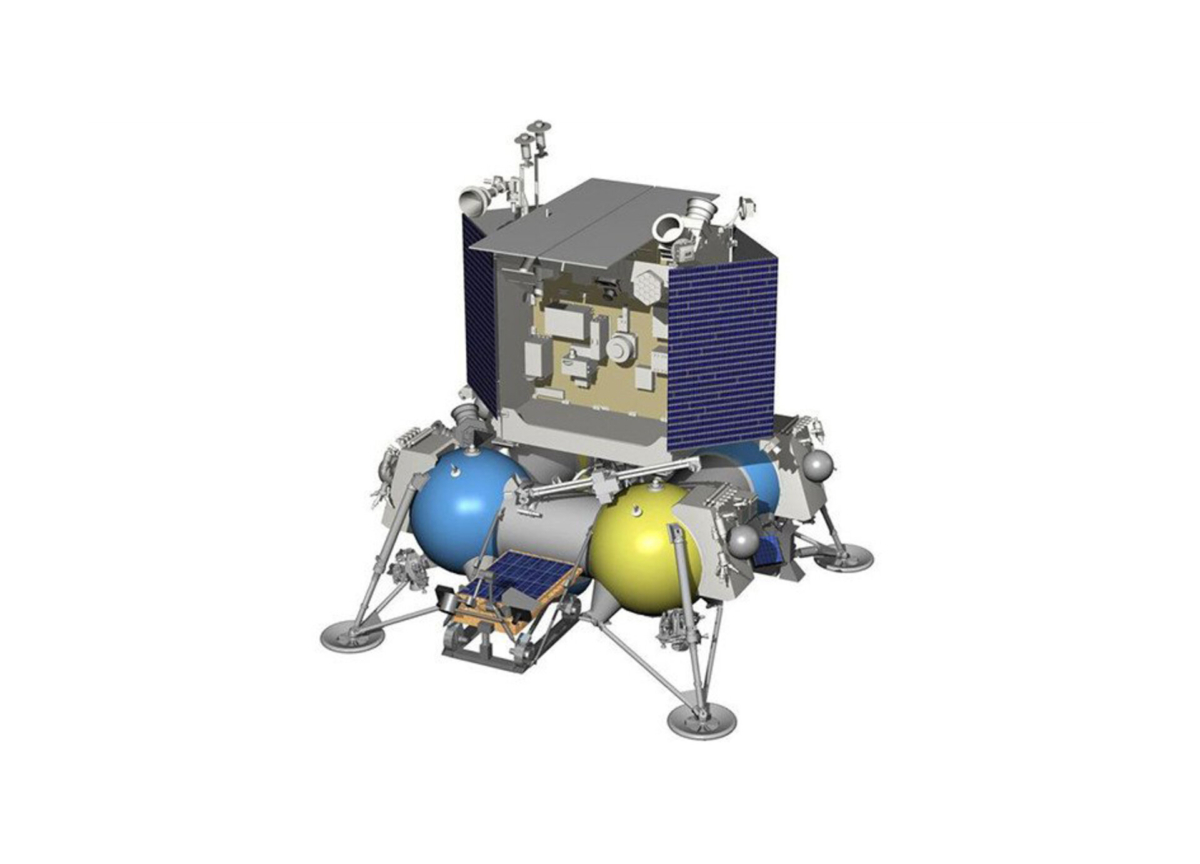
Luna-27
Credit: Roscosmos/ESA
ESA/Russia cooperation
When Luna-25 lands on the Moon, it will image the terrain with a European Pilot-D camera built specifically for landing.
According to ESA, two years after Luna-25, the Luna-26 orbiter will be sent to lunar orbit for remote scientific measurements and as a possible communications relay for the next lander mission. It will transmit data back to ground stations on Earth, including ESA’s ground station network.
The Luna-27 lander will be launched one year after Luna-26 and will be larger than its predecessor Luna-25. It will fly to a challenging landing site closer to the lunar south pole using a European system called Pilot as its main navigation system.
Additionally, Luna-27 will deploy the European Prospect drill that will search for water ice and other chemicals under the surface.
 Posted in Space News

