 By
By  August 13th, 2023
Image credit: RT/Inside Outer Space screengrab
Following its August 10 liftoff, Russia’s Moon-bound Luna-25 has switched on its scientific equipment. All systems on the spacecraft are working normally, reports Roscosmos, the Russian space corporation.
“Communication with it is stable, the energy balance is positive. Today, the first switching on of the complex of scientific equipment developed by IKI RAS,” [Space Research Institute of the Russian Academy of Sciences (IKI)].

Pre-launch testing.
Image credit: Roscosmos/IKI
“Service telemetric information from all devices showed their regular functioning. The first measurement data on the flight to the Moon have been received, and the project’s scientific team has begun processing them,” the Roscosmos statement notes.

Russia’s return-to-the-Moon Lunar-25 hardware undergoes testing.
Image credit: Roscosmos
Landing spots
Luna-25 will nudge itself into lunar orbit on August 16, a Roscosmos posting explains, and the craft’s soft landing on the Moon is scheduled for August 21.
Following its voyage to the Moon and multiple days in lunar orbit, the spacecraft is slated to set down at the Moon’s south pole, near the Boguslawsky crater.

Topographic map of the southern sub-polar region of the Moon showing the location of Boguslawsky crater.
Credit: Ivanov et al., 2015 via Arizona State University/LROC
Two backup landing spots are also in play: southwest of Manzini Crater and south of Pentland A Crater.
Luna-25 will work on the lunar surface for at least one Earth year.
Water ice
One key scientific quest of the probe makes use of a lunar manipulator complex (LMK) able to excavate lunar regolith and deliver that material directly into a laser mass spectrometer.
In addition, an infrared spectrometer installed on this hardware can remotely inspect the material, assessing the prospect of finding water ice.
Litvak Maxim Litvak, head of the IKI planning group for the Luna-25 scientific instrumentation complex, has said that the exact properties of the south pole soil is an unknown.
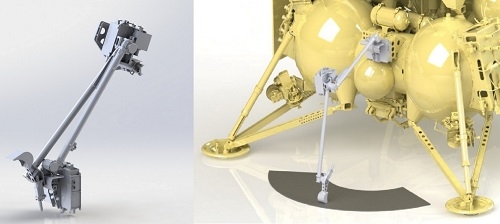
Credit: NPO Lavochkin/IKI/Roscosmos
Soil simulations
A special cryogenic vacuum bench was created at IKI as part of lunar soil simulations, and how the LMK will operate in dealing with south pole samples.
“We poured it into this stand, added water in different concentrations, froze it to ‘lunar’ temperatures and dug with a technological sample of the manipulator. This gave a lot of food for thought – how can we dig regolith on the Moon, including if there is water ice in it,” Litvak said in an IKI posted interview.
“With the help of the work at the stand, we learned that if about one percent of water is added to the soil and frozen in a vacuum, then in terms of strength it begins to resemble concrete,” Litvak said.

Credit: NPO Lavochkin
“Nevertheless, we were convinced that we can still dig such soil – the design of our LMK allows this. Of course, the excavation area remains limited – only near the spacecraft, Luna-25 is not a lunar rover that can move away from the landing site. But in the working area of the manipulator, you can try different places. If a stone is found in the ground, then it can be bypassed,” Litvak added.

Luna-26
Image credit: Roscosmos/IKI

Luna-27
Image credit: Roscosmos/IKI

Luna-28
Image credit: Roscosmos/IKI

Luna-28, sample return mission.
Image credit: NPO Lavochkin
Future missions
IKI’s Litvak emphasized that the Russian lunar program is already planning out future missions based on the development of Luna-25’s design. Luna-26, which will orbit the Moon, will be followed by two landing efforts: Luna-27 will deliver a drilling rig to the Moon, and Luna-28 is designed to deliver regolith from the Moon’s polar regions to Earth.
“Re-establishing Russia’s capability for landing robotically on the Moon after 47 years represents an important step in humanity returning to the Moon, this time to stay,” said Clive Neal, a leading lunar scientist at the University of Notre Dame in Indiana. “Congratulations to the Luna 25 team for a successful launch. I am looking forward to the subsequent Luna 26 and 27 missions.”
For more information about the Russian lunar program and Luna-25’s scientific and political meaning, go to: “Russia’s Return to the Moon With Luna-25: High Risk, High Stakes” at:
 Posted in Space News

