 By
By  October 21st, 2023
Image credit: Roscosmos/IKI/NPO Lavochkin
Russia’s re-rendezvous with Moon exploration, despite the crash of its Luna-25 lander, has produced an informative scientific result.
Prior to Luna-25’s smashing encounter with the Moon on August 19, the probe imaged the Zeeman crater on August 17.
Using the craft’s Service Television System (STS-L), the imagery was compared to available data on the lunar regolith at that locale.

The Luna-25 station photographed the Zeeman crater on August 17, 2023.
Image credit: IKI RAS
Water ice
According to researchers at Russia’s Institute of Space Research of the Russian Academy of Sciences (IKI RAS), who built the STS-L hardware, the soil of the crater walls contains a larger proportion of water ice compared to its bottom.
The Zeeman crater is located on the far side of the Moon near the south pole and is a unique formation: This feature is third on the list of the deepest craters in the southern hemisphere of the Moon; it has an unusual size ratio, a diameter of roughly 118 miles (190 kilometers), the depth is nearly 2 miles (3 kilometers), and the height of the walls, compared to the bottom, is about 5 miles (8 kilometers).
Additionally, the crater’s bottom is dotted with smaller “potholes,” and several small craters that formed later, features that are clearly visible on the walls.
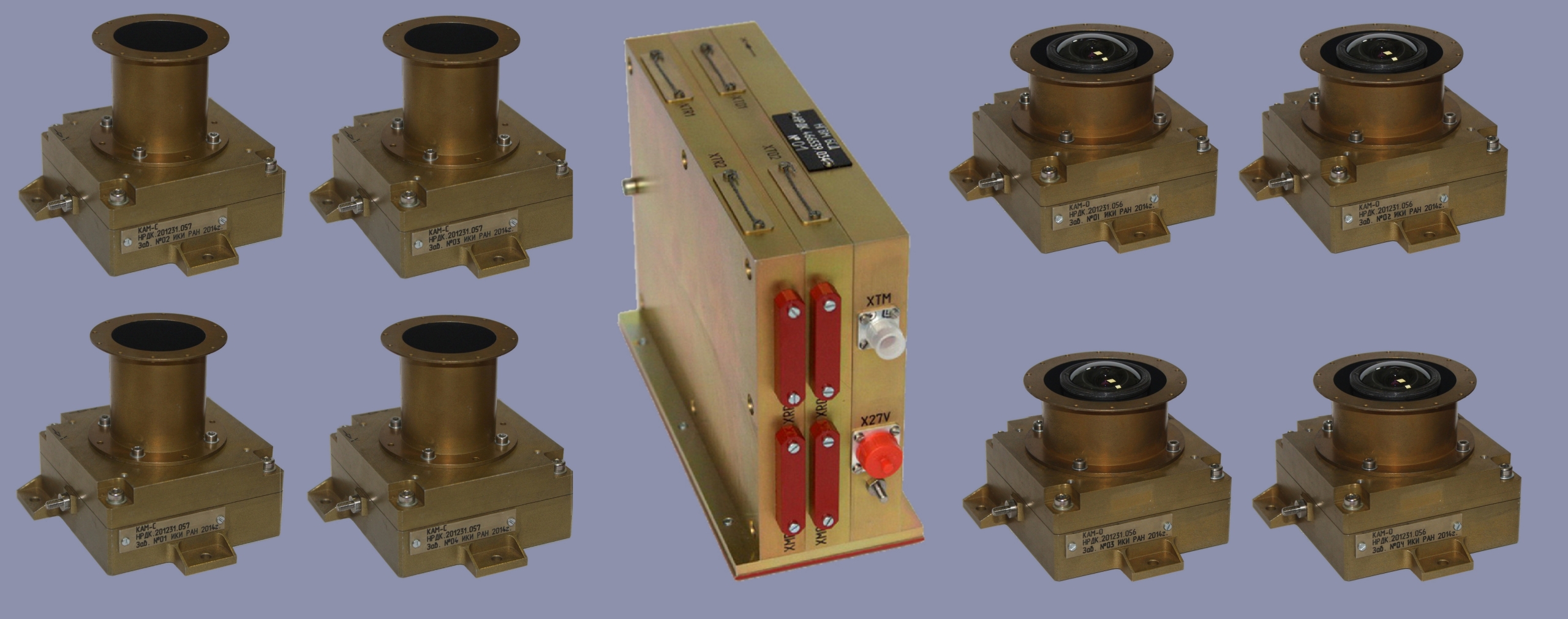
An image of the STS-L equipment carried by Russia’s Luna-25.
Image credit: IKI RAS
Data comparison
“The STS-L image shows how different the bottom and walls of the crater are,” explains an IKI posting on its website. “The bottom surface is rough, and the walls are smoother. As the participants of the Luna-25 project noticed immediately after receiving the image, the walls look in the image as if the camera was not in focus.”
Crater imagery was compared with data from the Lunar Orbiter Laser Altimeter (LOLA) on board NASA’s Lunar Reconnaissance Orbiter (LRO).
According to altimetry data, IKI researchers note, the difference between different parts of the surface is also noticeable, although not as pronounced as in the STS-L photograph.

Lunar crater Zeeman, combination of images obtained using the LOLA laser altimeter (LRO, NASA) and the STS-L equipment of the Luna-25 station (darker fragment in the center of the image). The blue background is a map of the mass fraction of water according to data from the Russian LEND neutron telescope on board LRO (NASA). The contours show areas of the surface that differ in geological characteristics.
Image credit: IKI RAS
LEND a hand
Researchers next superimposed on the image of the crater a map of the mass fraction of water in the ground according to data from the LRO-carried Lunar Exploration Neutron Detector (LEND) – also created by IKI RAS.
LEND gauges the neutron flux from the Moon’s surface, which varies depending on the concentration of hydrogen in the lunar soil.
“Since the main substance in the lunar soil containing hydrogen is water, the LEND data can be converted into the percentage of water ice in the soil at a depth of up to 1 meter,” explains the IKI posting, and the difference in water content in different areas of the surface of the Zeeman crater could be ascertained.
Research results
“The least amount of it is at the bottom of the crater – less than 0.1% by mass. And the ‘wettest’ areas are located in the vicinity of small, more ‘fresh’ impact craters formed on the walls of the main one. Here the proportion of water by mass is estimated to be up to 0.2%,” IKI researchers explain.
The Zeeman crater appraisal how revealed a difference in the properties of the surface, which, as it turned out during a detailed analysis, corresponds to a difference in the content of water frozen into the ground.
These results were presented at the 14th International Moscow Symposium on Solar System Research (IKI RAS, October 9–13, 2023) in a report by M. V. Dyachkova, A. B. Sanin, Ya. D. Elyashev, I. G. Mitrofanov , M. L. Litvak, I. V. Polyansky and A. E. Zubarev.

Onboard STS-L camera captured Luna-25 spacecraft emblem and the bucket of the probe’s lunar manipulator complex, visible (top left).
Image credit: IKI RAS
 Posted in Space News

