 By
By  July 28th, 2025
Image credit: Roscosmos
Russia is prepping for an August 20 launch of a biosatellite from the Baikonur Cosmodrome atop a Soyuz-2.1b rocket.
The craft is considered a “Noah’s Ark” of space, carrying 75 mice, more than 1,000 fruit flies, cell cultures, microorganisms and plant seeds.
The Bion-M No. 2 will reportedly be lofted into a nearly circular orbit at an inclination of roughly 97 degrees, a pole-to-pole orbit, remaining in space for 30 days.
That orbit will increase the level of cosmic radiation by at least an order of magnitude compared to that on the Bion-M No. 1 spacecraft launched back in April 2013, flying for 30 days.
Radiation data
According to the Institute of Medical and Biological Problems, Bion-M No. 2 is flying to obtain data, such as:
— Data on effects of microgravity on radiation susceptibility, therefore on radiation damageability of living beings in the environment of real deep space flight under exposure to increased doses of space radiation of wide spectrum
— general data applicable to development of adjusted requirements to the medical support of future space flights
— data on biological outcomes of space effects applicable to the general Earth medicine.
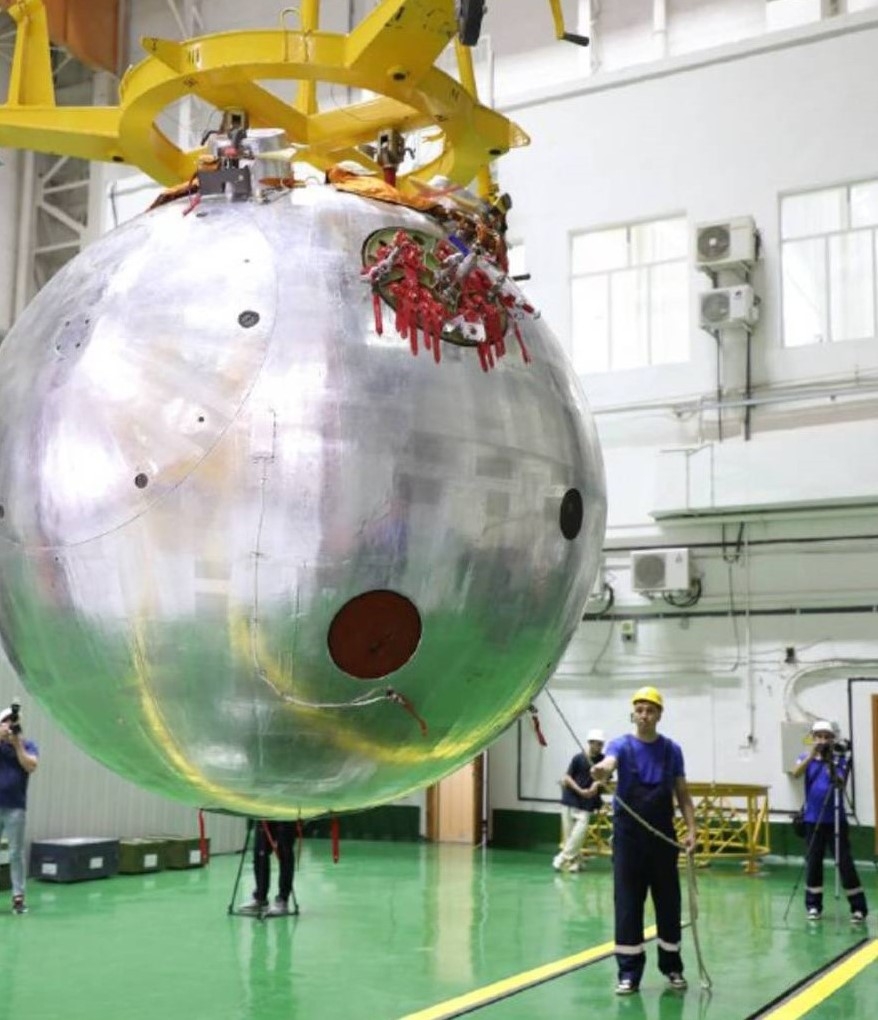
Technicians work on the Bion-M No. 2 mission.
Image credit: Roscosmos
Moon simulants
Also onboard is a payload tied to future exploration of the Moon.
The Vernadsky Institute of Geochemistry and Analytical Chemistry teamed with the Institute of Medical and Biological Problems to produce a container holding 16 test tubes. The vials hold lunar simulants – dust and rocks — that mimic Moon topside materials found at high latitudes of the Moon.
To be exposed in radiation and vacuum for a month, the lunar simulants will be appraised after return to Earth as to their behavior in space, providing insight into Moon construction ideas.

Bion-M No. 1’s return to Earth.
Image credit: Institute of Medical and Biological Problems
 Posted in Space News

