 By
By  March 3rd, 2015
On February 14, 2015, the Optical, Spectroscopic, and Infrared Remote Imaging System (OSIRIS) on the Rosetta spacecraft observed the surface of comet 67P Churyumov-Gerasimenko in the Imhotep region with the Sun directly behind it from an altitude of six kilometers.The image resolution is 11 centimeters per pixel. The orbiter’s shadow is visible as a dark rectangular patch in the lower part of the image.
Credit: ESA/Rosetta/MPS for OSIRIS Team MPS/UPD/LAM/IAA/SSO/INTA/UPM/DASP/IDA
Close-up images of comet 67P Churyumov-Gerasimenko have been taken by the Optical, Spectroscopic and Infrared Remote Imaging System (OSIRIS) on the Rosetta spacecraft during a recent overflight.
Rosetta is a European Space Agency (ESA) mission with contributions from its member states and NASA.
Recent images show the comet’s terrain – abruptly terraced steps separating flat ground from fissured areas.
Scientists have given this region, which is situated not far from the equator of the larger part of the comet nucleus, the name Imhotep.
Philae landing site, still unknown
According to the DLR, Imhotep is on the opposite side to Philae’s landing site, which means the scientists were denied the possibility of discovering the landing craft’s location during this overflight.
Rosetta’s Philae lander that touched down on the comet is funded by a consortium headed by the German Aerospace Center (Deutsches Zentrum fuer Luft- und Raumfahrt; DLR), the Max Planck Institute for Solar System Research (MPS), CNES and the Italian Space Agency (ASI).
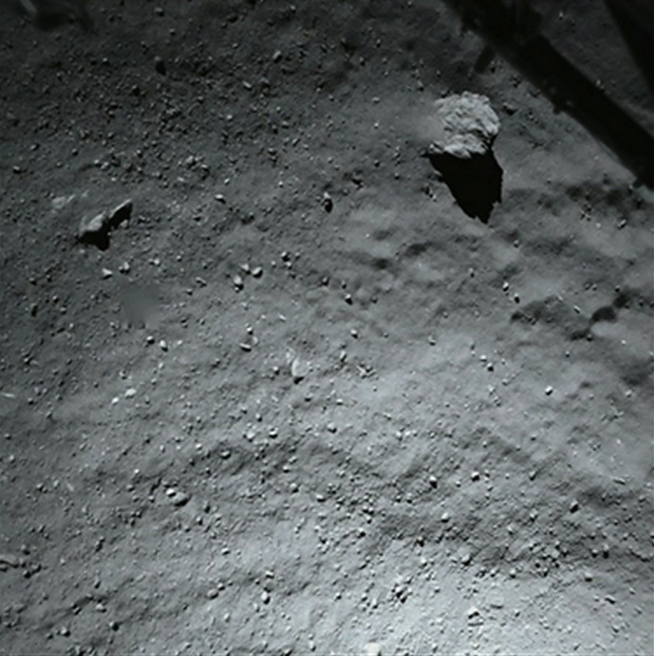
This image was acquired by the Rosetta Lander Imaging System (ROLIS) on board the Philae Lander from a height of approximately 40 meters, before the first touchdown. The resolution is four centimeters per pixel.
Credit: SA/Rosetta/Philae/ROLIS/DLR
So far, only the Rosetta Lander Imaging System (ROLIS), installed on the bottom of the Philae lander, has been able to acquire higher resolution photographs of the comet’s surface as it descended towards 67P Churyumov-Gerasimenko.Scientists are currently analyzing photographs of the comet’s surface, which were taken immediately after landing using artificial light.
It is hoped that these images will provide definitive information on the celestial body’s fine structure. Preliminary results are expected in April 2015, according to the DLR.
 Posted in Space News

