 By
By  August 15th, 2016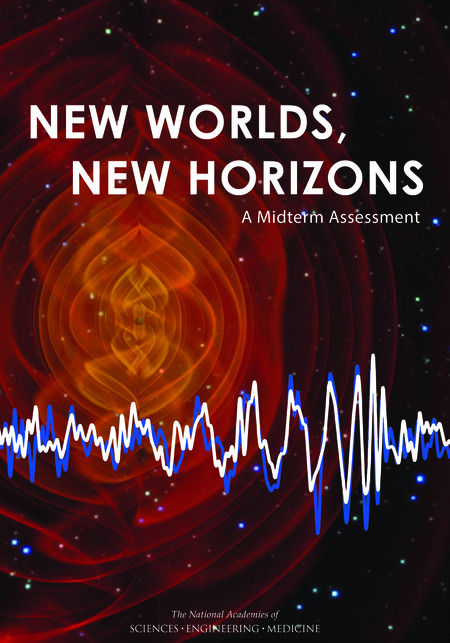
Credit: NAS
A just issued report has focused a critical eye on the suite of large-, medium-, and small-scale astronomy and astrophysics programs, including NASA’s Wide Field Infrared Survey Telescope (WFIRST) and the NSF/DOE’s Large Synoptic Survey Telescope (LSST).
The new report — New Worlds, New Horizons: A Midterm Assessment — gives advice on midcourse corrections to the funding agencies involved in a bevy of ground and space-based tools.
As a bottom line, the report explains that many goals outlined in an earlier decadal survey in astronomy and astrophysics have been met…but others are delayed by “unforeseen constraints.”
The report comes from a blue ribbon committee of experts pulled together under the National Academies of Sciences, Engineering, and Medicine and calls for NASA, National Science Foundation (NSF), and the U.S. Department of Energy (DOE) – the federal agencies largely responsible for funding and implementing these research activities – to maintain, and in some cases adjust, their programs in order to meet the survey’s scientific objectives.
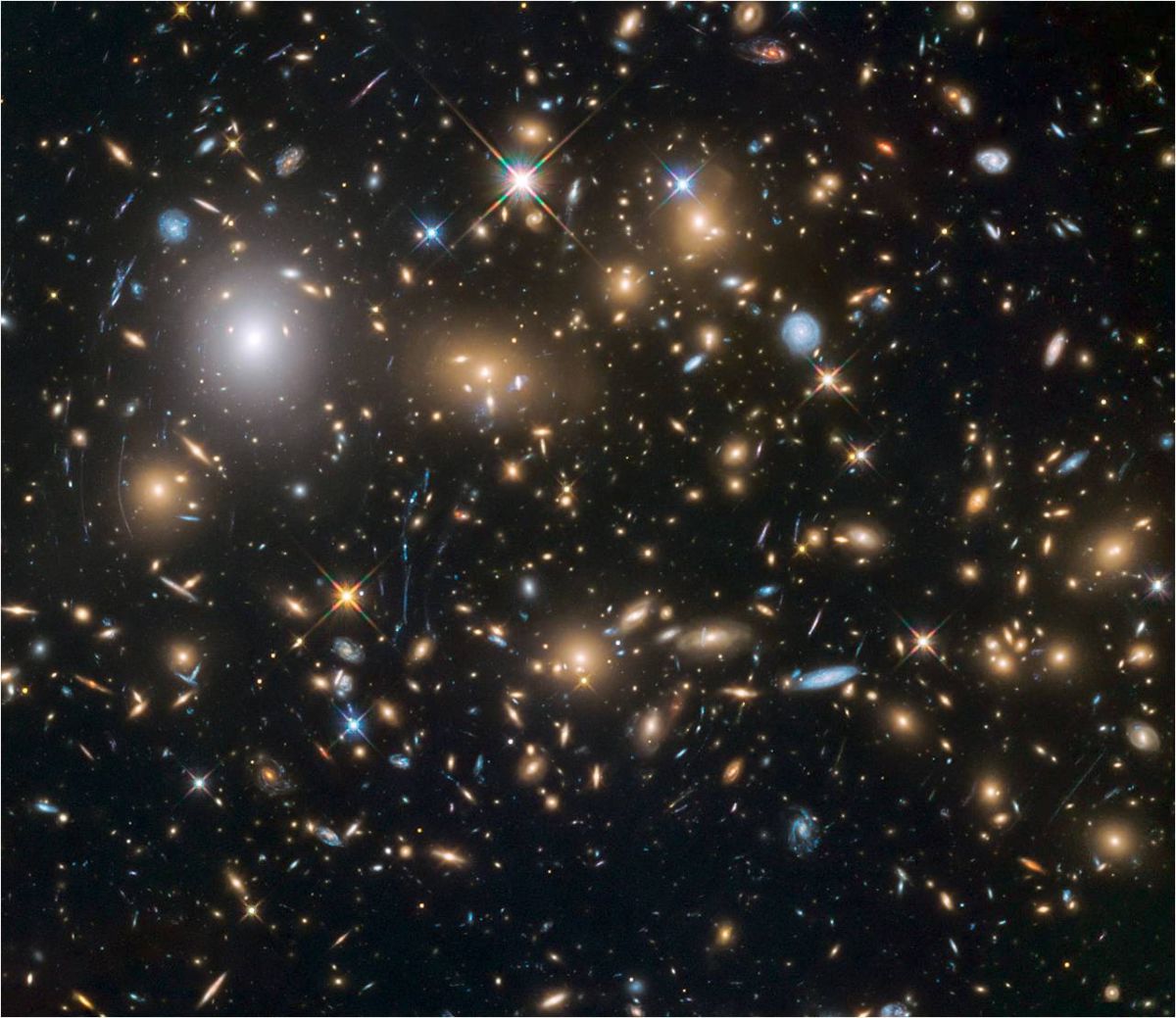
Hubble Frontier Fields image of the galaxy cluster MACS J07175+3745. Faint blue arcs are distant galaxies that have been magnified and distorted by the light-bending gravity of the massive cluster in front of them. The six clusters observed to unprecedented depth by the Frontier Fields program serve as natural gravitational telescopes, allowing Hubble to discover galaxies back into the first half billion years of cosmic history.
Credit: NASA, ESA and the HST Frontier Fields team (STScI).
Major accomplishments
As noted in a National Academies of Sciences press statement, some of the recent major scientific accomplishments that the report highlights are:
- The first detection of gravitational waves by the NSF-funded Laser Interferometer Gravitational-Wave Observatory (LIGO)
- The NASA-funded Kepler satellite’s extraordinary discovery of diverse planets and planetary systems that indicate the possibility of more than a billion Earth-like planets among the exoplanets that are present around stars throughout the galaxy
- Success of the Atacama Large Millimeter Array (ALMA) – a huge array of radio telescopes in the Atacama desert of Chile, recommended by the 2000 decadal survey and built by NSF and a consortium of international partners.
WFIRST – dark energy
Spotlighted in the report is a look at NASA’s Wide Field Infrared Survey Telescope (WFIRST), designed to answer questions about dark energy, exoplanets, and general astrophysics.
The WFIRST scope and design have evolved to include a 2.4-meter telescope, larger infrared detectors, and an instrument called a coronagraph that enables directly imaging an exoplanet by blocking the light emitted by its parent star.
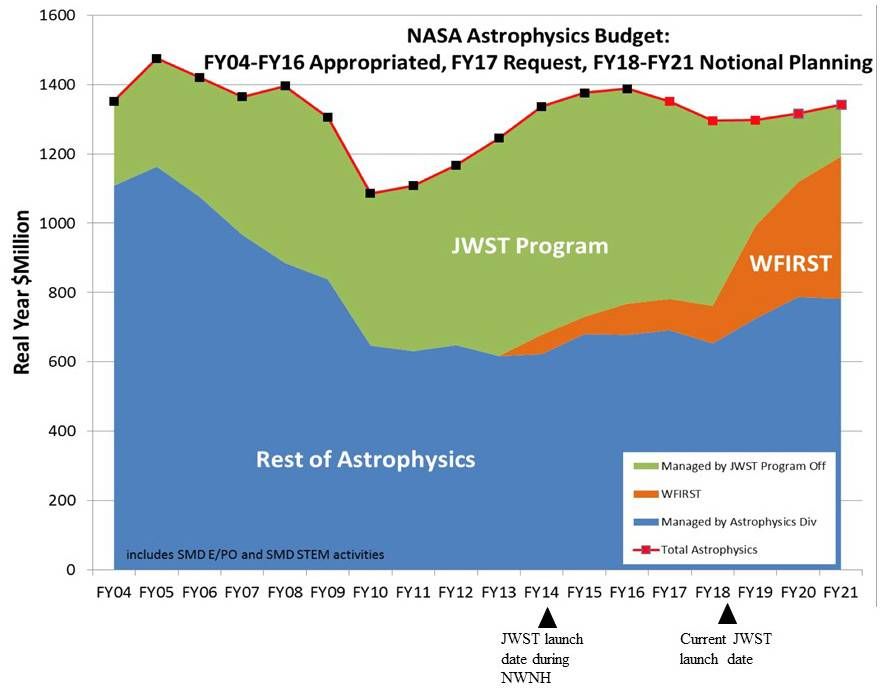
NASA-Astrophysics Division Program (APD) budget from FY2004 to FY2021. Squares on the upper boundary mark the sum of the James Webb Space Telescope (JWST) budget and the NASA-APD budget, with values for FY2017 and FY2018-FY2021 representing the administration request and the notional out-year planning budget, respectively.
Credit: Figure adapted from a presentation by P. Hertz, NASA/Data from NASA
JWST – driving factor
These WFIRST changes, while scientifically compelling, could result in further increased costs and further delays for the mission, the committee said.
A committee recommendation is that prior to final confirmation of the WFIRST changes, NASA conduct an independent review of the project to ensure it does not crowd out investment in the rest of NASA’s astrophysics portfolio and, if necessary, de-scope the mission.
The report also finds that the driving factor in the delay or non-pursuit of some new NASA initiatives, including WFIRST, was the schedule change and increased cost associated with the James Webb Space Telescope (JWST) – a successor to the Hubble Space Telescope that is set to launch in 2018.
Report PDF
The study was sponsored by NASA, the National Science Foundation, and the U.S. Department of Energy.
To focus in on the report and read a free PDF of its conclusions and recommendations, go to:
http://www.nap.edu/catalog/23560/new-worlds-new-horizons-a-midterm-assessment
 Posted in Space News

