 By
By  July 13th, 2022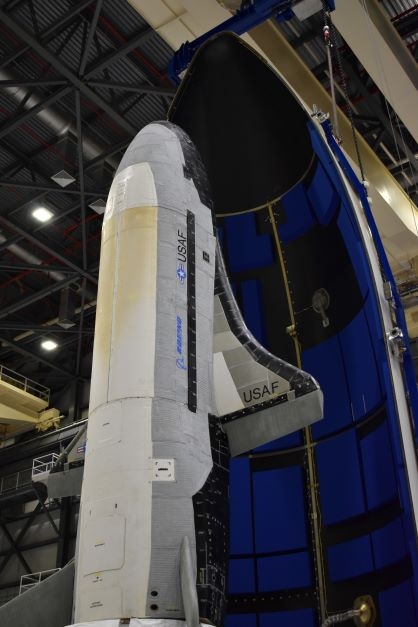
Encapsulated X-37B Orbital Test Vehicle for United States Space Force-7 mission.
Credit: Boeing
The still orbiting X-37B space drone broke the program’s on-orbit record for long duration flight on 6 July at 5:49:08 ZULU, according to a Pentagon statement.
This U.S. Space Force robotic craft zipped by the last milestone-making flight of the program: 780 days on orbit.
Not a word on how long this current 6th mission — X-37B Orbital Test Vehicle (OTV-6) – will remain in orbit. It was launched on May 17, 2020 from Cape Canaveral Air Force Station, Florida.

Encapsulated X-37B Orbital Test Vehicle for United States Space Force-7 mission.
Credit: Boeing
“The X-37B team continues to exemplify the kind of lean, agile and forward-leaning technology development we need as a nation in the space domain,” said U.S. Space Force Chief of Space Operations, Gen. John “Jay” Raymond.
“Each launch represents a significant milestone and advancement in terms of how we build, test, and deploy space capabilities in a rapid and responsive manner, Raymond said in saluting the OTV-6 launch.
Service module
This mission underway is the first X-37B vehicle to use a service module to host experiments. The service module is an attachment to the aft of the vehicle that allows additional experimental payload capability to be carried to orbit.

Coin and patch of the same design might be showing the X-37B “service module.”
Courtesy: Mike Rose
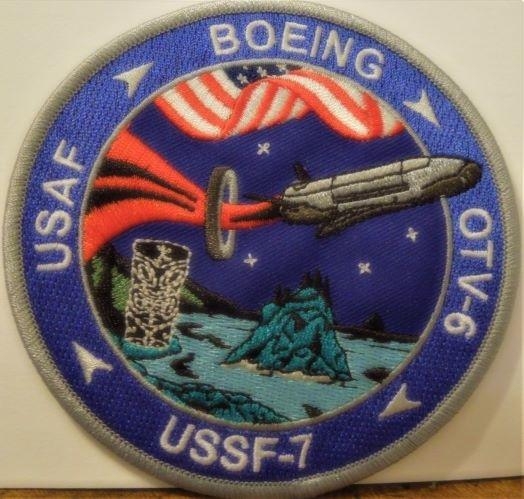
Coin and patch of the same design might be showing the X-37B “service module.”
Courtesy: Mike Rose
The mission deployed the FalconSat-8, a small satellite developed by the U.S. Air Force Academy and sponsored by the Air Force Research Laboratory to conduct several experiments on orbit.
In addition, two NASA experiments are onboard the space plane to study the results of radiation and other space effects on a materials sample plate and seeds used to grow food.
Also, a U.S. Naval Research Laboratory experiment is evaluating technology to transform solar power into radio frequency microwave energy.

X-37B (OTV-5) on the runway after landing at the Kennedy Space Center.
Credit: U.S. Air Force
Technologies being tested in the X-37B program include advanced guidance, navigation and control, thermal protection systems, avionics, high temperature structures and seals, conformal reusable insulation, lightweight electromechanical flight systems, advanced propulsion systems, advanced materials and autonomous orbital flight, reentry and landing.
Flight roster
Here’s a listing of previous flights of the space plane:
OTV-1: launched on April 22, 2010 and landed on December 3, 2010, spending over 224 days on orbit.
OTV-2: launched on March 5, 2011 and landed on June 16, 2012, spending over 468 days on orbit.
OTV-3: launched on December 11, 2012 and landed on October 17, 2014, spending over 674 days on-orbit.
OTV-4: launched on May 20, 2015 and landed on May 7, 2015, spending nearly 718 days on-orbit.
OTV-5: launched on September 7, 2017 and landed on October 27, 2019, spending nearly 780 days on-orbit.
As to when and where OTV-6 will return to a wheels-stopped landing is anybody’s guess.
OTV-1, OTV-2, and OTV-3 missions landed at Vandenberg Air Force Base, California, while the OTV-4 and OTV-5 missions landed at Kennedy Space Center, Florida.

Encapsulated X-37B Orbital Test Vehicle for United States Space Force-7 mission.
Credit: Boeing
 Posted in Space News

