 By
By  February 5th, 2025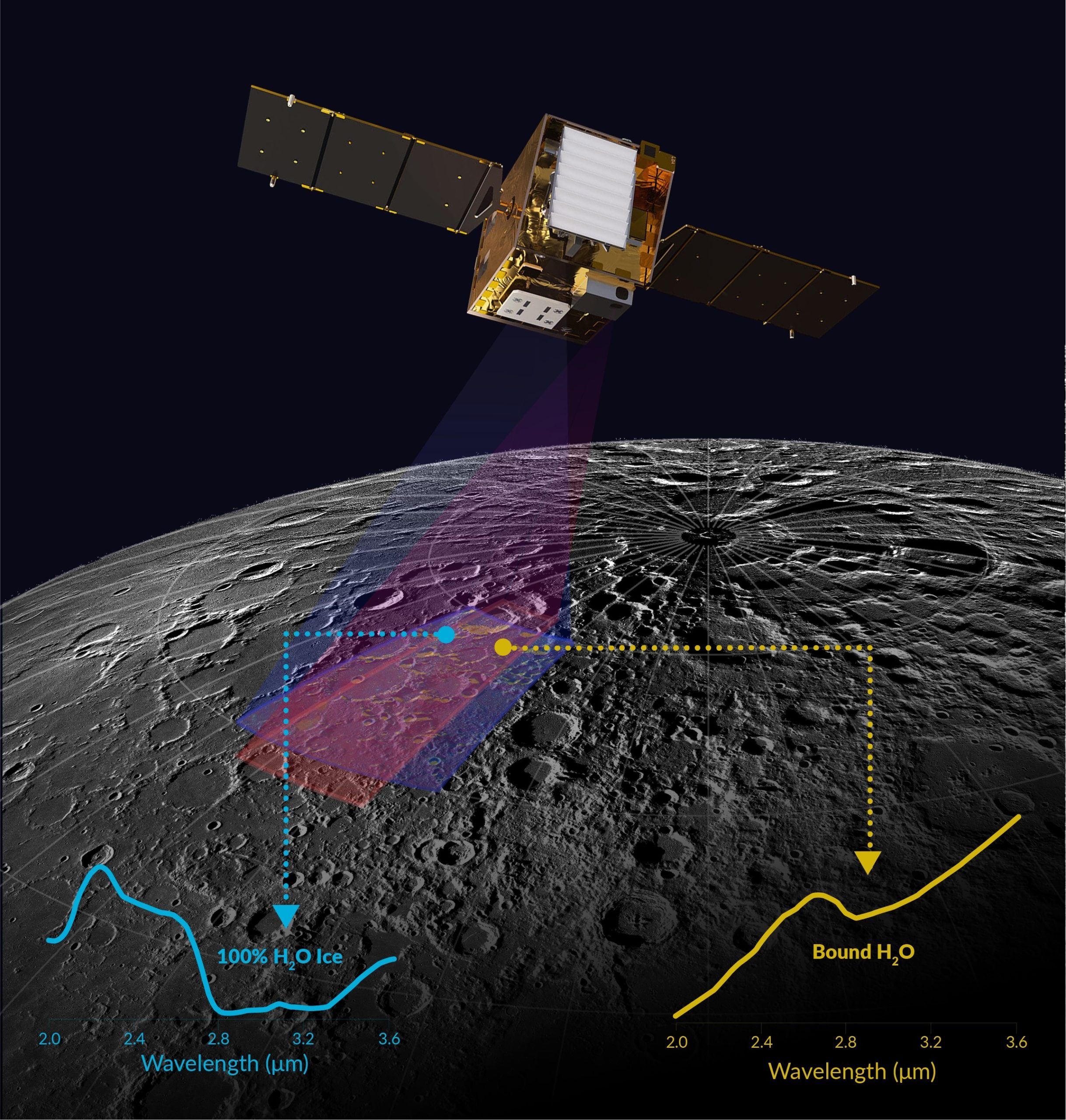
Science instruments onboard Lunar Trailblazer smallsat probe for lunar water.
Image credit: Jasper Miura, Lockheed Martin
LITTLETON, Colorado – A university-led lunar orbiter is nearing takeoff that will operate in patrol mode to detect signatures of ice in reflected light, pinpointing the locales of ice or water trapped in rock at the Moon’s surface.
The Lunar Trailblazer is now in Florida and slated to be stacked atop a SpaceX Falcon 9 launcher. It will be boosted in “rideshare” mode — likened to Uber/Lyft-pool transportation – along with the commercial Intuitive Machines-2 lunar lander named Athena.
Clean room preparation
Prior to its transport, I spent time here within a Lockheed Martin clean room where the probe was undergoing final grooming for shipping.

Leonard David, a dirty reporter in Lockheed Martin clean room gets up-close view of moonbound Lunar Trailblazer.
Image credit: Barbara David
Lunar Trailblazer utilizes the aerospace company’s new Curio platform – a novel and scalable deep space smallsat spacecraft architecture, designed for deep space exploration and probe scientific questions at less cost.
University/industry duties
Lunar Trailblazer is managed by NASA’s Jet Propulsion Laboratory and led by the California Institute of Technology (Caltech) in Pasadena, California. Bethany Ehlmann, professor of planetary science at Caltech is principal investigator for Lunar Trailblazer.
Lockheed Martin developed and built the roughly 440 pound (200 kilograms) spacecraft, as well as integrated the craft’s science instruments. The probe is outfitted with two deployable solar arrays.
For more information on this spacecraft and its duty to scout for water ice on the Moon, go to my new Space.com story – “SpaceX to launch water-hunting moon probe ‘Lunar Trailblazer’ on Feb. 26” – at:
 Posted in Space News

