 By
By  April 9th, 2017
Pluto nearly fills the frame in this image from the New Horizon’s Long Range Reconnaissance Imager (LORRI).
Credit: NASA/APL/SwRI
The NASA Innovative Advanced Concepts (NIAC) Program nurtures visionary ideas that could transform future NASA missions with the creation of breakthroughs.
Among a new slate of NIAC 2017 Phase I awards is a “Pluto Hop, Skip, and Jump” concept.
The idea has been proposed by Benjamin Goldman of Global Aerospace Corporation in Irwindale, California.
Low fuel load
According to Goldman, imagine a craft that could enter Pluto’s atmosphere and deliver a lander to the surface using aerodynamic drag and just a few kilograms of propellant.

Credits: Benjamin Goldman
Pluto’s surface pressure is just 10 millionths of Earth’s, but its atmosphere is about seven times higher than Earth’s and its volume is about 350 times the volume of Pluto itself.
Over a several hundred kilometer entry distance, this ultra-low ballistic coefficient craft can dissipate over 99.999% of its initial kinetic energy, resulting in a terminal velocity comparable to or less than past planetary landers or rovers.
With this architecture, the total propellant requirement for landing on Pluto is less than 8 pounds (3.5 kilograms).
Surface science
“After making science measurements at its initial landing site, the lander switches to “hopper” mode,” Goldman reports, “taking advantage of the low gravitational acceleration (0.063 gee) and a modest propellant store to literally hop, skip, and jump around the surface, sometimes kilometers at a time, investigating features of interest.”
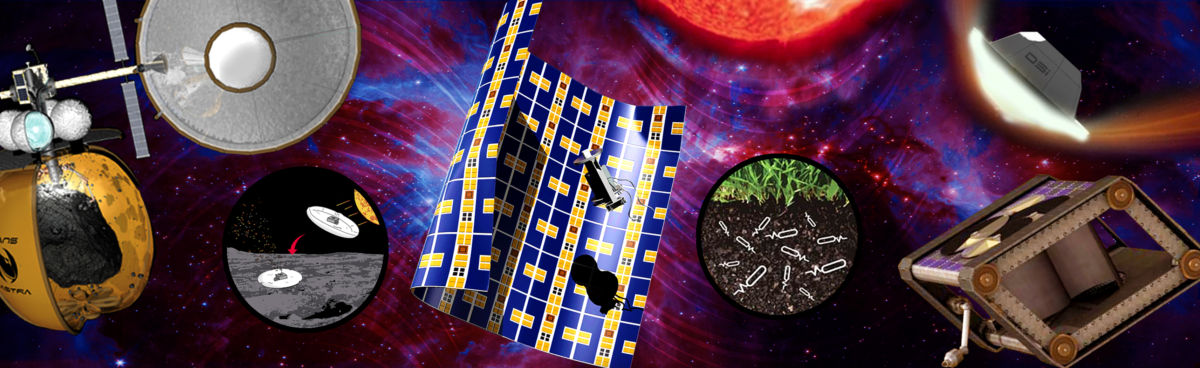
The NASA Innovative Advanced Concepts (NIAC) Program nurtures visionary ideas that could transform future NASA missions with the creation of breakthroughs.
Credit: NIAC
Goldman suggests that the proposed concept would enable on-the-spot surface science at Pluto with low overall mass, a reasonable cost, and in a timeframe of about 10-15 years.
Initial definition and analysis
Phase I awards are valued at approximately $125,000, for nine months, to support initial definition and analysis of their concepts. If these basic feasibility studies are successful, awardees can apply for Phase II awards.
For more information on NIAC’s just announced Phase 1 and Phase 2 awards, go to:
https://www.nasa.gov/press-release/nasa-invests-in-22-visionary-exploration-concepts
 Posted in Space News

