 By
By  February 4th, 2017
Wake-up call: The 2013 incoming space rock over Chelyabinsk, Russia.
Credit: Alex AlishevskikhNew work in planetary defense not only shows how hard it is to knock out an asteroid with Earth’s name on it…but also what happens if such an object hits our planet.New work in Planetary Defense not only shows how hard it is to knock out an asteroid with Earth’s name on it…but also what happens if such an object hits our planet.
New work in planetary defense not only shows how hard it is to knock out an asteroid with Earth’s name on it…but also what happens if such an object hits our planet.
Back in February 2013, an asteroid with a diameter of roughly 60 feet (18 meters) detonated over the Russian town of Chelyabinsk. That unexpected sky show caused ground injuries and material damage to buildings.
Looking over the leftovers, the Chelyabinsk meteorite was found to be a highly shocked, low porosity, ordinary chondrite, probably similar to S- or Q-type asteroids.

Global worry: Near-Earth Objects (NEOs).
Credit: Texas A&M
International project
Thanks to an international project, led by Spain’s National Research Council, (CSIC), a dedicated effort has focused on how an asteroid might be deflected so as not to collide with the Earth.
Recent research published in The Astrophysical Journal yields information about the local mechanical properties of the minerals forming this meteorite. Those tests are also useful to understand the potential to deflect threatening asteroids using a kinetic projectile.
“Studying the chemical and mineralogical composition of the Chelyabinsk meteorite allows us to grasp the importance of the collision compaction processes that asteroids suffer as they near the Earth,” says CSIC researcher Josep Trigo-Rodríguez of the Institute of Space Sciences in Barcelona, Spain.
“The results of this work are extremely relevant for a possible mission in which we want to efficiently deflect an asteroid which is close to Earth,” Rodriguez adds.
Component materials
Ordinary chondrites, say CSIC researchers, represent the most potentially dangerous asteroids in terms of component materials. Potentially hazardous asteroids that threaten the Earth suffer many collisions before reaching our planet; therefore, their consistency increases and their minerals appear battered.
CSIC experiments used an instrument known as a nanoindentor – a small piston tipped with a diamond head that applies a predefined pressure on the material and generates small notches in it, while measuring both the depth achieved and the material’s elastic recovery time.
Numbers of studies have prompted planetary defense concepts.
Credit: NRC
Those tests made it possible to determine key parameters such as fracture strength, hardness, elastic recovery time of the targeted material. All these could be determinants for the success of a kinetic projectile trying to adjust an asteroid’s orbit from an impending smack-down with Earth.
The CSIC work is reported in “Nanoindenting the Chelyabinsk meteorite to learn about impact effects in asteroids,” The Astrophysical Journal (2017) (DOI:10.3847/1538-4357/835/2/157).
Go to:
https://arxiv.org/abs/1612.07131
Also, go to: Assessment and Mitigation of Asteroid Impact Hazards: Proceedings of the 2015 Barcelona Asteroid Day by Trigo-Rodriguez, Josep Maria, Gritsevich, Maria, Palme, Herbert (Eds.)
This volume outlines the latest advances in asteroid research, particularly on the potential impact hazards.
Go to:
http://www.springer.com/gp/book/9783319461786
Splash down!
Meanwhile, scientists from Los Alamos National Laboratory (LANL) and the University of Texas, Austin have been using high performance computing to investigate how an asteroid’s kinetic energy is transferred to the atmosphere and Earth’s ocean.
Given that Earth is largely covered by water, an asteroid splashing down in one of Earth’s oceans could inject billions of tons of water into the atmosphere. But the risk of a catastrophic tsunami is reportedly relatively small.
LANL won the Best Visualizaiton and Data Analytics Showcase award at Supercomputing 2016 for their video detailing the science and high performance computing behind the study of asteroid impacts in the ocean.

NASA’s Lindley Johnson is head of NASA’s Planetary Defense Coordination Office.
Credit: Leonard David
These studies help scientists understand the consequences of asteroid impacts and assist NASA’s Office of Planetary Defense in deciding how to deal with potentially threatening near-Earth objects (NEOs).
Megatons of water
LANL’s visualizations show varying factors, especially the differences in airburst events on the transfer of energy from the asteroid to the water.
They report, in some simulations, this resulted in lofting as much as 250 metric megatons of water into the atmosphere. “Because water vapor is a potent greenhouse gas, this may have a significant impact on climate.”
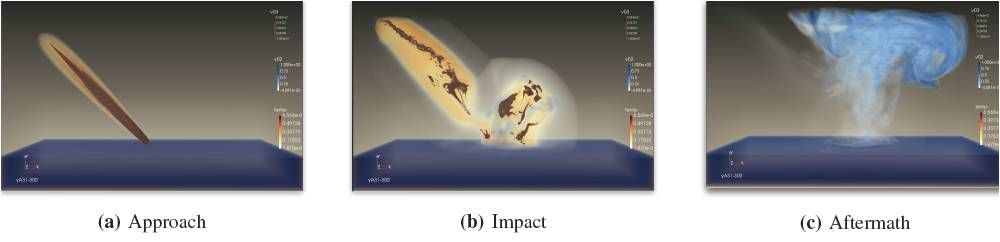
A 250 meter wide asteroid impacting deep water at 45deg with no airburst. High concentrations of asteroid are shown in reddish tones while water is indicated in blue and temperature in yellow.
Credit: LANL
Furthermore, a surprisingly significant factor is the elevation at which the asteroid explodes.
Some asteroids explode on impact with the water. Others airburst and explode prior to entering the water.
Pressure pulse
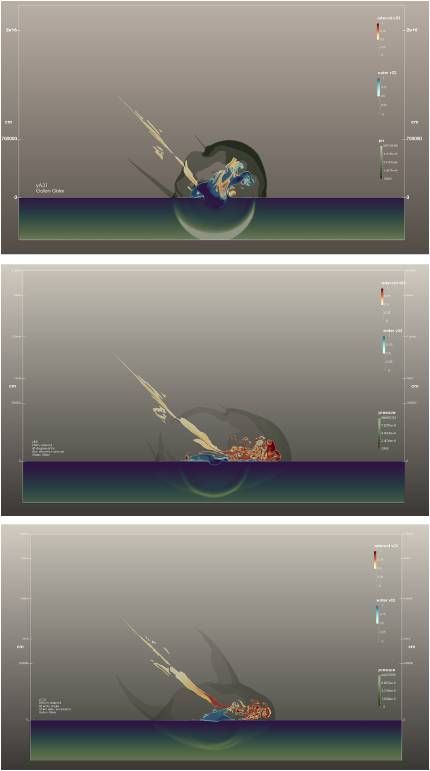
Visualization showing asteroid material (reddish),
water (blue and green), and pressure wave (transparent circle)
for three different simulations in which the height of the
airburst was varied.
Credit: Galen Gisler/LANL
The pressure pulse generated by the airburst propagates in all directions from the source of the explosion. The momentum of the asteroid enhances its downward — generally oblique –impulse, spreading it over a wide area.
In an airburst, pressure pulse is transmitted to the surface of the water by the incoming projectile’s momentum. It is spread over a larger area and displaces less water, so the wave is more coherent as it moves through the water. This produces a wave that travels further.
A surface water explosion causes colliding energy, canceling out the impact on the wave propagation
For their work on this project, Los Alamos’ Data Science at Scale Team won the Best Visualization and Data Analytics Showcase award at Supercomputing 2016 for their video “Visualization and Analysis of Threats from Asteroid Ocean Impacts.”
This is the second consecutive year that Los Alamos’ Data Science at Scale Team has won this award.
Watch the award winning 2016 video here at:
 Posted in Space News

