 By
By  May 4th, 2022
Credit: Ken Farley
NASA’s Perseverance rover that is exploring Jezero Crater may unload its first cache of collected samples, perhaps near year’s end.
That prospect was highlighted during this week’s Mars Exploration Program Analysis Group (MEPAG) Meeting #39 being held in Denver, Colorado.
Ken Farley of Caltech and the Mars 2020 Project Scientist said the Jezero cache should contain roughly 12 of Perseverance’s 43 sample tubes, allowing roughly 31 to be available for a second cache/handoff later in the rover’s mission.

Credit: NASA/JPL-Caltech
Mars sample return
“Putting the cache down on the Three Forks Landing Strip makes a lot of sense,” Farley told Inside Outer Space. “The combination of extremely benign terrain and the fact that Perseverance does not need a long divert to implement it make it desirable from both engineering and science perspectives.”

Credit: Ken Farley
When deployed, this first Jezero cache of samples will provide a target for the Mars Sample Return mission should Perseverance fail prematurely, Farley said.
The Mars Sample Return (MSR) mission needs Perseverance to document landing and cache depot sites, thereby ensuring acceptability of the site. The robot’s survey will provide detailed data for sample pickup planning – a reconnoitering task that may require several months of the mission’s time, Farley said.

Credit: Ken Farley
The MSR project will make use of two individual landers – one each for a Fetch Rover and another for the Mars Ascent Vehicle that will be loaded with samples.
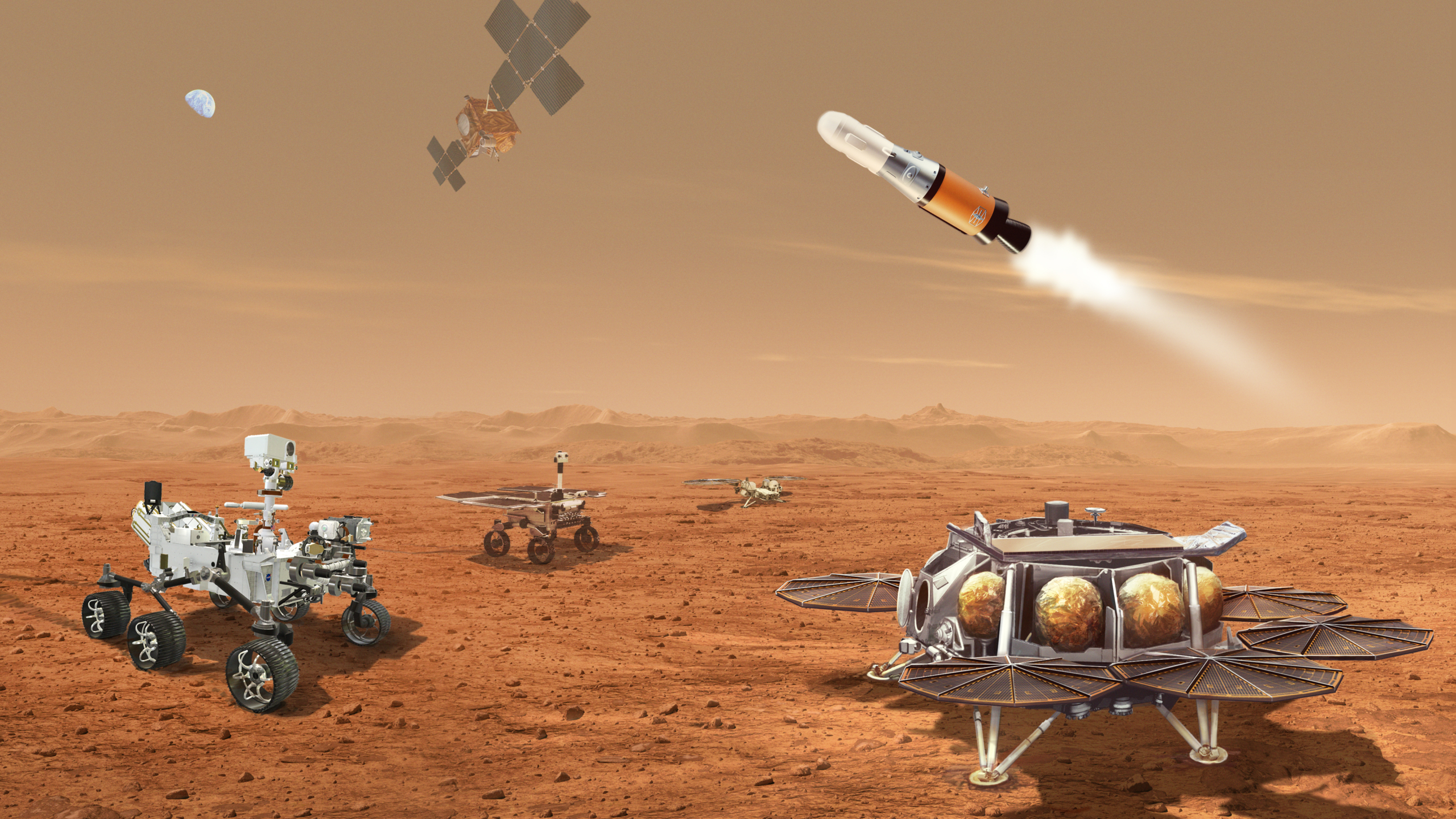
This illustration shows a concept for multiple robots that would team up to ferry to Earth samples in the 2030’s collected from the Mars surface by NASA’s Mars Perseverance rover.
Credit: NASA/JPL-Caltech
MSR is being orchestrated by NASA and the European Space Agency. The sets of geologic and atmospheric samples gathered by Perseverance are to be transported to Earth.
Intriguing ridgeline

NASA’s Ingenuity Mars Helicopter recently surveyed a ridgeline near the ancient river delta in Mars’ Jezero Crater at request of the Perseverance rover’s science team.
Credit: NASA/JPL-Caltech
Perseverance officially began the “Delta Front Campaign” on April 18th. Each campaign represents a sub-portion of the Mars 2020 mission and is dedicated to exploring a distinct region, drilling designated sets of cores for possible future return to Earth, and taking numerous in situ science observations with onboard instruments to study the environmental and geologic features that characterize that region.
Meanwhile, NASA’s Ingenuity Mars Helicopter recently surveyed an intriguing ridgeline near the ancient river delta in Jezero Crater. Imagery of that feature was captured on April 23, during the helicopter’s 27th flight. The photos were taken at the request of the Perseverance Mars rover science team, which wanted a closer look at the sloping outcrop.
 Posted in Space News

