 By
By  March 8th, 2021
Credit: ISS/NASA
Earth’s Moon hangs there like a celestial nightlight. We have an enduring relationship with this object. But trying to shed daylight on its origins…we remain in the “dark ages.”
Where did our Moon come from? That child-like question would appear simple to answer. But today those are six words that engender debate, scads of peer-reviewed geological papers, and downright tumult in scientific circles.

Credit: NASA
As multiple nations are now engaged in a new round of robotic lunar exploration –with boots to follow – extracting the truth from the Moon about its beginnings is true CSI – Celestial Science Investigation.
A new research paper spotlights the complexities of making out a model for the origin of Earth’s Moon.
Decades of research
Prepared for the forthcoming volume of New Views of the Moon II, a research paper led by Robin Canup of the Planetary Sciences Directorate at Southwest Research Institute in Boulder, Colorado, clarifies the challenges ahead.
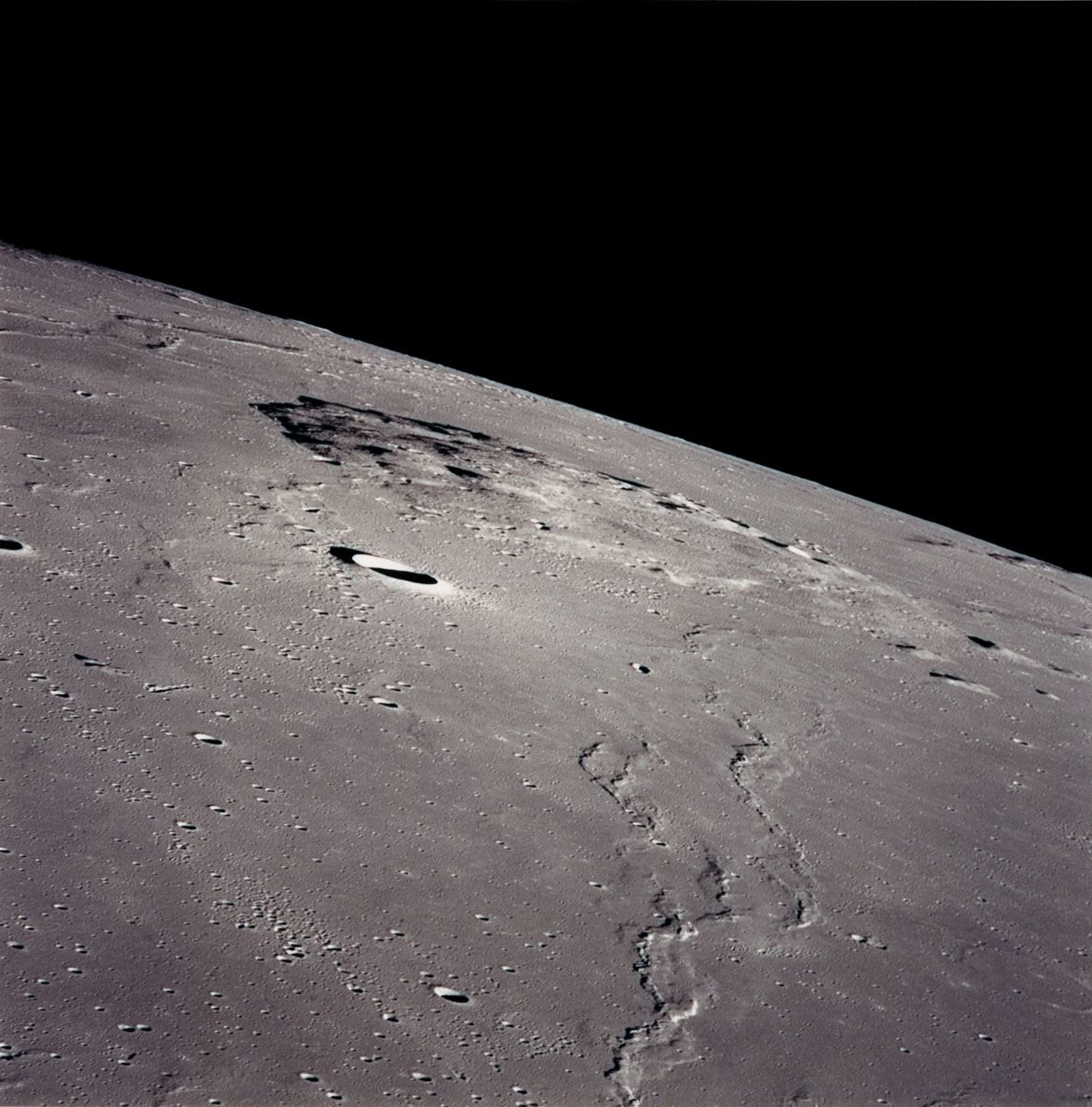
Apollo 15 image of the Mons Rümker region in the northern part of Oceanus Procellarum.
Credit: NASA
First of all, the Earth-Moon system is odd in several respects, Canup and colleagues make clear. The Moon is roughly one-fourth the radius of the Earth. That’s a larger satellite-to-planet size ratio than all known satellites – other than Pluto’s Charon.
Our Moon has a tiny core, perhaps just one-percent of its mass compared to Earth whose core contains nearly 30 percent of its mass.
The Earth-Moon system has a high total angular momentum, implying a speedily spinning Earth when the Moon formed. In addition, the early Moon was hot and at least partially molten with a deep magma ocean.
“Identification of a model for lunar origin that can satisfactorily explain all of these features has been the focus of decades of research,” the research paper notes.

Early Earth and Moon, perhaps created in a different manner than has previously been thought?
Credit: NASA
Impact origin
The lunar research group explains that decades of modeling have shown that large impacts are efficient producers of moons. However, the paper puts forward that the overall likelihood of explaining the particular characteristics of our Earth-Moon system “may be small, even given innovative and diverse impact models.”
Impact origin studies share a common goal, the paper adds, to identify collisional scenarios that can account for the properties of the Earth-Moon system.
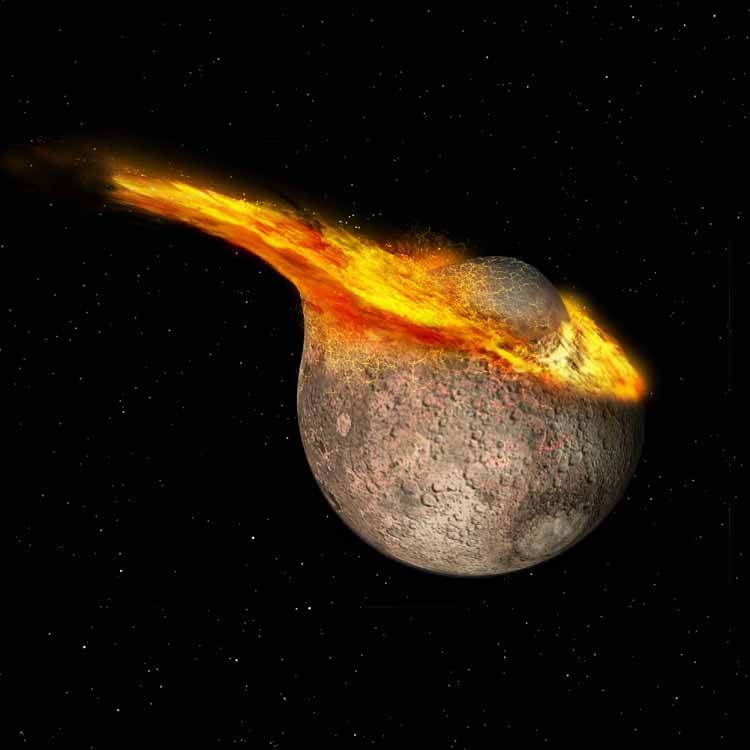
A variety of scenarios for a Moon-forming impact are detailed in the paper. How about a roughly Mars-mass impactor that collides with Earth at a low velocity? Perhaps there was a “hit-and-run” impact? What about fender-bender simulations that advocate our planet was on the receiving end of multiple planetary-scale impacts during its final accretion?
Credit: NASA
Perhaps the Moon did not form by impact, the research team puts forward. That prospect, however, seems very difficult to explain basic characteristics, for one, the Moon’s lack of iron.
“The famous principle of Occam asserts that the simplest explanation for an observation is preferred, or alternatively, that ‘more things should not be used than are necessary,’” the paper points out.
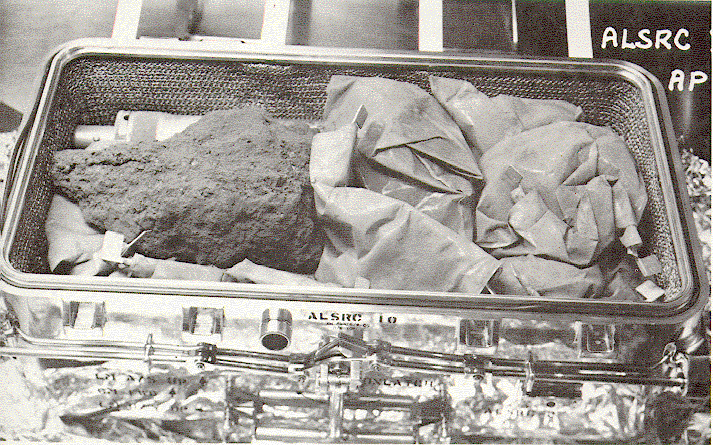
One of the Apollo 16 sample boxes being opened in the Lunar Receiving Laboratory on Earth. The box contains a large rock and many small sample bags.
Credit: NASA/Johnson Space Center
Spirit of Sherlock Holmes
Future work may well rule out many of the models pondered, Canup and her colleagues write. If that’s the case, and in the spirit of Sherlock Holmes, whatever is left, however improbable, will be the solution?
“Perhaps a process that at this time appears constraining may later be understood to be probable. Or perhaps there is a more probable solution that eludes us still,” they add.
Whatever outcome from the detective trail, thanks to the Moon’s accessibility, facts of its detailed composition and physical properties will likely always exceed that of the other planets in the inner Solar System, the researchers conclude.

Moon base design.
Credit: ESA/P. Carril
High precision chemical and isotopic analyses of Moon samples brought back to Earth “have shaken the foundations of the paradigm of lunar formation by a giant impact,” the researchers conclude. “However, a multitude of new concepts have emerged whose details and implications still need to be evaluated. This, together with increasing prospects for further lunar exploration in the near-term, makes this a truly exciting time for lunar origin science.”
To read the entire “Origin of the Moon” research paper by Canup, Kevin Righter, Nicolas Dauphas, Kaveh Pahlevan, Matija Ćuk, Simon Lock, Sarah Stewart, Julien Salmon, Raluca Rufu, Miki Nakajima, and Tomáš Magna, go to:
https://arxiv.org/ftp/arxiv/papers/2103/2103.02045.pdf
Special thanks to Jatan Mehta and his “Moon Monday” newsletter for flagging this new research paper. Moon Monday is available at:
https://moonmonday.jatan.space
 Posted in Space News

