 By
By  April 21st, 2017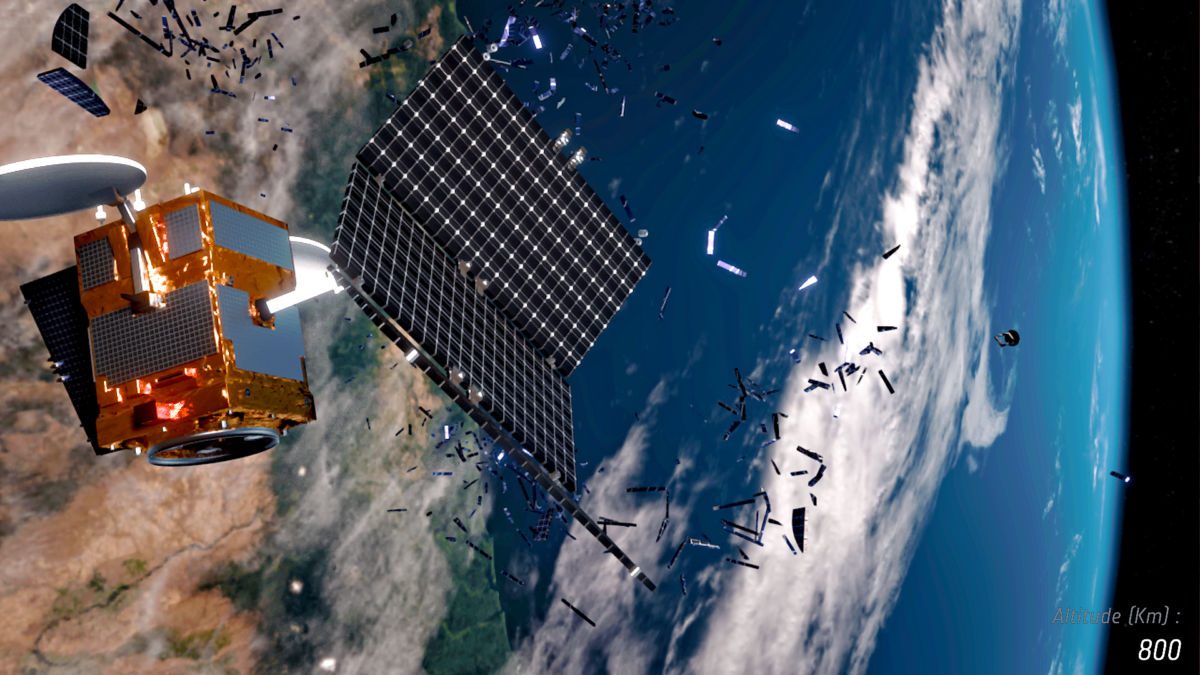
As of April 2017, more than 290 break-ups in orbit have been recorded since 1961. Most were explosions of satellites and upper stages – fewer than 10 involved accidental and intentional collisions.
Credit: ESA/ID&Sense/ONiRiXEL, CC BY-SA 3.0 IGO
A volley of worrisome messages came from the week-long 7th European Conference on Space Debris held this week at the European Space Agency’s (ESA) mission control centre in Darmstadt, Germany.
According to an ESA statement that focused on findings from the meeting, the take-away message:
“Despite progress in technology, and in understanding the space environment, the need for significantly increasing the pace in applying proposed measures to reduce debris creation has been identified.”
Urgent threat
The scientific gathering in Darmstadt was dedicated to space debris with participants from governments, space organizations, academia and industry sharing information and the latest research into the debris threat and on new technologies aimed at mitigating debris creation and reducing the orbital debris population.

At the 7th European Conference on Space Debris, the world’s largest scientific gathering dedicated to the topic, over 350 participants from governments, space organizations, academia and industry shared information and the latest research into the debris threat and on new technologies aimed at mitigating debris creation and reducing the orbital debris population.
Credit: ESA/J. Mai
“There was wide agreement that the continuing growth in space debris poses an urgent threat to economically and scientifically vital orbital regions,” according to the ESA overview.
Key observations
As this year’s meeting drew to a close, key observations include:
- The prospect of large constellations of several hundreds of satellites in critical orbital regimes has been identified as a potential additional challenge.
- There is a consensus that debris mitigation strategies defined long ago are important today as never before.
- Implementation of orbital debris countermeasures is still a challenge, and this has the utmost importance in view of plans to deploy constellations of hundreds of satellites in space.
- Active removal of objects is now necessary to reverse the debris increase, and researchers have seen evidence that the environment in some orbital regions has already reached a critical state.
- There is evidence that fewer than half of the satellites that should be deorbited at end of life are actually commanded to do so. There is no enforceable international regime to ensure this.
- Applicable technologies to approach, capture and safely deorbit a large and massive target object are being studied. These range from sensors for the inspection of defunct space objects and their dynamics, capture technologies including nets, robotic arms and harpoons, up to system aspects of a removal mission.
- Work is progressing on ESA’s e.Deorbit, a demonstration mission for the removal of a large ESA-owned target object. This effort has now reached a high maturity level of preparation.
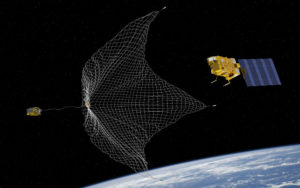
One capture concept being explored through ESA’s e.Deorbit system study for Active Debris Removal – capturing the satellite in a net attached to a tether.
Credit: ESA–David Ducros, 2016

Numbers game
According to ESA, since 1957, more than 5,250 space launches have led to an on-orbit population today of more than 23, 000 tracked debris objects.
Only about 1,200 are functional spacecraft. The remaining are classified as space debris and no longer serve any useful purpose.
A large percentage of the routinely tracked objects are fragments from the approximately 290 breakups, explosions and collisions of satellites or rocket bodies that are known to have occurred.
An estimated 750,000 objects larger than 1 centimeter and a staggering 166 million objects larger than 1 millimeter are thought to reside in commercially and scientifically valuable Earth orbits.
“It’s the classic ‘tragedy of the commons’…except it’s happening in space and could ruin modern technological society for everyone,” said Holger Krag, Head of ESA’s Space Debris Office and conference chair.
 Posted in Space News

