 By
By  May 1st, 2023
Image credit: ABS
The American Bureau of Shipping (ABS) has published the first international requirements for the design and construction of offshore spaceports, announcing those publicized requisites during an Offshore Technology Conference in Houston, Texas.
ABS provides classification and technical advisory services to the marine and offshore industries.
“The offshore space industry is growing rapidly, and ABS is already a pioneer in the field of offshore space support with our industry-leading work on autonomous rocket recovery droneships,” said Miguel Hernandez, ABS Senior Vice President, Global Offshore.
This new publication allows ABS, Hernandez adds, “to provide clear support for organizations that are engaging with regulatory agencies to reactivate assets such as offshore support vessels, barges and liftboats to support space flight.”
Offshore assets
ABS produced a new set of requirements based on service experience with industry leading aerospace rocket launch and recovery companies, according to an ABS statement, “to guide the burgeoning maritime aspects of the space flight industry in the safe design and construction of offshore assets.”
Up to now, there were no industry requirements “to address an offshore spaceport’s unique concept of operation,” said the ABS.
The ABS Requirements for Building and Classing Offshore Spaceports addresses several vessel types including barge type units, column-stabilized, offshore installations and self-elevating units.
ABS’ joint development project with SpaceX reviewed the remotely controlled functions of autonomous rocket recovery droneships used for booster rocket recovery at sea.
To view a copy of ABS Requirements for Building and Classing Offshore Spaceports, go to:

Image credit: Space Perspective/ABS
Spaceship Neptune
Last month, ABS and Space Perspective announced the first marine spaceport for human spaceflight.
Space Perspective is offering six-hour passenger-carrying balloon jaunts skyward in a pressurized capsule. The capsule accommodates eight passengers and a captain.
Called Spaceship Neptune, Space Perspective will launch from land at Kennedy Space Center in Florida, and now also from sea using the MS Voyager, which will reside on the coast of Florida, where the company is based.
According to the group, the first in a planned fleet of ships globally for Space Perspective, MS Voyager will also eventually enable flights around the Gulf and Caribbean.
Flexible launch locations
The ocean-going MS Voyager would transport passengers to an approved offshore location where a huge “space balloon” is filled with hydrogen and lift Spaceship Neptune and its passengers 20 miles above the Earth. At the end of the six-hour flight, the pressurized capsule will gently splash down in the ocean where MS Voyager will retrieve Spaceship Neptune’s captain and the aerial commuters.
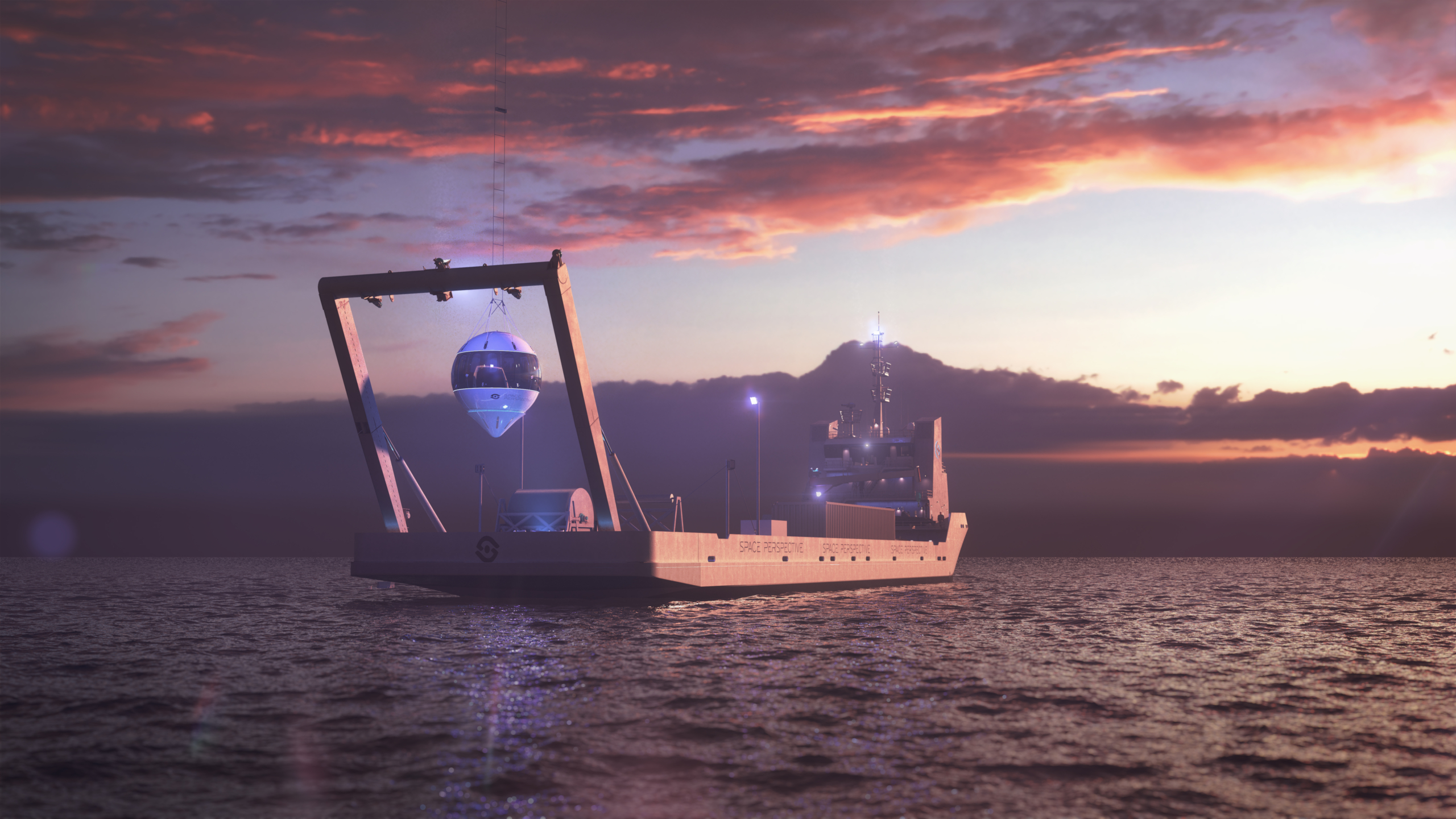
Image credit: Space Perspective/ABS
ABS is providing class, engineering review and regulatory services for MS Voyager, with completion expected later this year.
Modifications to the near 300-foot-long offshore supply vessel are already underway and will include the addition of the balloon launch system and a space capsule A-frame, which will house Spaceship Neptune using a specially designed cradle on the aft deck.
“The future of space travel is on the water,” said Taber MacCallum, founder and co-CEO of Space Perspective.
“MS Voyager unlocks flexible launch locations, ideal launch conditions, and more frequent launch opportunities. Our collaboration with the experts at ABS is helping us make space travel more accessible to the world than ever before,” MacCallum said in a statement.
For more information on Space Perspective, go to:
 Posted in Space News

