 By
By  August 14th, 2017

Space rock slips by Earth.
Courtesy: Texas A&M
One of the largest of the near-Earth asteroids, will approach close to Earth at the end of August, and will shoot safely by our world on September 1.
“Although many known asteroids have passed by closer than this, all of them were smaller asteroids. Florence is the largest asteroid to pass this close to our planet since the first near-Earth asteroid was discovered over a century ago,” explains JPL’s Paul Chodas, manager of the Center for NEO Studies (CNEOS).
The JPL Center for NEO Studies (CNEOS) computes high-precision orbits for Near-Earth Objects (NEOs) in support of NASA’s Planetary Defense Coordination Office.

Credit: CNEOS
Detailed measurements
At its closest point, Florence will be 4.4 million miles (7.0 million kilometers) from Earth, or about 18 times the average Earth-Moon distance.
“The September 1 flyby of Florence will provide astronomers with an excellent opportunity to make detailed measurements of a large near-Earth asteroid,” Chodas adds. “In particular, radar scientists expect to obtain high-resolution images of Florence that could reveal surface features as small as about 10 meters (30 feet).”
Chodas says that infrared measurements from NASA’s Spitzer Space Telescope and the NEOWISE spacecraft indicate that Florence is roughly 2.7 miles (4.3 kilometers) in size, and measurements of its brightness variations indicate that it rotates once every 2.36 hours.
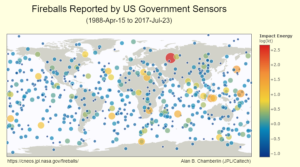
Fireball and bolide events are recorded by U.S. Government sensors. Chart shows reported fireball events for which geographic location data are provided. Each event’s calculated total impact energy is indicated by its relative size and by a color.
Credit: CNEOS
Easily visible
“As it approaches in late August and early September, it is expected to brighten to 9th magnitude, making it easily visible, even using a small telescope,” Chodas notes.
Asteroid Florence was discovered in 1981 and named in honor of Florence Nightingale (1820-1910), the founder of modern nursing.
Tracking observations of asteroid Florence span nearly 40 years and its orbit is already well known.
“The orbital calculations indicate,” Chodas concludes, “that asteroid Florence poses no risk of colliding with Earth for many centuries to come.”
 Posted in Space News

