 By
By  June 30th, 2022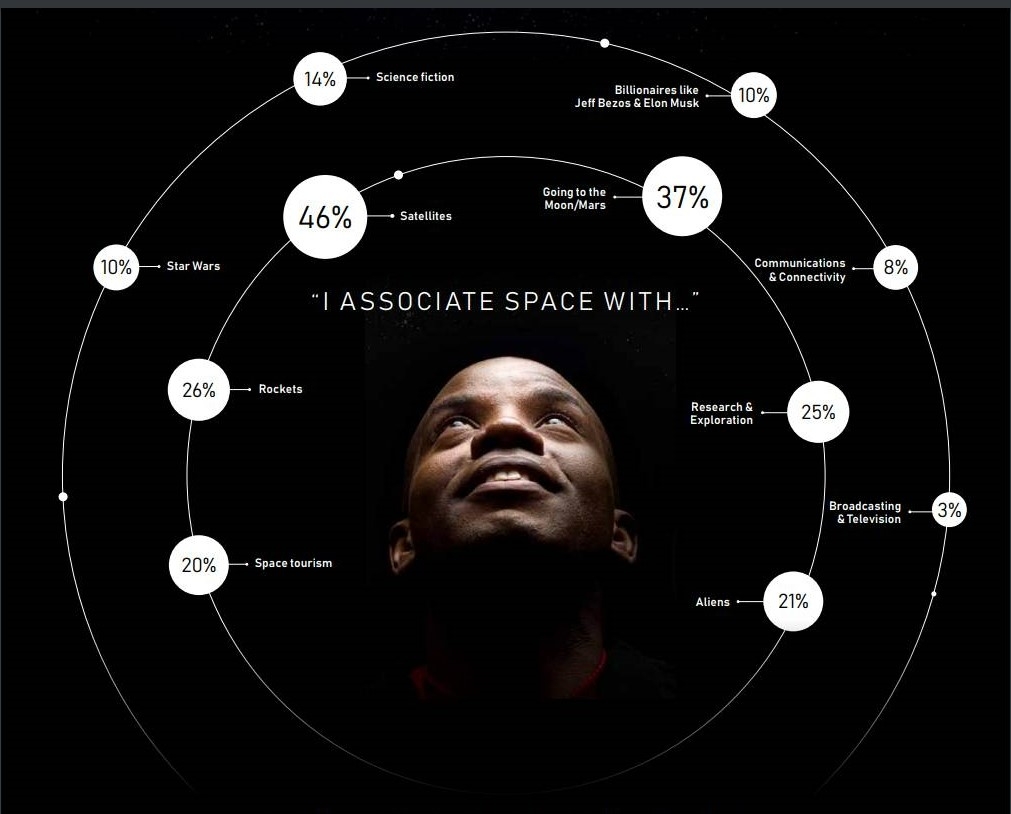
Credit: Inmarsat
A worrisome new report finds that people are unaware about the benefits of using space, and a majority view space as a threat, with space junk and climate change main concerns.
The newly-released society snapshot took in 20,000 respondents across 11 countries.
Unveiled by Inmarsat, a global, mobile satellite communications provider, the report signals that people have a low understanding of the size and richness of the work being done in space today.

Credit: Inmarsat
Underappreciated and misunderstood
Rajeev Suri, CEO of Inmarsat, said in a statement: “This report should be a wake-up call for our industry. Space appears to be underappreciated and misunderstood in the real-world. In many respects, the knowledge we possess as a society is inaccurate and incomplete.”
The Inmarsat report — “What on Earth is the value of space?” — found that those aged 65 and above, who were teenagers when humans first walked on the Moon, are more optimistic and hopeful than Gen-Z. They are more likely to associate space with research and exploration, rockets, and satellites – with their understanding of space more rooted in science than science-fiction.
Report findings
Other findings of the report include:
- People’s ambitions for space center around tackling major challenges on Earth – finding new energy sources, essential resources, and helping solve climate change. However, this does not yet counteract our fears – as 97 per cent of the global population feel space is a threat.
- One in 9 people are “terrified” of what could happen in space – with space junk and collisions in orbit (47 per cent), pollution (39 per cent), and damaging the Earth’s atmosphere (35 per cent) seen as the top threats. Older people are more worried about space junk, while younger generations fear the environmental impact most.
- Only a quarter of the public (23 per cent) said they feel space exploration is “important.” Almost half (46 per cent) consider satellites when thinking of space, while 37 per cent think of expeditions to the Moon and Mars, 21 per cent think of aliens, and almost 1 in 10 think of Star Wars (9 per cent). Fewer than 1 in 10 people globally think of communications and connectivity.
- The research highlights a small core of people globally who are aware of the potential for space to answer many of the world’s challenges. For example, 7% of respondents said that space can alleviate poverty. While another 7% thought space can support the goal of producing enough food to feed our growing population. 11% imagined space will have a role in researching and finding cures for diseases like cancer.

Credit: Inmarsat
Global respondents
Touted as the largest independent global representative consumer survey of attitudes towards space included 20,000 respondents (18-65+ years of age) across the UK (3,000), US (2,000), Brazil (2,000), Canada (2,000), Germany (2,000), Australia (2,000), China (2,000), India (2,000), South Korea (1,000), Japan (1,000) and UAE (1,000).

Credit: Inmarsat
The study was conducted by Yonder Consulting in April 2022 on behalf of Inmarsat.
To view the full report — “What on Earth is the value of space?” — go to:
https://www.inmarsat.com/en/insights/corporate/2022/value-of-space.html
 Posted in Space News


In most states not much is taught about space. Many teachers would like to teach more about space but very little teaching material is available. Many teachers do not feel they know enough about it. Even where school programs have been started, like it Texas, they have often had to be aborted because no one is providing what the teachers or students need to learn. https://uh-ir.tdl.org/bitstream/handle/10657/1192/KITMACHER-DISSERTATION-2013.pdf