 By
By  July 26th, 2026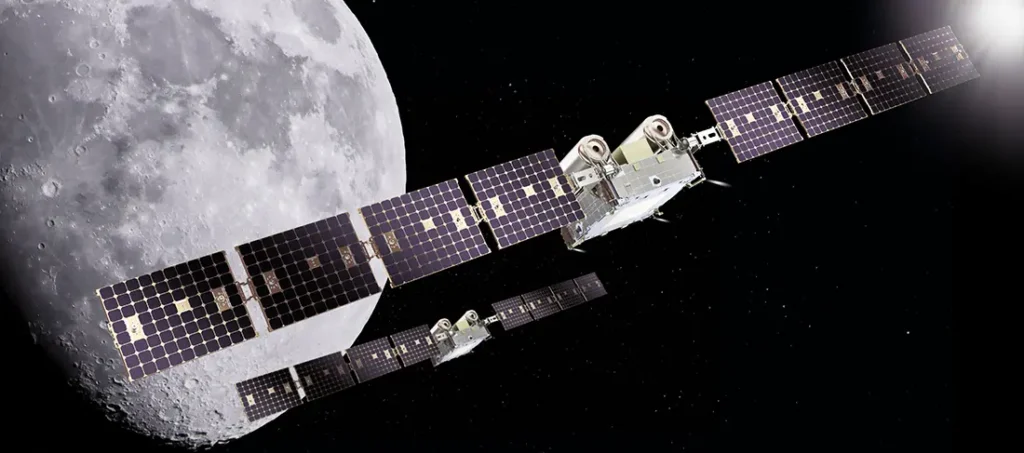
Image artwork: Terran Orbital
A new dual spacecraft mission has been green-lighted to augment operations at the Moon, including the build-up of an Artemis Moon Base.
As operations at the Moon scale in quantity, foundational technologies such as autonomous navigation will be critical to enable safe and long-term operations.
Advanced Space of Westminster, Colorado has announced a CAPSTONE 02 mission – a two spacecraft endeavor is underway for launch in 2027 in partnership with NASA along with Terran Orbital, a Lockheed Martin Company, as the “bus” provider.
The spacecraft bus is the structural component in which the payload and all scientific instruments are placed.

Earth’s Moon as viewed from the International Space Station.
Image credit: NASA
Operations in cislunar space
CAPSTONE 02 is designed to advance rendezvous and proximity operations (RPO) and autonomy capabilities in multibody cislunar orbits.
“With CAPSTONE 02, we are taking the next step toward routine, resilient operations in cislunar space,” said Bradley Cheetham, president and CEO of Advanced Space.
“By maturing autonomous rendezvous and proximity operations in this complex environment,” Cheetham said, “we are directly enabling the future of lunar exploration, development, and long-term presence. CAPSTONE 02 can reduce risk for Moon Base, Artemis and every lunar mission that follows.”

Image credit: NASA
Rectilinear halo orbit
The innovative CAPSTONE 01 was launched by Rocket Lab on June 28, 2022. It concluded its mission for NASA in June 2026. That microwave oven–sized, 55-pound CubeSat operating was the first commercially owned and operated spacecraft to orbit the Moon.
NASA’s original CAPSTONE demonstration — short for Cislunar Autonomous Positioning System Technology Operations and Navigation Experiment – was the first spacecraft to operate in a near rectilinear halo orbit around the Moon. This is a nearly stable orbit due to the interactive pull of gravity from both the Earth and the Moon.
One major CAPSTONE 01 assignment was attached to NASA’s Lunar Gateway, a Moon-orbiting outpost in NASA’s Artemis program. However, Gateway plans were canceled in March 2026, with NASA announcing it would now focus on developing a lunar surface base between 2029 and 2036.

CAPSTONE 01 over the Moon’s North Pole.
Image credit: NASA/Daniel Rutter
“CAPSTONE demonstrated what is possible in cislunar operations with small satellite technology and rapid mission timelines,” added Alec Forsman, CAPSTONE 02 program chief engineer at Advanced Space.
“The CAPSTONE 02 mission will push that envelope even further by demonstrating RPO in a three-body orbit, enabling demonstration of cislunar communications architectures, and proving autonomy capabilities that future lunar missions will depend on,” said Forsman.
Numerous partners
Advanced Space and NASA are working with numerous partners to enable the CAPSTONE 02 mission, such as:
- Terran Orbital will provide mission operation and launch integration services.
- Stellar Exploration will deliver a chemical propulsion system enabling lunar insertion and RPO maneuvering capabilities.
- Utah State University Space Dynamics Laboratory provides the communications system, including direct-to-Earth communications and crosslink communications.
- Lawrence Livermore National Laboratories (LLNL) will provide integrated optical payloads, including LLNL-patented monolithic optics.
- CAPSTONE 02 will also fly NASA’s Compact Electron Proton Spectrometer (CEPS) instrument demonstrating space weather radiation forecasting, and three NASA-developed navigation software payloads.
Lead of the In‑Space Infrastructure portfolio within the Research and Technology Mission Directorate at NASA Headquarters in Washington, DC. CAPSTONE 02 is funded by NASA’s Human Spaceflight Mission Directorate. The mission is managed by Small Spacecraft & Distributed Systems, based at NASA’s Ames Research Center in California’s Silicon Valley.

Image credit: NASA
Formation flying
The two identical spacecraft for the CAPSTONE 02 mission weigh roughly 882 pounds (400 kilograms).
Mission operators will conduct a series of rendezvous and proximity operations and loitering – or formation flying – techniques in lunar orbit with each spacecraft to better understand the trajectories of the spacecraft under the simultaneous influence of Earth and Moon gravities, otherwise known as three-body orbits.
“This mission represents an important step in the maturation of cislunar capabilities,” said Sean Fuller, Moon Base CAPSTONE manager. “By expanding on the lessons learned from CAPSTONE to demonstrate increasingly sophisticated operational concepts, CAPSTONE 02 lays the foundation for lunar infrastructure and commercial services that support Artemis, Moon Base, and future missions to deep space.”
 Posted in Space News

