 By
By  June 14th, 2024
Image taken by mini-rover of Change’-6 lander/ascender spacecraft on the far side of the Moon.
Image credit: CNSA
NASA’s Lunar Reconnaissance Orbiter (LRO) now circling the Moon has taken its first look at China’s far side Chang’e-6 landing spot.
The lander is flanked by two craters similar in size to it, and is on the edge of a much more subtle crater about 50 meters wide, reports Mark Robinson, the principal investigator of the sharp-shooting camera system onboard LRO.
Chang’e-6 has been sighted within the Apollo basin on the lunar far side on June 7, 2024. The lander is seen as the small cluster of bright pixels in the center of the image.
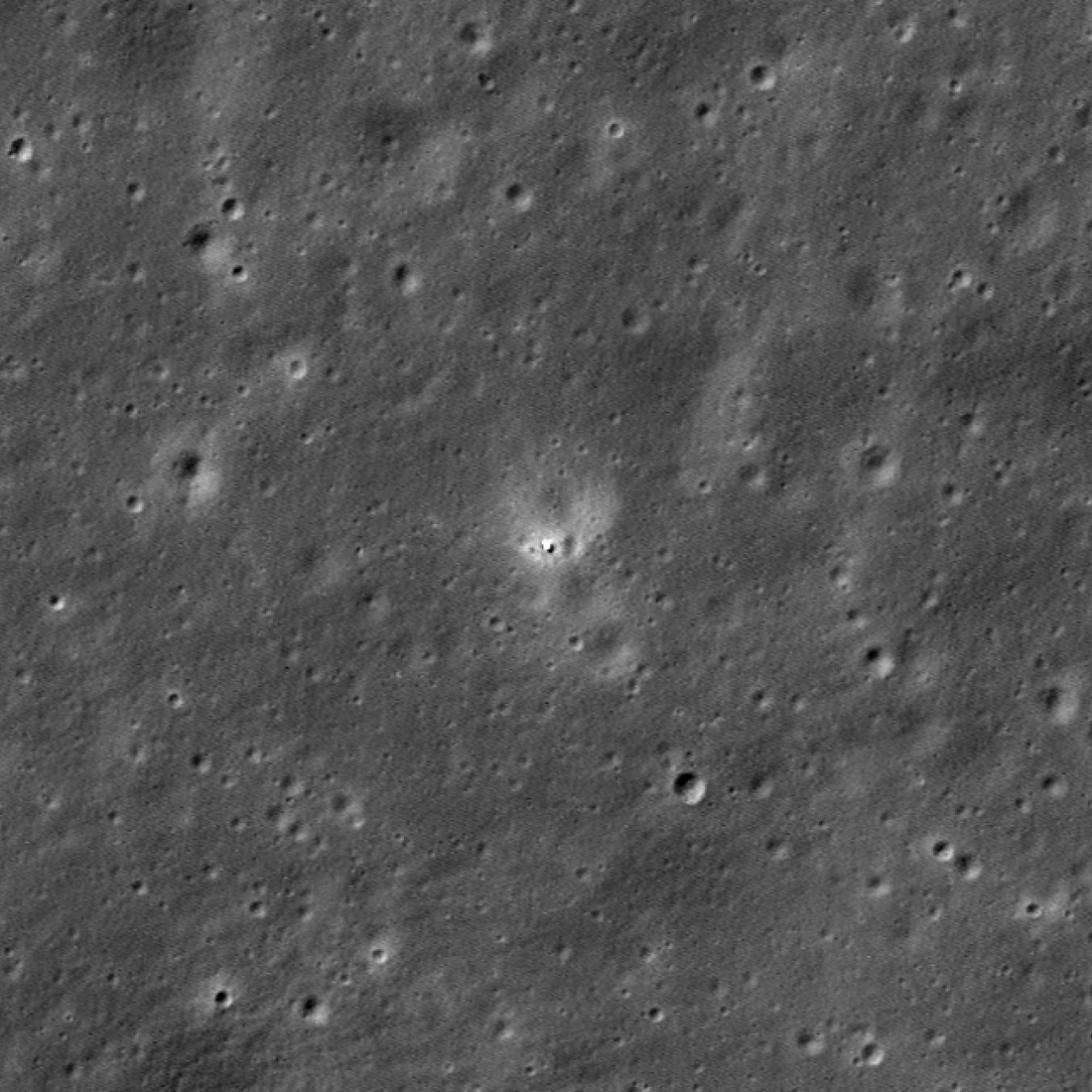
Landing locale of China’s Change’-6 far side lander.
Image credit: NASA/GSFC/Arizona State University
Rim shot
NASA’s LRO imaged China’s Chang’e 6 sample return spacecraft on the lunar farside five days after its June 1st landing and when LRO passed over, acquiring an image showing the Chang’e-6 lander on the rim of an eroded ~50 meter diameter crater.
The Lunar Reconnaissance Orbiter Camera (LROC) team computed the landing site coordinates as -41.6385°N, 206.0148°E, at -5256 meters elevation relative to the average lunar surface, with an estimated horizontal accuracy of plus-or-minus 30 meters.
“The increased brightness of the terrain surrounding the lander is due to disturbance from the lander engine and is similar to the blast zone seen around other lunar landers.
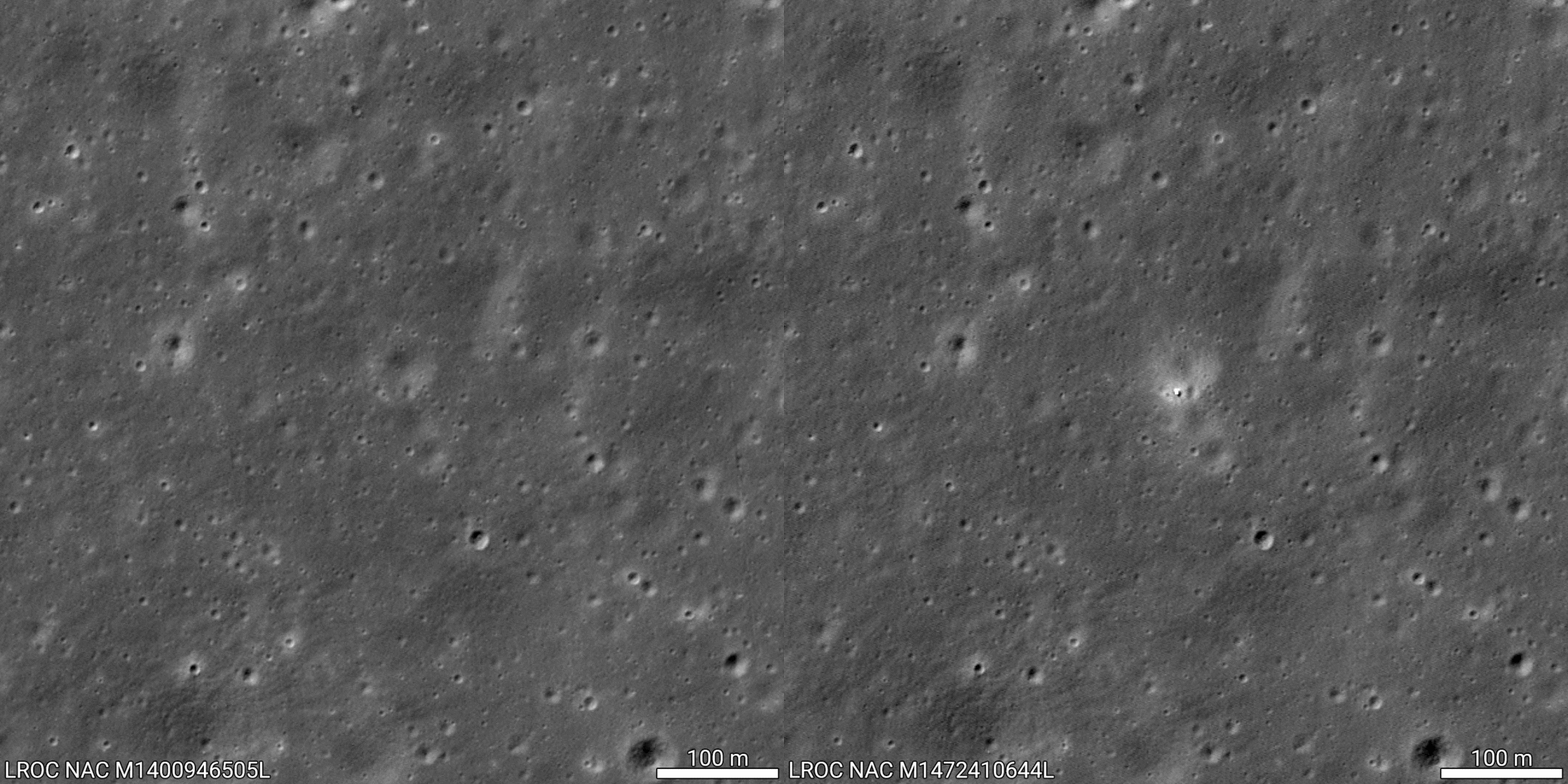
Click on image for before and after photography. Image credit: NASA/GSFC/Arizona State University
Before and after imagery
In comparative imagery, a before image is from March 3, 2022, and the after image is the June 7, 2024 image.
The Chang’e 6 landing site is situated on a mare unit at the southern edge of the Apollo basin.
Robinson and colleagues at Arizona State University note that Basaltic lava erupted south of Chaffee S crater approximately 3.1 billion years ago and flowed downhill to the east until it encountered a local topographic high, likely related to a fault.
“Several wrinkle ridges in this region have deformed and raised the mare surface,” according to an LRO posting. “The landing site sits approximately halfway between two of these ridges. The lava flow also overlaps a slightly older flow, visible further east, but the younger flow is distinctive because it has higher iron oxide and titanium oxide abundances, the posting reports.
Homeward bound
Chang’e-6 was launched from south China’s Hainan Province on May 3, with the Chang’e-6 multi-component craft making the first-ever gathering of lunar samples from the far side of the Moon.
After completing its collection of lunar samples, the probe’s ascender segment departed from the lunar surface with the precious cargo.

Parachuting to Earth, the Chang’e-6 capsule toting its lunar collection.
Image credit: CNSA/CCTV/Inside Outer Space screengrab
After re-uniting with the Chang’e-6 mission orbiter and completing the lunar sample transfer last week, the returner segment is continuing to orbit the Moon, awaiting the time to initiate its return journey back to the Earth.
A projected date of June 25 is the likely return to Earth of the returner’s capsule, toting its cache of lunar collectibles, parachuting into a pre-picked landing zone at Siziwang Banner in north China’s Inner Mongolia Autonomous Region.
At parachute touchdown, the Chang’e-6 will wrap up its 53-day journey of going to the Moon and back.

NASA’s Lunar Reconnaissance Orbiter (LRO).
Credit: NASA’s Goddard Space Flight Center Conceptual Image Lab
 Posted in Space News

