 By
By  November 18th, 2014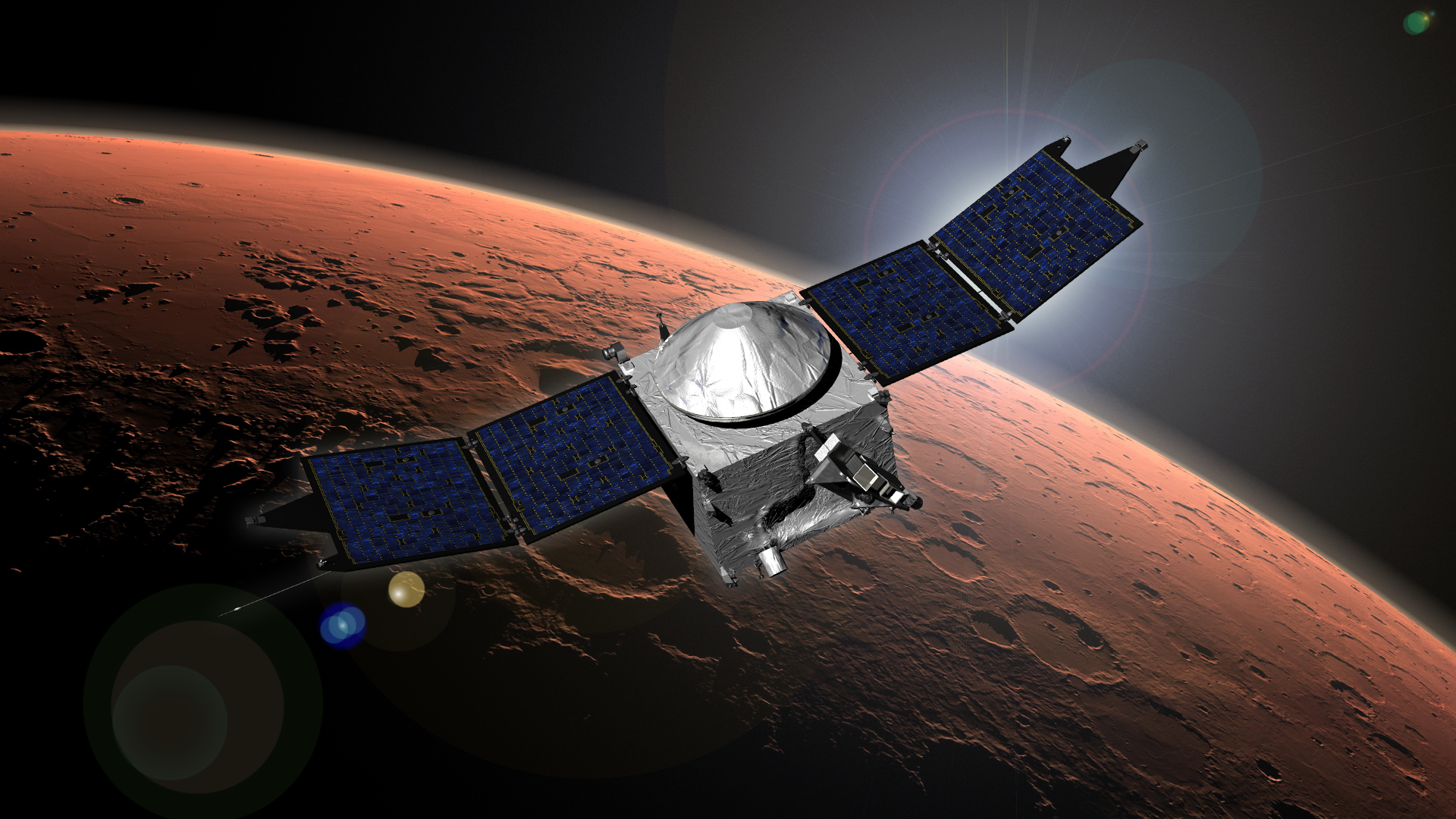
Artist’s image shows NASA’s MAVEN spacecraft in orbit around Mars. (Courtesy NASA/GSFC)
NASA’s Mars Atmosphere and Volatile Evolution Mission (MAVEN) is off and running – starting its one-year primary science mission on November 16.
“With the formal start of our science mission, we’re on track to be able to carry out our full mission as planned, and the science team is looking forward to an incredibly exciting year,” said Bruce Jakosky, MAVEN Principal Investigator at the University of Colorado, Boulder.
The start of science is actually a “soft start”, in that the instruments started making science measurements beginning almost as soon as we were in orbit, and some instrument calibration activities will be continuing throughout the mission.
The commissioning of MAVEN, in what the spacecraft’s team called its “transition phase”, included adjusting the orbit to get into its science orbit, deploying the booms that hold a number of the instruments away from the spacecraft, ejecting the Neutral Gas and Ion Mass Spectrometer instrument cover, turning on and checking out each of the science instruments, and carrying out calibration activities for both the spacecraft and the instruments.
Comet observations
“This period also included the close approach of Comet Siding Spring, which whizzed by Mars at a rough distance of only 135,000 kilometers on October 19, Jakosky said in a NASA statement.
“We also took time off from commissioning to observe the comet and to take before and after observations of the Mars atmosphere to look for changes,” Jakosky said.
“Using several MAVEN instruments, observations both revealed a tremendous quantity of metal ions that came from cometary dust that entered the atmosphere,” Jakosky said. “Their presence was unexpected, in that the nominal models of the paths taken by dust grains, calculated prior to the comet passage, indicated that no dust would make it all the way to Mars. We’re certainly glad that we took precautions to protect us from dust during the encounter!”
 Posted in Space News

