 By
By  May 26th, 2026
Image credit: NASA
NASA provided today a contract-packed update on the space agency’s Moon Base strategy. The base is to serve as a lunar habitat for long duration exploration and science.
Moon Base is NASA’s lunar exploration and infrastructure initiative designed to enable sustained human presence and expanded scientific and commercial activity at the lunar South Pole.
As detailed today, robotic missions will work alongside Artemis astronauts to study the Moon and help prepare NASA for future Mars missions.
Moon base movement: 2026
During the event, NASA scoped out “Moon Base” phases:
Moon Base I: Targeted for launch no earlier than fall 2026, this mission will use Blue Origin’s Blue Moon Mark 1 Endurance lander to deliver NASA payloads. Equipment will include the Stereo Cameras for Lunar Plume-Surface Studies instrument to study how thrusters interact with the Moon’s surface, and the Laser Retroreflective Array, which helps orbiting spacecraft determine a more precise location using reflected laser light. The mission will land on the Shackleton Connecting Ridge to demonstrate capabilities that reduce risk for future crewed Artemis landing missions in 2028.
Moon Base II: Planned for launch later this year, this mission will deliver more than 1,100 pounds of cargo on Astrobotic’s Griffin lander, including Astrolab’s FLIP rover, to mature mobility systems that inform future lunar terrain vehicle, or LTV, operations.
Moon Base III: Also targeted for this year, this mission will fly the first payload selected through NASA’s Payloads and Research Investigations on the Surface of the Moon initiative. Its anchor investigation, Lunar Vertex, will fly on Intuitive Machines’ Nova-C Trinity lunar lander and study lunar swirls, or light spots on the surface of the Moon, to improve understanding of surface evolution and material behavior under extreme conditions. The mission will include payloads from ESA (European Space Agency) and the Korea Astronomy and Space Science Institute, reflecting commercial and international participation in Moon Base activities.

Artwork depicts two Artemis astronauts planting an American flag at the lunar south pole.
Image credit: NASA/Daniel O’Neal
New industry partners
During a live news event from NASA Headquarters, agency leaders discussed progress on the Moon Base program, including new industry partners and mission plans.
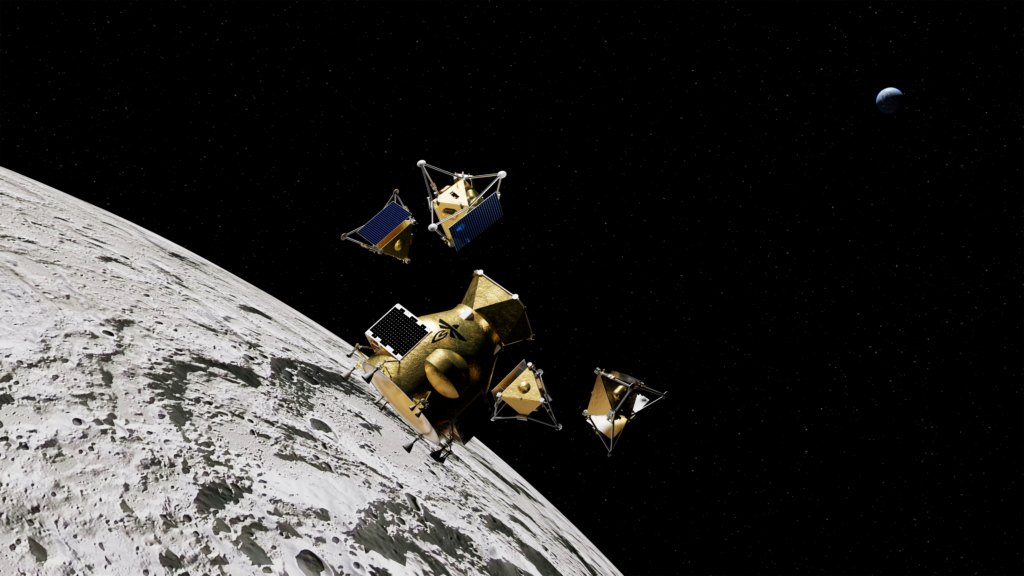
Image credit: Firefly Aerospace
Firefly Aerospace was awarded a subcontract from the Jet Propulsion Laboratory (JPL) to deliver three or four drones to the Moon’s south pole in support of NASA’s MoonFall mission, targeted to launch no earlier than 2028.
MoonFall is part of the first phase of NASA’s Moon Base initiative.
JPL is building the drones and managing the mission for NASA, which will source the launch vehicle for MoonFall.
Go to my earlier story at Space.com:
Drone deploying spacecraft
Upon launching, Firefly’s Elytra spacecraft will carry the drones over a 45-day transit to the Moon and enter lunar orbit before deorbiting and performing a braking maneuver to deploy the drones approximately 50 km above the Moon’s south pole.
The drones will then land and operate for up to 14 days to survey the lunar south pole terrain ahead of future human missions under NASA’s Artemis program.
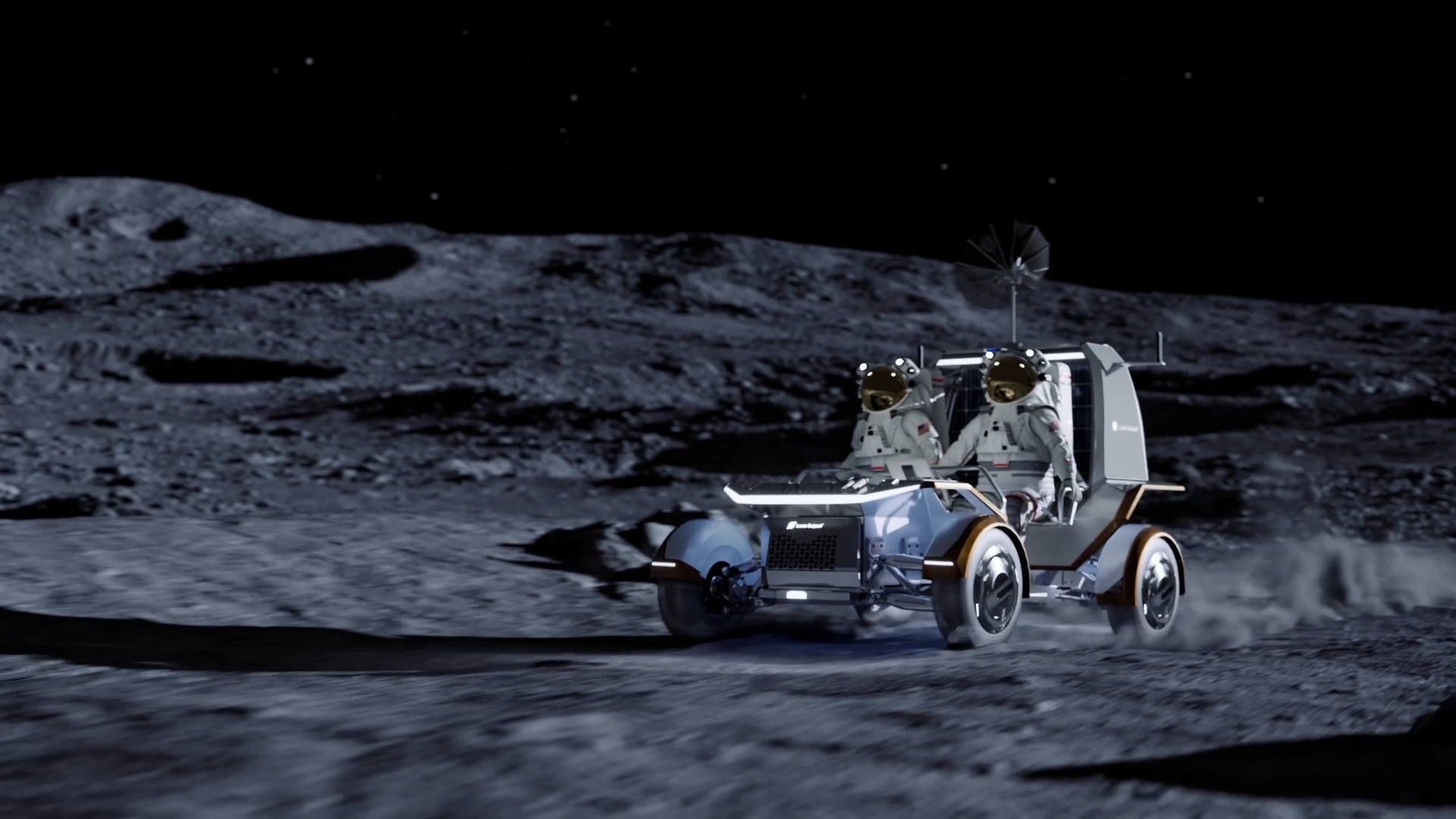
Image credit: Lunar Outpost
Next-generation mobility on the moon
Carlos García-Galán, program executive, Moon Base, also detailed a new contract with Lunar Outpost for its Lunar Terrain Vehicle Services (LTVS) program, advancing the company’s new Pegasus vehicle as a next-generation mobility platform for permanent lunar operations.
Also selected is Venturi Astrolab, Inc. (Astrolab) as a provider of a crewed lunar rover for the Artemis campaign, advancing the agency’s plans to establish sustained surface mobility at the lunar South Pole.
Endurance lander
Lastly, targeted for launch no earlier than fall 2026, Blue Origin’s Blue Moon Mark 1 Endurance lander is to deliver NASA payloads to the lunar landscape.
The mission will land on the Shackleton Connecting Ridge to demonstrate capabilities that reduce risk for future crewed Artemis landing missions in 2028.
In related news, NASA will provide an update on the agency’s Artemis III mission and announce the astronauts assigned to the test flight in Earth orbit during a live event at 11 a.m. EDT on Tuesday, June 9, at the agency’s Johnson Space Center in Houston.
Artemis III will launch four astronauts from NASA’s Kennedy Space Center in Florida aboard the Orion spacecraft on the Space Launch System rocket. The mission will test needed rendezvous and docking capabilities between the Orion spacecraft and commercial human landing systems, required seating to deliver astronauts to the Moon’s surface.
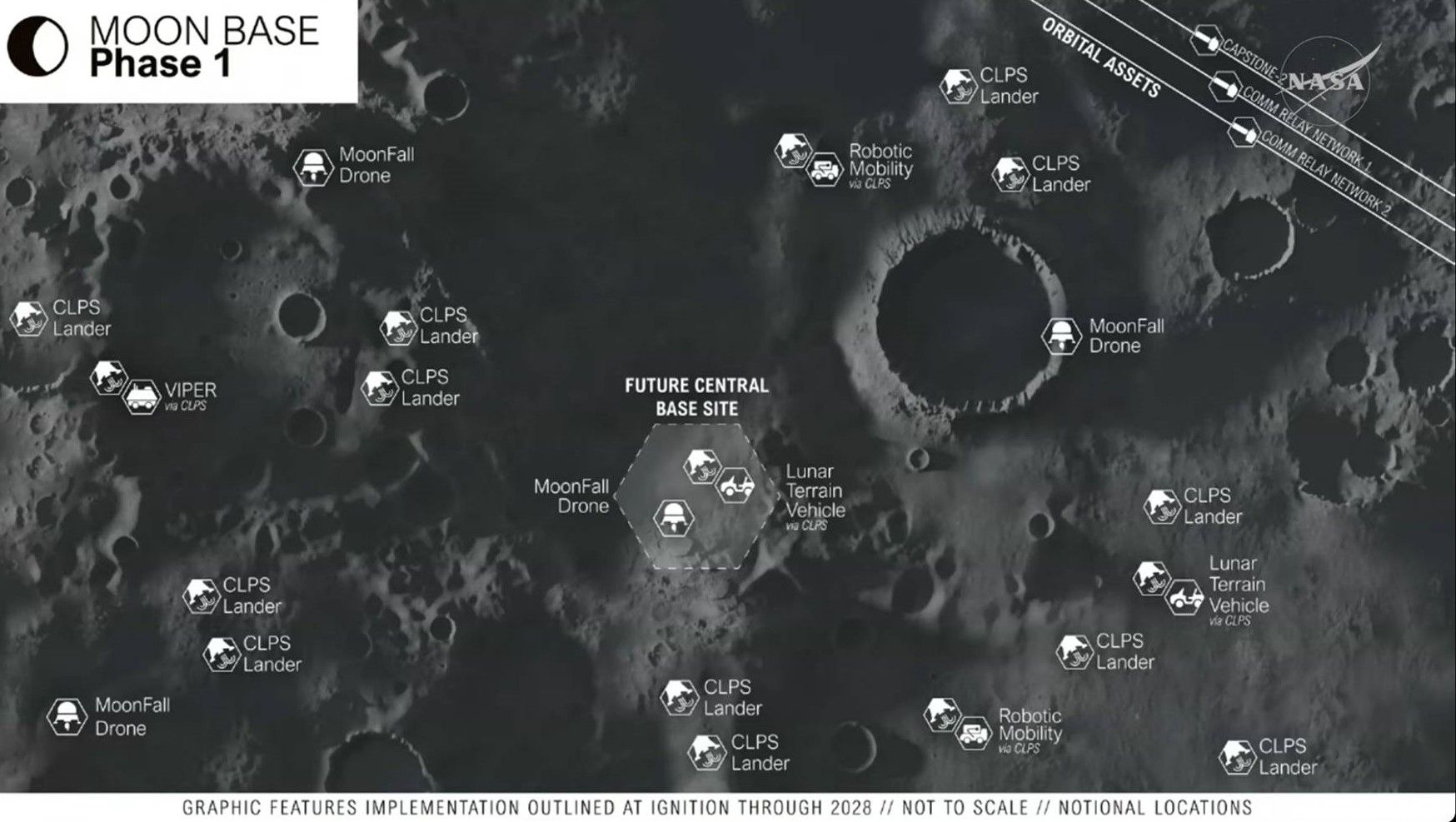
Image credit: NASA
For full Moon Base details, go to:
https://www.nasa.gov/news-release/nasa-provides-update-on-moon-base-rovers-landers-missions/
Also, go to:
https://www.nasa.gov/moonbase/
For a replay of the briefing, go to:
 Posted in Space News

