 By
By  January 9th, 2017
The first X-37B Orbital Test Vehicle waits in the encapsulation cell of the Evolved Expendable Launch vehicle on April 5, 2010 at the Astrotech facility in Titusville, Fla. Half of the Atlas V five-meter fairing is visible in the background.
Credit: U.S. Air Force
Hurled spaceward over a year and seven months ago, the puzzling United States Air Force’s X-37B space plane has winged past 600 days of operation in Earth orbit. It is just 75 days away from setting a programmatic milestone.
Known in military space speak as OTV-4 (Orbital Test Vehicle-4), this robotic mini-space plane was sent into Earth orbit on the program’s fourth clandestine flight on May 20, 2015.
Rocketed into orbit by a United Launch Alliance Atlas V rocket from Florida’s Cape Canaveral Air Force Station, just what this “winged warrior” is doing high above Earth is an on-going, tight-lipped affair.

A United Launch Alliance (ULA) Atlas V rocket successfully launched the U.S. Air Force X-37B space plane on May 20, 2015.
Credit: ULA
Moreover, how long the vehicle will remain in orbit is not known.
Milestone recordkeeping
The first OTV mission began April 22, 2010, and concluded on Dec. 3, 2010, after 224 days in orbit.
The second OTV mission began March 5, 2011, and concluded on June 16, 2012, after 468 days on orbit.
An OTV-3 mission chalked up nearly 675 days in orbit when it landed Oct. 17, 2014.
All the OTV craft have guided their way on auto-pilot to a Vandenberg Air Force Base, California tarmac-touchdown.
But that may change for OTV-4’s landing in the whenever.
Heading for Florida?
Just when and where the currently flying craft will wheel to a full-stop is unidentified.

Former shuttle processing area at the Kennedy Space Center has been overhauled by Boeing to prep the military’s secretive X-37B space plane.
Credit: Malcolm Glenn
What is known is that progress has been made on consolidating X-37B space plane operations, including use of NASA’s Kennedy Space Center (KSC) in Florida as a landing site for the robotic space plane.
A former KSC space-shuttle facility known as Orbiter Processing Facility (OPF-1) was converted into a structure that will enable the Air Force “to efficiently land, recover, refurbish and relaunch the X-37B Orbital Test Vehicle (OTV),” according to Boeing.
The X-37B vehicle development falls under the Boeing Space and Intelligence Systems in El Segundo, California, the firm’s center for all space and experimental systems and government and commercial satellites.
The Air Force Rapid Capabilities Office is leading the Department of Defense’s OTV initiative, by direction of the Under Secretary of Defense for Acquisition, Technology and Logistics and the Secretary of the Air Force.
Fleet size
To date, only two reusable X-37B vehicles have been confirmed as constituting the space plane “fleet.” Also, this current OTV-4 space trek is the second flight of the second X-37B vehicle built for the Air Force by Boeing.
Appearing like a miniature version of NASA’s now-retired space shuttle orbiter, the reusable military space plane is 29 feet (8.8 meters) long and 9.6 feet (2.9 meters) tall, and has a wingspan of nearly 15 feet (4.6 meters).
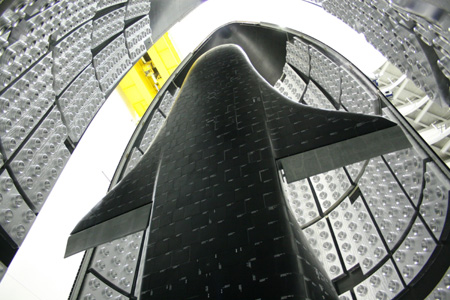
A previous X-37B being readied for launch atop Atlas booster.
Credit: Boeing
The space drone has a payload bay about the size of a pickup truck bed that can be outfitted with a robotic arm. It has a launch weight of 11,000 pounds (4,990 kilograms) and is powered on orbit gallium arsenide solar cells with lithium-ion batteries.
Payloads
Some payloads onboard the OTV-4 craft have been previously identified.
For example, Aerojet Rocketdyne has said that its XR-5A Hall Thruster had completed initial on-orbit validation testing onboard the X-37B space plane. Also onboard is a NASA advanced materials investigation.

Air Force X-37B robotic space plane is shown after Vandenberg AFB landing. Third mission of the program was the longest duration flight of the winged spacecraft. Now in orbit is the fourth mission of the space plane – and could shatter the previous time in orbit of this type of craft.
Credit: USAF/Boeing
That test-bedding of equipment on the winged space robot has been given high-marks by Winston Beauchamp, deputy undersecretary of the Air Force for Space.
“It remains a very useful way to test out things,” Beauchamp told Space.com last September during an American Institute of Aeronautics and Astronautics (AIAA) meeting in Long Beach, California. Asked about any interest in increasing the X-37B fleet size, he said that the number of vehicles in use is fine due to the pace of experiments it conducts.
 Posted in Space News

