 By
By  August 16th, 2021
Credit: NASA
New research suggests Earth’s Moon is far from a bone dry world.
The Imaging Infrared Spectrometer (IIRS) instrument onboard India’s Chandrayaan-2 lunar orbiter has found the presence of both hydroxyl ions (OH) and water molecules (H2O) on the lunar surface.
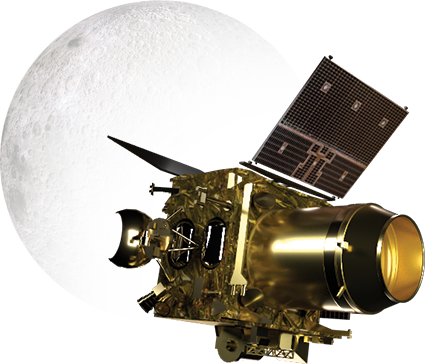
Chandrayaan 2 Orbiter.
Credit: ISRO
The assessment has further quantified the amount of water molecules present on regions of the Moon the instrument imaged, and sorts out places on the lunar landscape that are water-rich and those locales scant in hydration.

Credit: Prakash Chauhan, et. al
Space weathering
Appearing in the journal Current Science, “Unambiguous detection of OH and H2O on the Moon from Chandrayaan-2 Imaging Infrared Spectrometer reflectance data using 3 μm hydration feature,” the lead author of the work is Prakash Chauhan of the Indian Institute of Remote Sensing, Indian Space Research Organization (ISRO).
Chauhan and colleagues point to space weathering – the solar wind or charged solar particles that bombard the lunar terrain – as the source of the water.
To access this paper, go to: https://www.currentscience.ac.in/Volumes/121/03/0391.pdf
In the shadows
Meanwhile, another piece of research suggests that the shadows cast by the roughness of the Moon’s surface create small cold spots for water ice to accumulate even during the ruthless lunar daytime.

Credit: NASA
Previous computer models suggested any water ice that forms during the lunar night should quickly burn off as the Sun climbs overhead.
However, in a new study, JPL scientist Björn Davidsson and co-author Sona Hosseini, a research and instrument scientist at JPL, suggest that shadows created by the “roughness” of the lunar surface provide refuge for water ice, enabling it to form as surface frost far from the Moon’s poles. They also explain how the Moon’s exosphere (the tenuous gases that act like a thin atmosphere) may have a significant role to play.
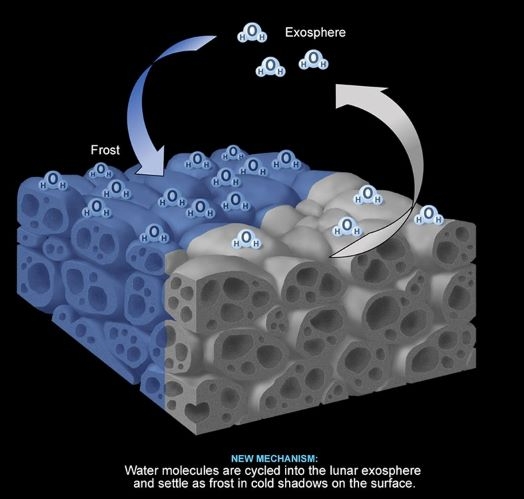
Credit: Björn Davidsson/Sona Hosseini
Strong influence
“This challenges our understanding of the lunar surface and raises intriguing questions about how volatiles, like water ice, can survive on airless bodies,” Davidsson said in a JPL statement.
In their research paper – “Implications of surface roughness in models of water desorption on the Moon” – they report that surface roughness substantially increases the capability of the Moon to retain water on its sunlit hemisphere at any latitude, and within 45 degrees of the poles, at any time of the lunar day.
“Hence, we show that lunar surface roughness has a strong influence on lunar water adsorption and desorption. Therefore, it is of critical importance to take account of surface roughness to get an accurate picture of the amount of water on the Moon’s surface and in its exosphere,” the researchers conclude.
To access this research, go to the Monthly Notices of the Royal Astronomical Society, Volume 506, Issue 3, September 2021 at:
https://doi.org/10.1093/mnras/stab1360
 Posted in Space News

