 By
By  August 5th, 2026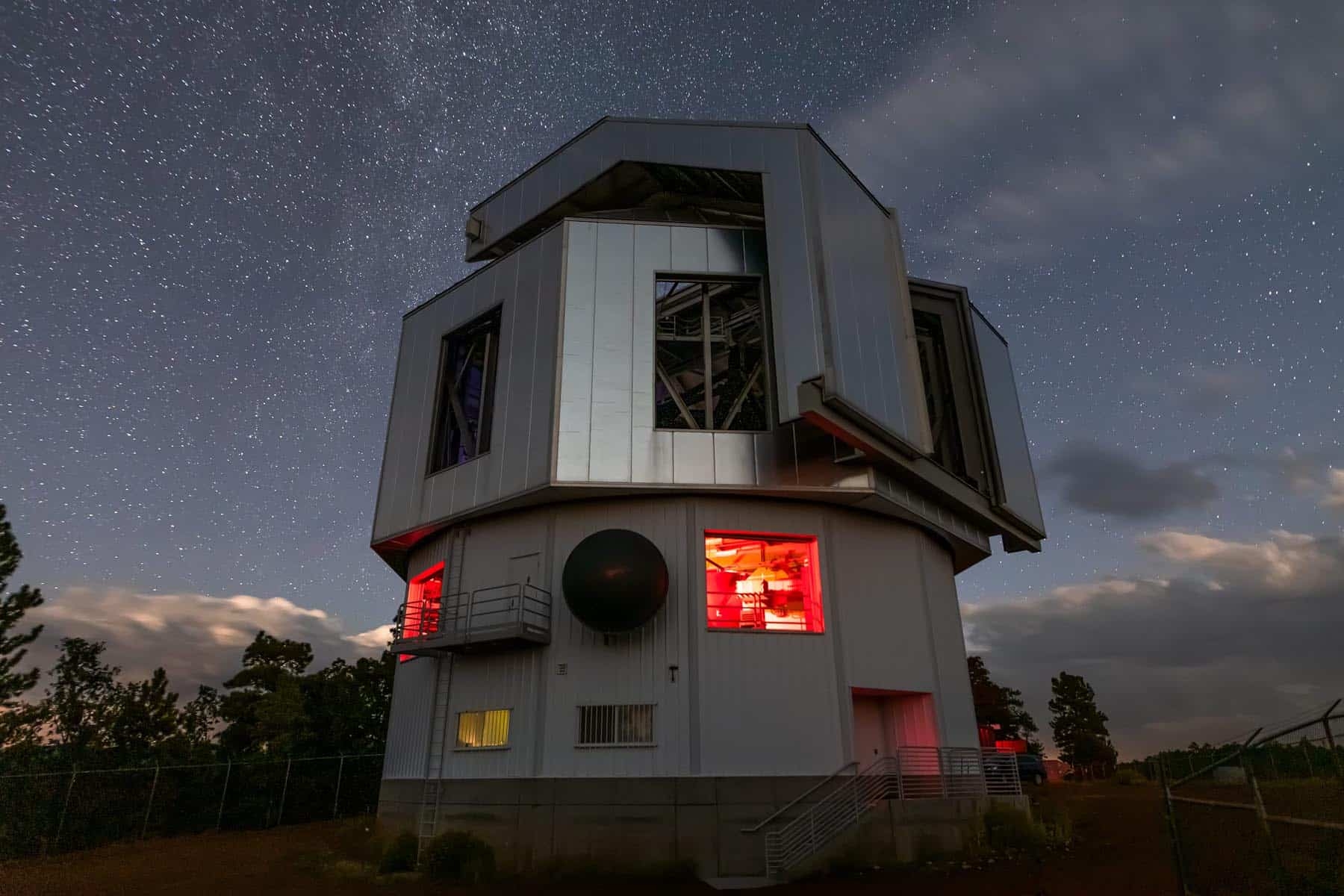
Lowell Discovery Telescope (LDT) Image credit: Lowell Observatory
Scientists at the Lowell Observatory in Flagstaff, Arizona report they detected a plume from the impact August 5 from that errant SpaceX rocket stage.
“We can safely say that we measured a response from the rocket stage impact as a sodium and lithium gas plume a few 10’s of kilometers in size lasting between 5 and 10 minutes after impact,” Carl Schmidt tells Inside Outer Space.
Schmidt is an assistant research professor at Boston University’s Center for Space Physics.
Schmidt said that his early analysis of what was observed is early and crude, “in order to recover a signal quickly.” Graduate students, he added, “are working slowly and carefully” on the data.
Two efforts
There were two efforts to observe the event at Lowell Observatory. One using fast imaging to record the brief light from the fireball, predicted to last a fraction of a second.
Observers at the 4.3-meter Lowell Discovery Telescope (LDT) in Happy Jack, Arizona, were also to use a long slit spectrograph to try and measure the sodium gas plume which was anticipated to persist for several minutes.
LDT is the 5th-largest optical telescope in the United States.
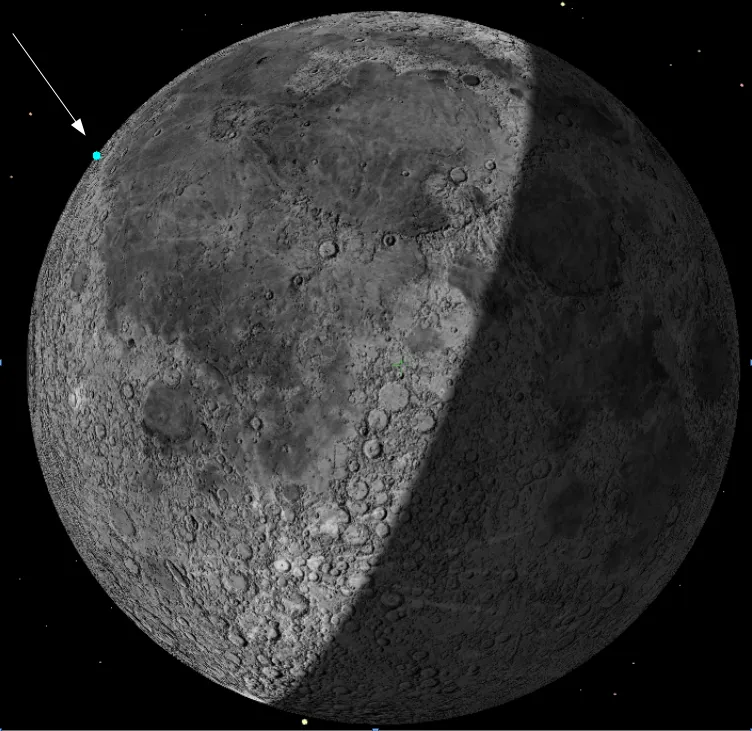
An illustration of the Moon with an arrow pointing to the predicted impact site for the Falcon 9 upper stage. Image credit: Bill Gray/Project Pluto
Unknown unknowns
The event was a literal “dust up” on the lunar landscape.
That Falcon 9 upper stage was a leftover from the launch that sent Firefly’s Blue Ghost-1 lander to the moon on Jan. 15, 2025. Also sent moonward on that flight was the Hakuto-R Mission 2, called Resilience, a robotic lunar lander developed by the Japanese company ispace.
The rocket stage collision on August 5 was pegged to occur near Einstein/Bell Craters near the lunar limb. What was not known: would the event be visible by ground and space-based assets.
Despite all the unknown unknowns, and modeling uncertainties, some specialists suggested if you’ve had the time and observational prowess, it was worth a look.
Such was the case for the Lowell Observatory.
 Posted in Space News

