 By
By  September 4th, 2020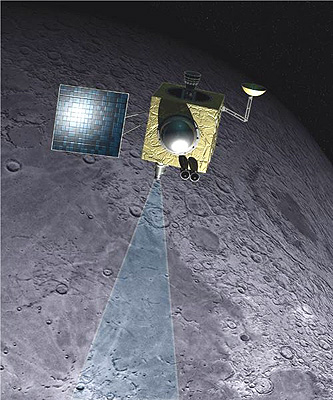
Chandrayaan-1 was an Indian Space Research Organization (ISRO) mission that carried a U.S.-provided Moon Mineralogy Mapper (M3) science instrument.
Credit: ISRO
Researchers continue to plumb data from the Moon Mineralogy Mapper (M3) that was carried onboard the Indian Chandrayaan-1 mission.
As the first Indian lunar probe under the country’s Chandrayaan program, the orbiter was launched by the Indian Space Research Organization (ISRO) in October 2008. The Moon-circling probe operated until August 2009.
M3 was a NASA-supported guest instrument on ISRO’s Moon remote sensing mission.
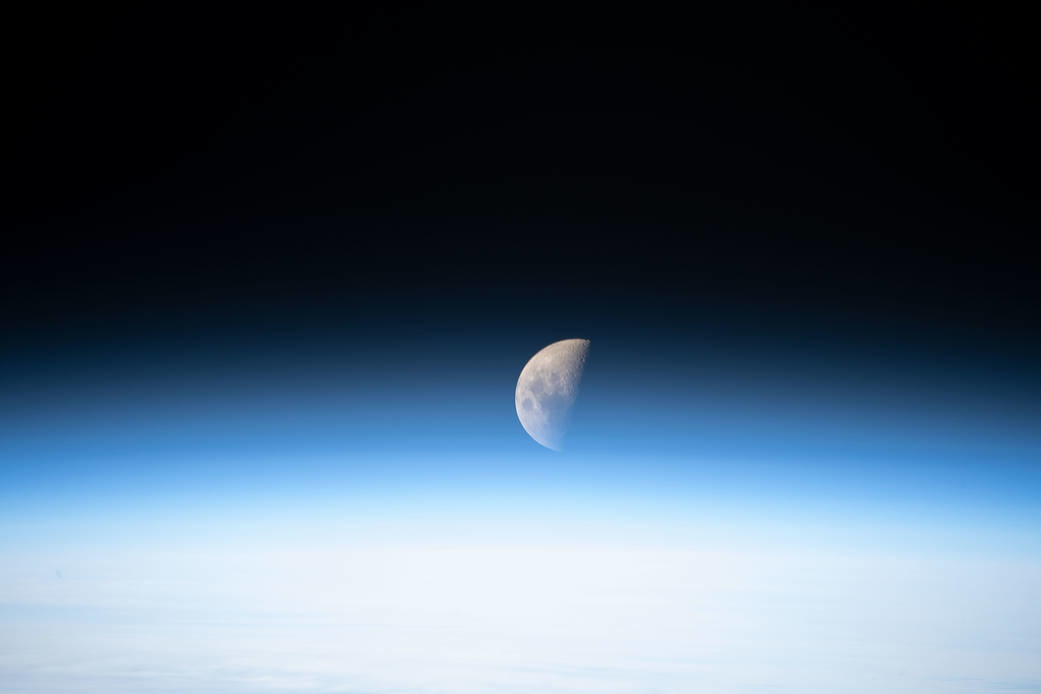
Credit: NASA/ESA
Nearside, farside facts
New analyses of the M3 data show that hematite, a ferric mineral, is present at high latitudes on the Moon, mostly associated with east- and equator-facing sides of topographic highs, and is more prevalent on the Moon’s nearside than the lunar farside.
Leading the research, published in Science Advances, is Shuai Li of the Hawai’i Institute of Geophysics and Planetology, University of Hawaii in Honolulu.

Using local resources on the Moon can help make future crewed missions more sustainable and affordable.
Credit: RegoLight, visualization: Liquifer Systems Group, 2018
Evolution of Earth’s atmosphere
“Hematite (Fe2O3) is a common oxidization product on Earth, Mars, and some asteroids.
Although oxidizing processes have been speculated to operate on the lunar surface and form ferric iron–bearing minerals, unambiguous detections of ferric minerals forming under highly reducing conditions on the Moon have remained elusive,” the study team notes.

The Earth straddling the limb of the Moon, as seen from above Compton crater.
Credit: NASA/GSFC/Arizona State University
Oxygen delivered from Earth’s upper atmosphere could be the major oxidant that forms lunar hematite, the researchers point out.
“Hematite at craters of different ages may have preserved the oxygen isotopes of Earth’s atmosphere in the past billions of years. Future oxygen isotope measurements can test our hypothesis and may help reveal the evolution of Earth’s atmosphere,” the research paper adds. “Studying the oxygen isotopes of hematite at different age craters may help reveal the evolution of Earth’s atmosphere in the past billions of years.”
Wanted: ground truth
“We really need ground truth to verify these new observations,” says lunar resource expert, Clive Neal, a professor at the University of Notre Dame in the Department of Civil & Environmental Engineering and Earth Sciences.
“Shuai Li has once again presented intriguing results from orbital data that challenge one of the basic paradigms of our understanding of the Moon,” Neal told Inside Outer Space, “that it represents a reducing environment. The presence of hematite, if verified, will shift that paradigm in terms of space weathering processes.”
Here on Earth, Hematite is used for a number of purposes. For one, it is a very dense and inexpensive material that is effective at stopping x-rays. For that reason it is used for radiation shielding around medical and scientific equipment.
For more information, go to:
“Widespread hematite at high latitudes of the Moon,” by Shuai Li, Paul G. Lucey, Abigail A. Fraeman, R. Poppe, Vivian Z. Sun, Dana M. Hurley, and Peter H. Schultz, go to:
 Posted in Space News

