 By
By  November 4th, 2020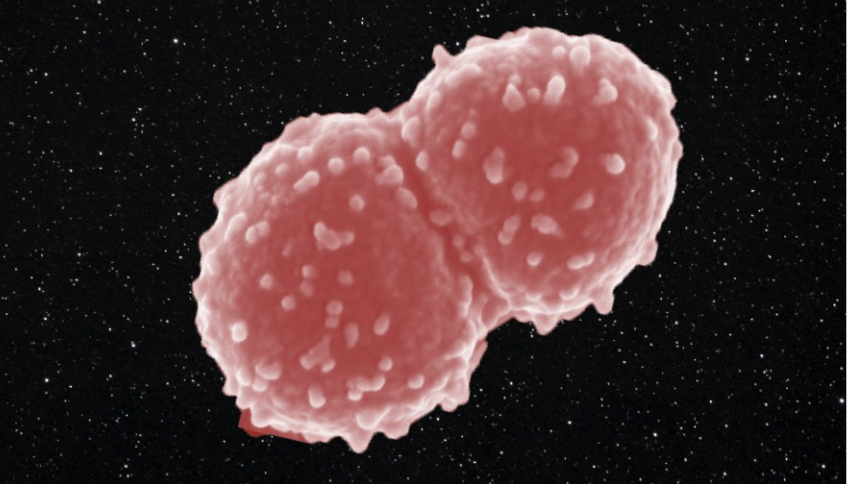
Space traveler Deinococcus radiodurans recovered after 1 year of exposure to low Earth orbit (LEO) outside the International Space Station during the Tanpopo space Mission.
Credit: Tetyana Milojevic
The extraordinarily resistant bacterium Deinococcus radiodurans has been found to withstand harsh environmental conditions present in outer space.
This bacterium was exposed in low Earth orbit (LEO) for one year outside the International Space Station (ISS) to investigate microbial survival and space travel. In addition, a ground-based simulation experiment with conditions, mirroring those from low Earth orbit, was performed.
The exposure panels were on board the SpaceX Dragon commercial cargo spaceship, which launched on April 15, 2015 from Cape Canaveral by the Space-X Falcon-9 rocket. They were manually attached to the exposed experiment handrail attachment mechanism (ExHAM) on the Japanese exposure facility of the ISS, which was transferred to its final position on May 26, 2015.

Earth orbiting research lab, internal and external – the International Space Station (ISS).
Credit: NASA
Panspermia hypothesis
Studies of extremophiles suggest that they may migrate between planets and distribute life across the Universe, underlying the panspermia hypothesis or interplanetary transfer of life.
“These investigations help us to understand the mechanisms and processes through which life can exist beyond Earth, expanding our knowledge how to survive and adapt in the hostile environment of outer space,” explains Tetyana Milojevic, a head of the Space Biochemistry group at the University of Vienna and a corresponding author of the study.
“The results suggest that survival of D. radiodurans in LEO for a longer period is possible due to its efficient molecular response system and indicate that even longer, farther journeys are achievable for organisms with such capabilities,” Milojevic explains in a University of Vienna statement.

Credit: NASA
Mars atmosphere
The researchers that performed the experiment note that results may increase awareness regarding planetary protection concerns on, for instance, the Martian atmosphere.
In addition, the results of the Tanpopo orbital mission should be considered in the context of planetary protection concerns and the development of new sterilization techniques for future space missions.
To read the paper – “Molecular repertoire of Deinococcus radiodurans after 1 year of exposure outside the International Space Station within the Tanpopo mission” – go to the journal Microbiome at:
https://microbiomejournal.biomedcentral.com/articles/10.1186/s40168-020-00927-5
 Posted in Space News

