 By
By  December 9th, 2016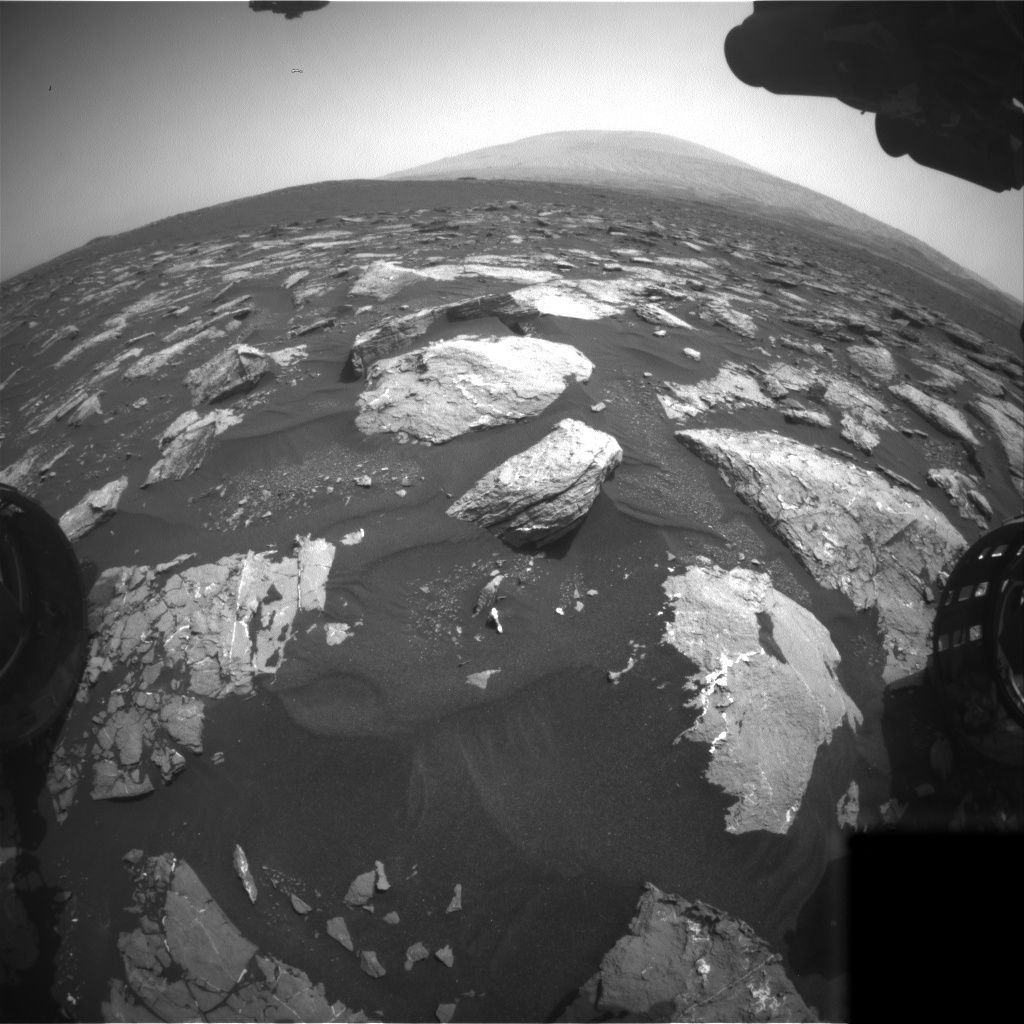
Curiosity Front Hazcam Left B image taken on Sol 1543, December 8, 2016.
Credit: NASA/JPL-Caltech
NASA’s Curiosity Mars rover is now in Sol 1544, still plagued by a problem in its drilling equipment.
Among a set of possible drill issues being assessed: a brake on the drill feed mechanism did not disengage fully or that an electronic encoder for the mechanism’s motor did not function as expected.
Curiosity is at a site on lower Mount Sharp selected for what would be the mission’s seventh sample-collection drilling of 2016.
Drill diagnostics
Reports Ken Herkenhoff of the USGS Astrogeology Science Center in Flagstaff, Arizona, since Sol 1542 drill diagnostics did not complete as intended, and as a consequence, neither did some of the later science activities.

Credit: NASA/JPL-Caltech
Therefore, those tests and activities from Sol 1542 were to be planned again on Sol 1543.
That plan firstly called for the rover’s Chemistry & Camera (ChemCam) to shoot its laser at a target near Hunters Beach, called “Bracy Cove,” and at the bright layers just above “The Anvil.”
“Opportunistic Derivitization” experiment
Late in the afternoon, ChemCam was to perform a routine observation of its titanium calibration target, the Left Mastcam was on the schedule to acquire a 5×1 mosaic of “Squid Cove,” and the rover’s Rear Hazcam was set to take another image to look for changes due to winds.
Overnight, the Sample Analysis at Mars (SAM) Instrument Suite was to perform an Opportunistic Derivitization experiment on a sample from Cumberland that has been carried since early in the landed mission.
This experiment has been some time in the making and should improve SAM’s ability to characterize the organic molecules within that sample,” Herkenhoff explains.

Curiosity Mastcam Right image taken on Sol 1542, December 7, 2016.
Credit: NASA/JPL-Caltech/MSSS
Clouds and dust
Early in the morning of Sol 1544, Curiosity’s Navcam was to search for clouds and dust devils; Mastcam was slated to measure dust in the atmosphere; and both cameras were to re-attempt the photometry observations that were planned the previous day.
As always, dates of planned rover activities are subject to change due to a variety of factors related to the Martian environment, communication relays and rover status.
Climbing to higher (younger) ground
At the rover’s current location, it has driven 9.33 miles (15.01 kilometers) since landing inside Mars’ Gale Crater in August 2012. That includes more than half a mile (more than 840 meters) since departing a cluster of scenic mesas and buttes — called “Murray Buttes” — in September 2016.
Curiosity has climbed 541 feet (165 meters) in elevation since landing, including 144 feet (44 meters) since departing Murray Buttes.
The rover is climbing to sequentially higher and younger layers of lower Mount Sharp to investigate how the region’s ancient climate changed, billions of years ago.
 Posted in Space News

