 By
By  December 13th, 2021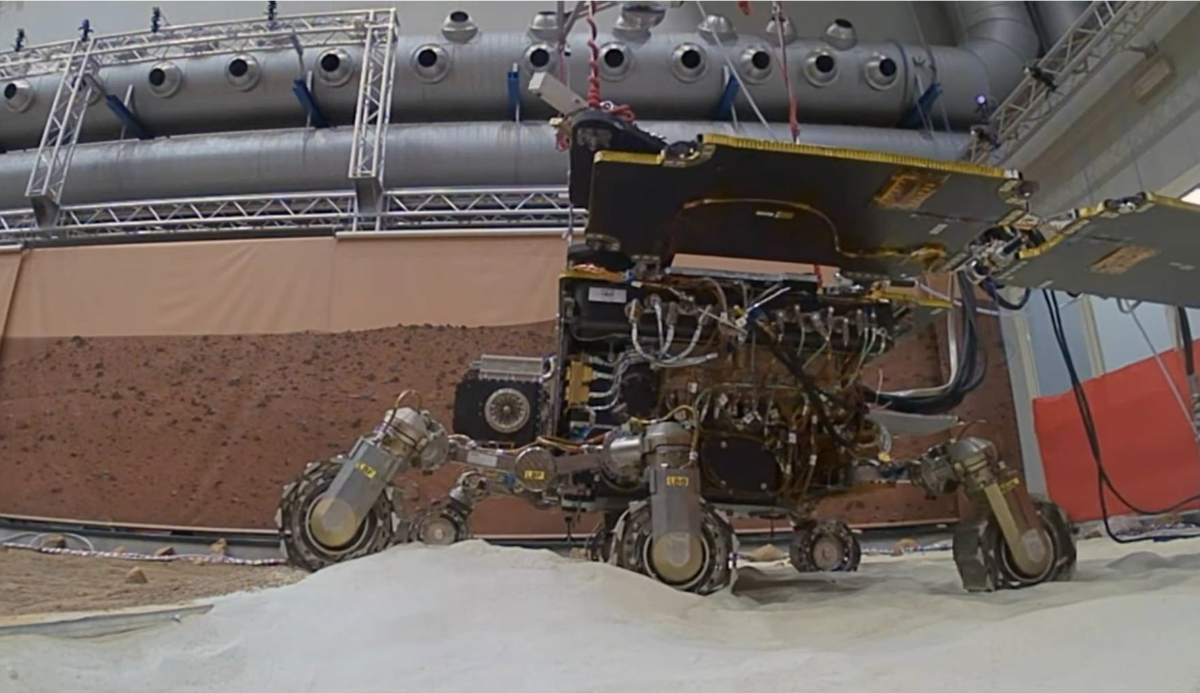
Credit: ESA/Inside Outer Space screengrab
Once Europe’s ExoMars rover, Rosalind Franklin, lands on Mars in June 2023 the machine will utilize a unique wheel walking locomotion mode.
Similar to leg movements, the robot’s wheel-walking combines motions of the deployment actuators (the legs) with the rotation of the wheels to progress without slippage.
This motion is designed to provide the rover good traction in soft soils and high slopes, such as dunes.

ExoMars Credit: ESA/ATG medialab
Functionality
Last month, in the Mars Terrain Simulator at the Rover Operations Control Center at Thales Alenia Space facilities in Turin, Italy, Rosalind Franklin showed off its skills. The facility is being used for training rover operators and simulating science operations that will be expected in the main mission.
Rovers on Mars have previously been caught in sand, and turning the wheels dug them in deeper, just like a car stuck in mud or snow.
“We hope to never need to use wheel walking on Mars to escape dangerous sand traps, but we are glad to have such functionality to potentially safeguard the mission,” said Luc Joudrier, ESA ExoMars Rover Operations Manager. “From a rover operational point of view, this is really our insurance against difficult terrains.”

Rosalind Elsie Franklin was a British chemist and X-ray crystallographer who contributed to unravelling the double helix structure of our DNA. She also made enduring contributions to the study of coal, carbon and graphite.
Credit: ESA/MRC Laboratory of Molecular Biology
Loose soils
In a test run, the back wheels drag once the front four wheels have gained good traction on firmer terrain. The sequence was optimized for climbing steep slopes with loose soils; a short rotation of the wheel follows each movement of the legs. This is to anchor the wheels, digging them a little bit into the soil, before moving the rest – like when you climb a slope with snow and firm up each step before making a new one.

Russian lander cocoons Rosalind Franklin rover.
Credit: Roscosmos
ExoMars 2022 is targeted for liftoff from Baikonur, Kazakhstan on September 20, 2022 (12 day launch window); landing on June 10, 2023.
ExoMars is led collaboratively by the European Space Agency and the Roscosmos State Corporation, designed to understand if life ever existed on Mars. Rosalind Franklin will be delivered to Mars via a Russian lander, “Kazachok,” which will also serve as a surface platform for conducting science experiments.
Take a look at this video that showcases the ExoMars rover’s ability at:
 Posted in Space News

