 By
By  December 17th, 2021
Artist’s impression of the ExoMars 2016 Trace Gas Orbiter at Mars.
Credit: ESA/ATG medialab
New research points to a water-rich region of Valles Marineris, making it a promising target for future human explorers.
As the largest canyon in the Solar System, Valles Marineris is arguably Mars’ most dramatic landscape, and a feature that is often compared to Earth’s Grand Canyon – despite being some ten times longer and five times deeper.
The water-rich area is about the size of the Netherlands and overlaps with the deep valleys of Candor Chaos, part of the canyon system considered promising in the hunt for water on Mars.

Valles Marineris, seen at an angle of 45 degrees to the surface in near-true colour and with four times vertical exaggeration.The largest portion of the canyon, which spans right across the image, is known as Melas Chasma. Candor Chasma is the connecting trough immediately to the north, with the small trough Ophir Chasma beyond. Hebes Chasma can be seen in the far top left of the image.
ESA/DLR/FU Berlin (G. Neukum), CC BY-SA 3.0 IGO
The finding stems from the European Space Agency’s (ESA) ExoMars Trace Gas Orbiter (TGO).
TGO launched in 2016 as the first of two launches under the ExoMars program. The orbiter will be joined in 2022 by a European rover, Rosalind Franklin, and a Russian surface platform, Kazachok, and all will work together to understand whether life has ever existed on Mars.

ESA’s Mars Express has taken snapshots of Candor Chasma, a valley in the northern part of Valles Marineris.
Credit: ESA/DLR/FU Berlin (G. Neukum), CC BY-SA 3.0 IGO
Below Mars’ surface
“With TGO we can look down to one meter below this dusty layer and see what’s really going on below Mars’ surface – and, crucially, locate water-rich ‘oases’ that couldn’t be detected with previous instruments,” reports Igor Mitrofanov of the Space Research Institute of the Russian Academy of Sciences in Moscow, Russia; lead author of the new study; and principal investigator of the FREND (Fine Resolution Epithermal Neutron Detector) neutron telescope onboard TGO.
Mitrofanov’s revealing research is carried in the journal Icarus.
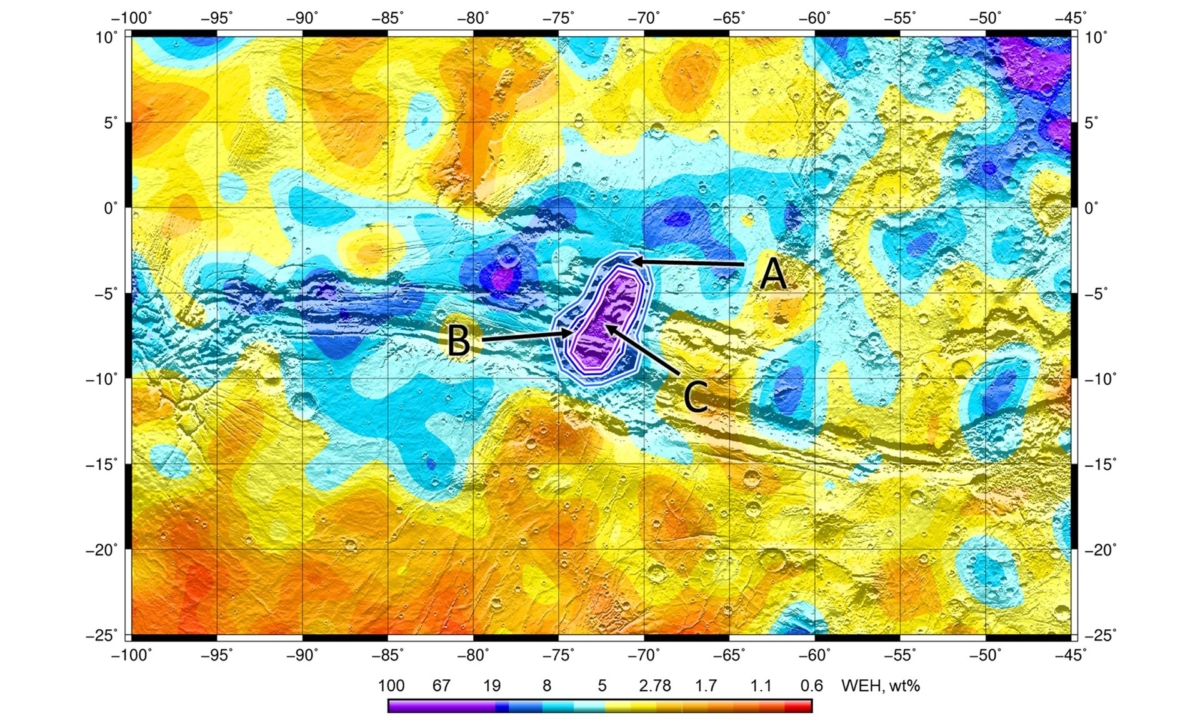
ExoMars Trace Gas Orbiter maps water-rich region of Valles Marineris.
The coloured scale at the bottom of the frame shows the amount of ‘water-equivalent hydrogen’ (WEH) by weight (wt%). As reflected on these scales, the purple contours in the centre of this figure show the most water-rich region. In the area marked with a ‘C’, up to 40% of the near-surface material appears to be composed of water (by weight). The area marked ‘C’ is about the size of the Netherlands and overlaps with the deep valleys of Candor Chaos, part of the canyon system considered promising in our hunt for water on Mars.
Credit: From I. Mitrofanov, et al. (2021)
Unclear mix of conditions
FREND revealed an area with an unusually large amount of hydrogen in the colossal Valles Marineris canyon system, Mitrofanov adds in an ESA statement.
The finding assumes the hydrogen detected is bound into water molecules. If so, as much as 40% of the near-surface material in this region appears to be water.
What special, as-yet-unclear mix of conditions must be present in Valles Marineris to preserve the water – or that it is somehow being replenished — that’s up for more research.
“This finding is an amazing first step, but we need more observations to know for sure what form of water we’re dealing with,” adds study co-author Håkan Svedhem of ESA’s ESTEC in the Netherlands, and former ESA project scientist for the ExoMars Trace Gas Orbiter.
The ExoMars project is a joint project of Russia’s Roscosmos and the European Space Agency.
To view the research paper – “The evidence for unusually high hydrogen abundances in the central part of Valles Marineris on Mars” – go to:
https://www.sciencedirect.com/science/article/pii/S0019103521004528?via%3Dihub
 Posted in Space News

