 By
By  August 3rd, 2023
Mosaic of the Valles Marineris hemisphere of Mars composed of 102 Viking Orbiter images of this huge feature on the Red Planet.
Image credit: NASA, USGS, Viking Project
A just-issued report offers a new avenue for exploring Mars, one that would entail flying lower-costing missions to the Red Planet.
A Mars Concurrent Exploration Science Analysis Group has scoped out the highest priority science that should be conducted in parallel with the NASA/European Space Agency Mars Sample Return (MSR) program – the mega-billion dollar undertaking now being blueprinted.

Mars sample return to Earth – a major undertaking by NASA, the European Space Agency.
Image credit: NASA/JPL-Caltech
Interconnected network
Flinging less-costly missions to Mars in the next decade (2023-2032) is tagged the “Braided River” approach. The tactic is an interconnected network of low-cost missions working together to address major outstanding Mars questions, driven by the sheer dynamic nature of the planet itself.
Multiple small, low-cost missions, orbiters, soft and hard landers could work together to address larger outstanding Mars questions.

The Rakaia river, in Canterbury, New Zealand, illustrating the concept of a ‘Braided River’
with interconnecting, merging, and splitting tracks. Image by Andrew Cooper
(https://commons.wikimedia.org/wiki/User:Andrew_Cooper#/media/File:Rakaia_River_NZ_aeri
al_braided.jpg), licensed under CC BY 3.0 (https://creativecommons.org/licenses/by/3.0/)
Final five
The study group identified a “final five” Mars science objectives that can benefit by the Braided River approach: planetary evolution; early environmental change; recent climate evolution; dynamic modern environments and modern habitability – the search for currently or recently habitable environments and present-day life on Mars.
Although challenging, a lower-cost mission initiative as envisioned by the group offers the chance to augment or replace existing infrastructure, provide landing site evaluation, make on-the-spot resource utilization assessments, and perform weather monitoring, “all of which will be critical for both future robotic and human exploration,” the group’s study report notes.

Depiction shows Jezero Crater — the landing locale of the Mars 2020 Perseverance rover — as it might have appeared billions of years ago when it was perhaps a life-sustaining lake. An inlet and outlet are also visible on either side of the lake.
Image Credit: NASA/JPL-Caltech
Search for life
As for the search for modern/extant life on Mars, the report explains that accessing the deeper subsurface where liquid water could be stable will be crucial to accessing habitable modern ecosystems where the harsh surface conditions are minimized, such as radiation.
A first key investigation to better understand the habitability and likelihood of extant life in the subsurface today would be to confirm or refute the hypothesis of a global deep aquifer on Mars.
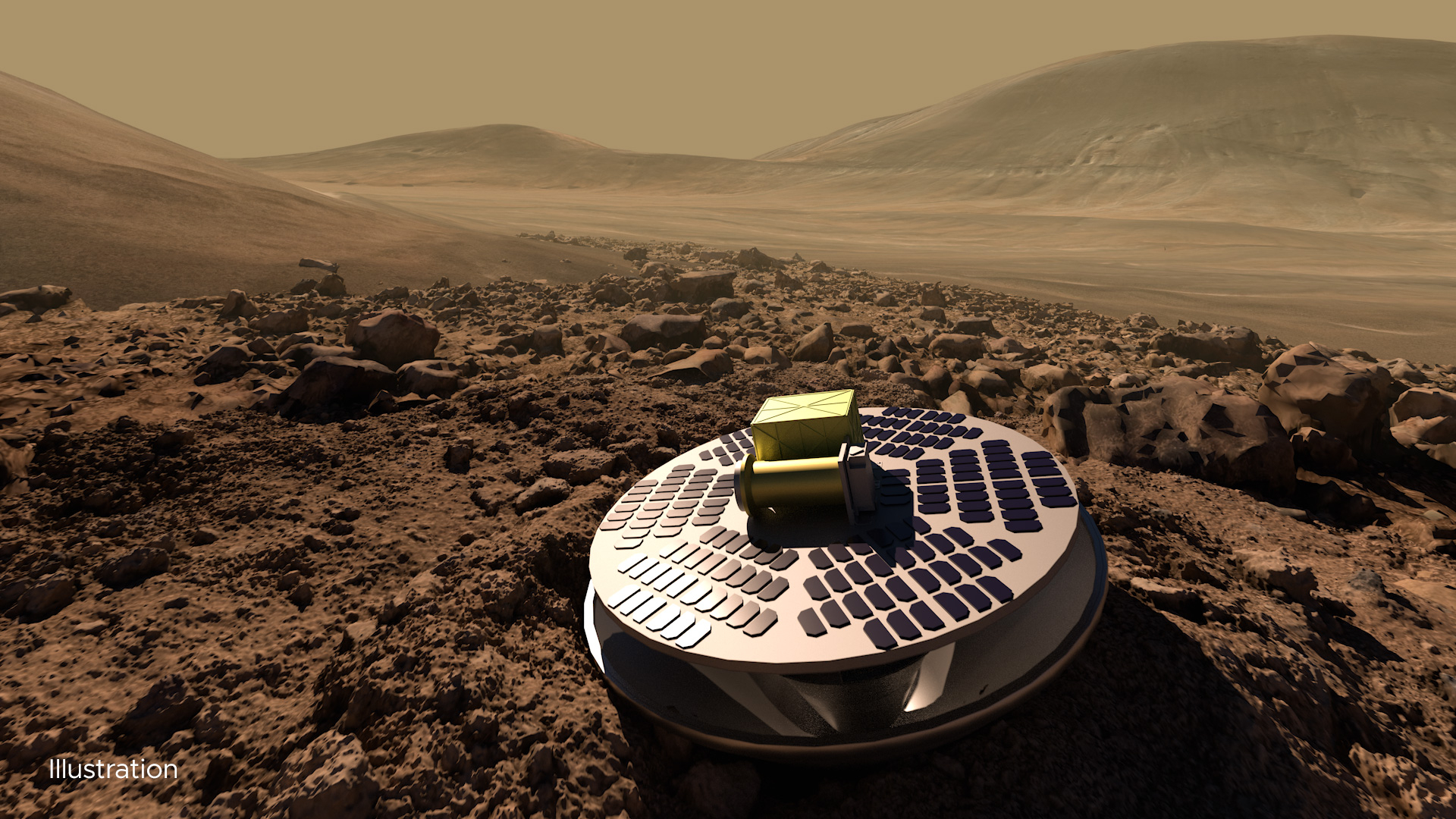
A current illustration of SHIELD that would allow lower-cost missions to reach the Red Planet’s surface by safely crash landing, using a collapsible base to absorb the impact. Image credit: California Academy of Sciences
Spotlighted in the report is subsurface sounding via a lander.
Also, a single lander or network of landers might make rapid, accurate measurements of the abundance of potentially biogenic gases like methane at the surface of Mars. Taken at hourly to annual timescales, data collected could help resolve many outstanding questions. Such a mission would also benefit from wind measurements to help further pinpoint the source of emitted gases.
Landing forces
One concept for a hard lander system able to deliver payloads to Mars is called SHIELD, short for Small High-Impact Energy Landing Device being developed at JPL. The SHIELD design omits heatshields, parachutes, and thrusters. It uses a basic impact attenuation system to help squelch much higher landing forces as contrasted to past Mars soft landings.
An ultra-compact ground penetrating radar is also under development as a Mars science helicopter payload.

The Red Planet as seen by Europe’s Mars Express.
Image credit: ESA/D. O’Donnell – CC BY-SA IGO
Such a high-flying radar could map layers in rock to a depth of approximately 65 feet (20 meters) and in ice to greater depths. By flying over troughs in the north polar layered deposits on Mars, this technique could potentially map a few hundred meters of ice layers spanning hundreds of thousands of years of deposition.
Business model
Highlighted in the report is need for adoption of a well-developed business model, one that “balances optimism and practicality through sound business acumen” and incorporates viable involvement of the commercial space industry.
To that end, the report points to NASA’s Commercial Lunar Payload Services (CLPS) program for the Moon as a possible model for low-cost Mars exploration.
“To date, however, no CLPS missions have flown, and so it remains to be seen the level of success attained by this program,” the report adds.

An expeditionary crew on Mars sets up drilling gear in a quest to utilize ice for sustaining a human presence on the Red Planet.
Image credit: NASA
Clear, cohesive, inspiring
The Braided River approach to investigating Mars in a less-costly manner can fill major knowledge gaps within a clear, cohesive, and inspiring program.
However, the report concludes that, for such a program to be successful and paradigm changing, “it would need to be well supported by frequent solicitations, regular launches, and robust technology development programs.”
It is the opinion of study group members that this Braided River proposal would be highly complementary to the existing Mars Exploration Program mission portfolio “and inject the excitement and novelty of a decidedly new approach to exploring the Red Planet.”
To review the full report by the Mars Concurrent Exploration Science Analysis Group, chartered by the Mars Exploration Program Analysis Group (MEPAG), go to:
https://www.lpi.usra.edu/mepag/reports/reports/MCE_SAG_Final_Report.pdf
 Posted in Space News

