 By
By  October 2nd, 2021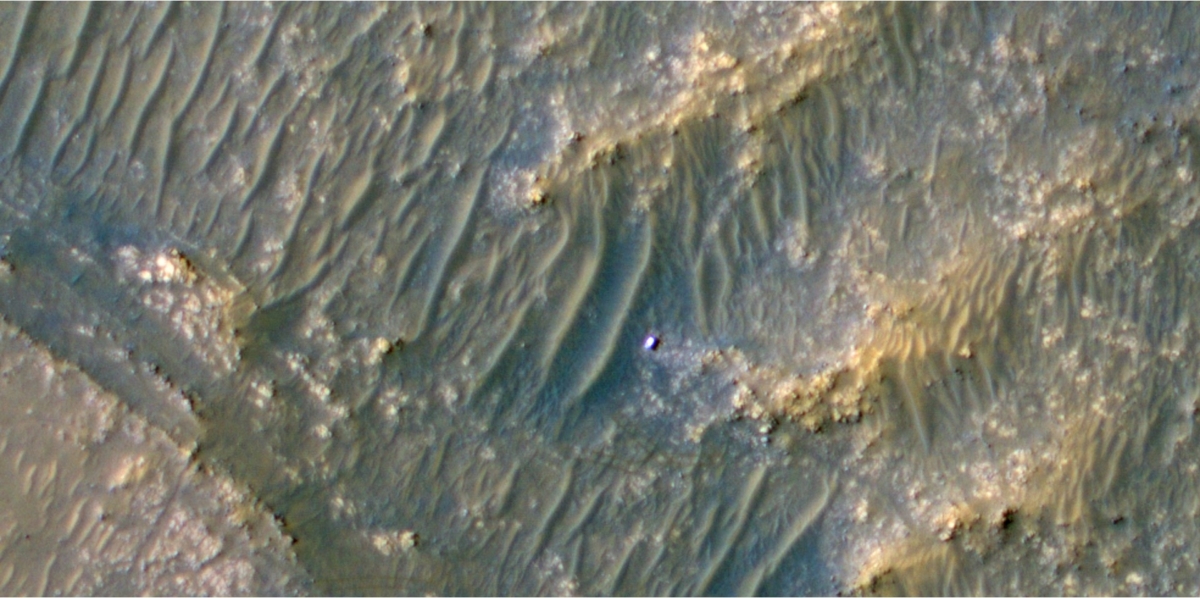
Credit: NASA/JPL/UArizona
Caught on camera!
NASA’s Perseverance rover now wheeling about in Jezero Crater has been imaged by NASA’s Mars Reconnaissance Orbiter using its powerful High Resolution Imaging Science Experiment (HiRISE).
Shane Byrne, HiRISE Deputy Principal Investigator at the University of Arizona explains that after a dramatic landing in February 2021, the Perseverance rover was re-imaged by HiRISE about 2,300 feet (700 meters) from its original landing site.
“The rover doesn’t drive in a straight line though, and has covered much more ground than that,” Byrne explains, pointing out faint wheel tracks on the nearby ground that are visible.
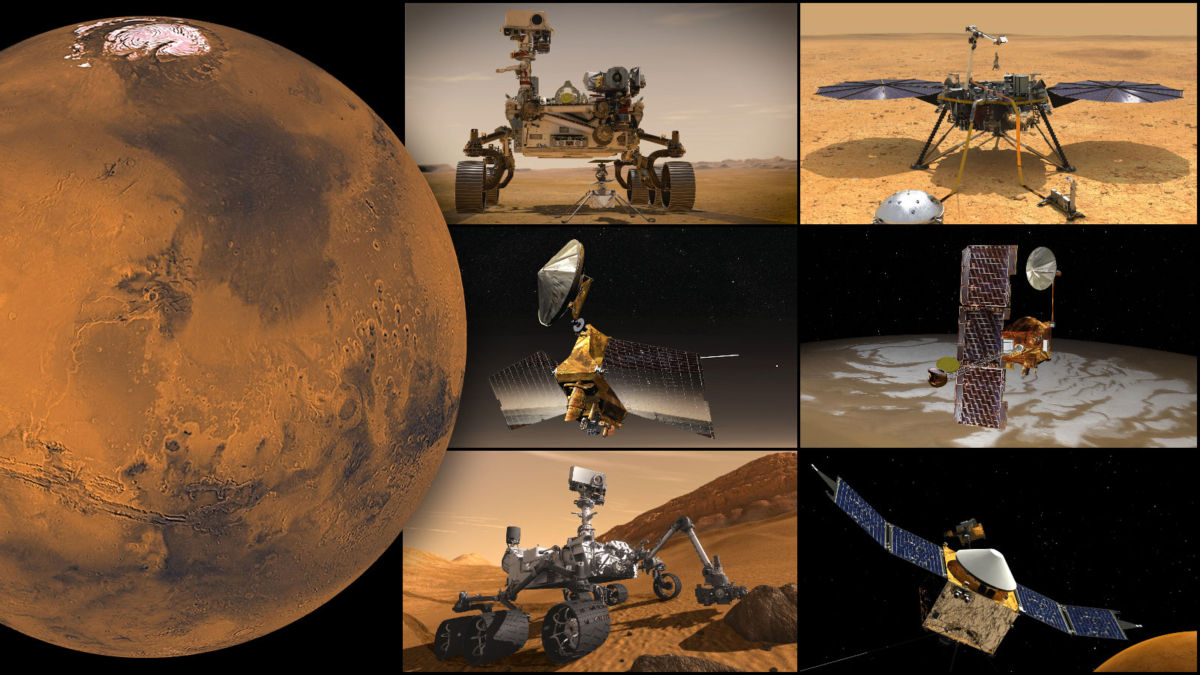
NASA’s Mars missions, clockwise from top left: Perseverance rover and Ingenuity Mars Helicopter, InSight lander, Odyssey orbiter, MAVEN orbiter, Curiosity rover, and Mars Reconnaissance Orbiter.
“HiRISE images like this one allow the rover team to choose the best route to get to their primary target and help put the rover’s observations in context within Jezero Crater,” Byrne adds.
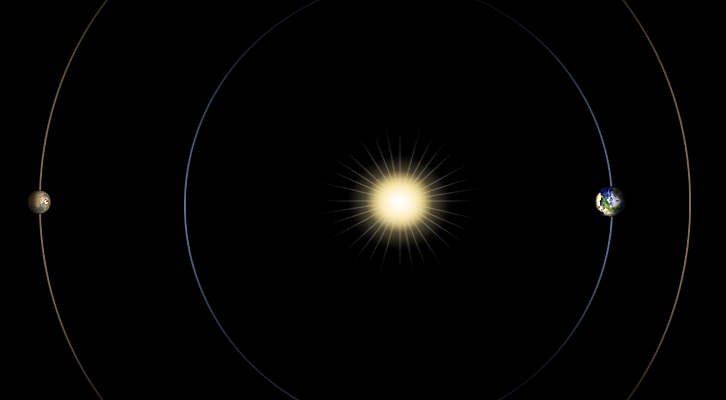
Conjunction junction. Credit: NASA/JPL/Caltech
Incommunicado
Meanwhile… the multi-nation armada of Mars missions are standing down from commanding Red Planet probes – orbiters and landers — for the next few weeks while Earth and the Red Planet are on opposite sides of the Sun. This period, called Mars solar conjunction, happens every two years.
As the Jet Propulsion Laboratory (JPL) explains, the Sun expels hot, ionized gas from its corona, which extends far into space. “During solar conjunction, when Earth and Mars can’t ‘see’ each other, this gas can interfere with radio signals if engineers try to communicate with spacecraft at Mars. That could corrupt commands and result in unexpected behavior from our deep space explorers.”

China’s Zhurong Rover.
Credit: CNSA/Inside Outer Space screengrab
This year, most missions will stop sending commands between Oct. 2 and Oct. 16. A few extend that commanding moratorium, says JPL, as it’s called, a day or two in either direction, depending on the angular distance between Mars and the Sun in Earth’s sky.

India’s MoM mission to Mars.
Credit: ISRO
Along with the slew of NASA Marscraft, also going virtually incommunicado: China’s Tianwen-1 Orbiter/lander/Zhurong rover, the UAE’s Hope Orbiter, Europe’s Mars Express and Trace Gas Orbiter, as well as India’s Mars Orbiter Mission (MOM).

UAE’s HOPE orbiter.
Credit: Mohammed bin Rashid Space Centre

ESA’s Mars Express.
Credit: ESA/AOES Medialab

Trace Gas Orbiter at Mars.
Credit: ESA/ATG medialab
 Posted in Space News

