 By
By  December 9th, 2015
Outward bound Voyager records with photos, messages, sounds.
Credit: NASA
Forget all that interstellar outreach to extraterrestrials – like the records on the Voyager spacecraft or the plaques on those Pioneer probes.
Furthermore, you might as well turn a deaf ear on those synthesizer tones used to converse with alien beings in the movie, “Close Encounters of the Third Kind.”
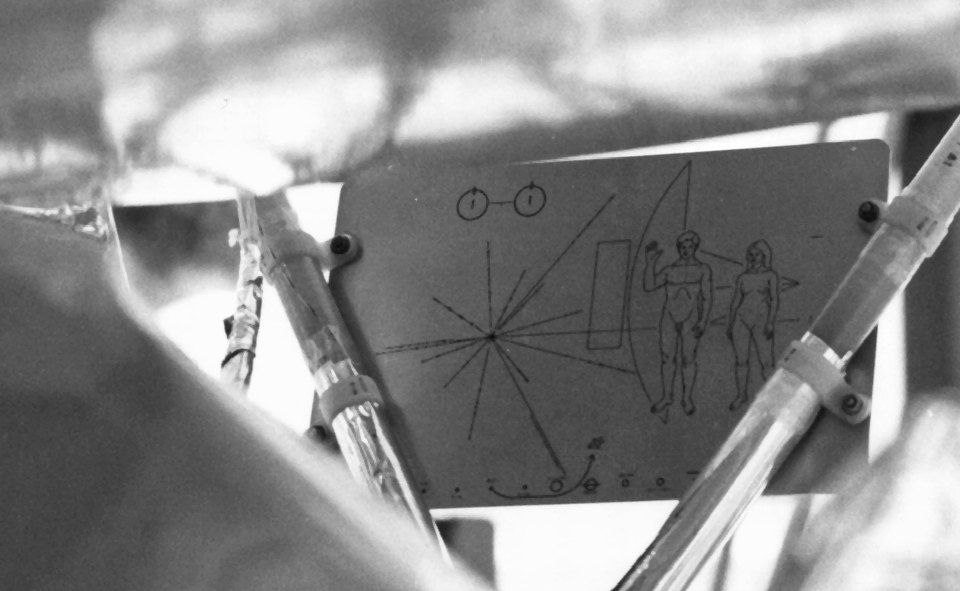
Pioneer plaques wave hello to ET.
Credit: NASA
Our human efforts here on Earth to communicate with ET via images or sound are doomed to failure, explains Don Hoffman, professor of cognitive sciences at the University of California, Irvine. And that may be for the best.
Deciphering dilemma
“Even the simplest of images will be misinterpreted,” Hoffman concludes in a paper on interstellar messages.
“We can’t even understand the language of dolphins despite decades of effort,” Hoffman points out. So the chance of aliens deciphering our words is similarly remote: “About zero,” he contends.
“It is not safe…to assume that images intelligible to humans using human rules of visual construction will also be intelligible to intelligent extraterrestrial species using their own rules of visual construction. It is even less safe to assume that intelligent extraterrestrials will use the same rules of cognitive interpretation that we do,” Hoffman writes.

Close encounters with ET via music, falling on deaf ears?
Credit: Columbia Pictures
Even the simplest of images will be misinterpreted, Hoffman suggests.
Psychophysical experimentation
His answer to reaching out and touching ET?
We should be prepared to engage, Hoffman suggests, “in the systematic, and potentially time-consuming, process of psychophysical experimentation and theory building that will be required to understand the rules of visual construction of each extraterrestrial species that we encounter.”
Moreover, we should be prepared for similar cross-species anthropological research to understand the rules of cognitive construction of each extraterrestrial species.
“Only then will we be able to construct images that communicate the messages we wish. And these images may look utterly alien to us,” Hoffman adds.
Repeatedly surprised
It is likely that contact with ET will be at a great distance.
“In this case we will not be able to conduct the controlled experiments that are necessary to understand the rules of visual construction used by the extraterrestrials. We will be limited to uncontrolled field studies: analyzing whatever signals we receive from the extraterrestrials and sending signals in return,” Hoffman observes.

SETI speak specialist, Don Hoffman.
Credit: Steve Zylius/UCI
It will be tempting in this case, Hoffman asserts, “to assume prematurely that we understand how the extraterrestrials perceive and interpret images and related signals. This could be a serious mistake. Even with species here on earth with which we have coexisted for millennia, we are repeatedly surprised by the results of our controlled experiments.”
To view Hoffman’s intriguing paper, go to:
 Posted in Space News

