 By
By  May 6th, 2022
Photo taking during Chang’e-5 surface sampling.
Credit: CCTV/Inside Outer Space screengrab
There is good news eking out of China’s Chang’e-5 lunar samples that were returned to Earth in December 2020.
Researchers with Nanjing University report in the scientific journal, Joule, that the lunar sample brought back by China’s Chang’e-5 probe contains active compounds that can convert carbon dioxide into oxygen and fuel.
According to the report, it is of high technological importance and scientific interest to develop a lunar life support system for long-term exploration.

Credit: CNSA
“Lunar in situ resource utilization offers a great opportunity to provide the material basis of life support for lunar habitation and traveling. Based on the analysis of the structure and composition, Chang’E-5 lunar soil sample has the potential for lunar solar energy conversion, i.e., extraterrestrial photosynthetic catalysts.”
Photosynthesis pathway
By evaluating the performance of the Chang’E-5 lunar sample as photovoltaic-driven electrocatalyst, photocatalyst, and photothermal catalyst, full water splitting and CO2 conversion are able to be achieved by solar energy, water, and lunar soil, with a range of target product for lunar life, including O2, H2, CH4 (Methane), and CH3OH (Methanol), the university scientists report.
“Thus, we propose a potentially available extraterrestrial photosynthesis pathway on the Moon, which will help us to achieve a ‘zero-energy consumption’ extraterrestrial life support system,” the researchers report.
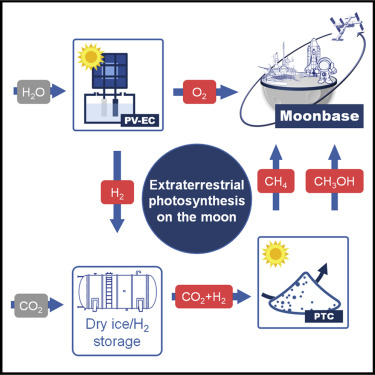
Credit: Yao Yingfang, Et al./Nanjing University
“We use in-situ environmental resources to minimize rocket payload, and our strategy provides a scenario for a sustainable and affordable extraterrestrial living environment,” said the paper’s first author Yao Yingfang from Nanjing University.
Improving the design
In a Xinhua news agency report, citing the researchers, with this method, no external energy apart from sunlight would be used to produce oxygen and fuel to support life on a Moon base. However, the challenge lies in the fact that catalytic efficiency of lunar soil is weaker than catalysts on Earth. As a research follow-up, the scientists are testing different approaches to improve the design, such as melting the lunar soil into a nanostructured high-entropy material.
“The team is looking for an opportunity to test the system in space, for instance, with China’s future crewed lunar missions,” the Xinhua story adds.
To access the research report – “Extraterrestrial photosynthesis by Chang’E-5 lunar soil” – in the Joule journal, go to:
https://www.sciencedirect.com/science/article/abs/pii/S2542435122001787
 Posted in Space News

